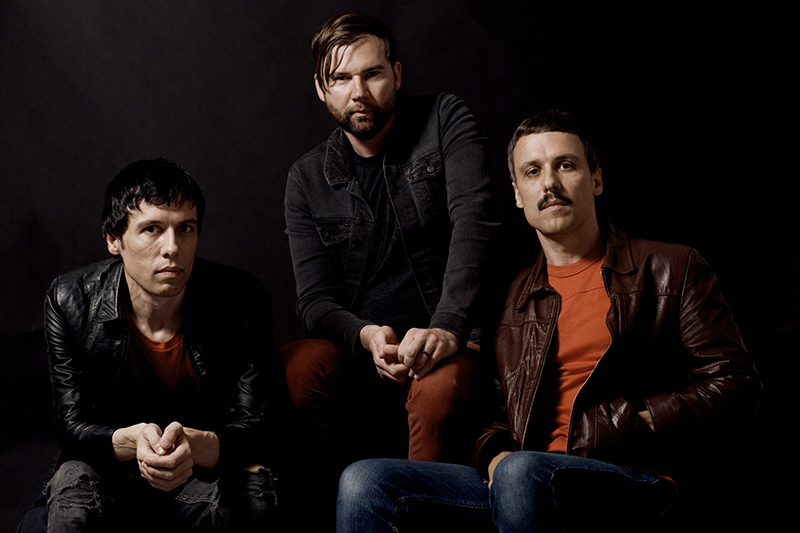
IT’S OUR BOLDEST RECORD
A CONVERSATION WITH GARY JARMAN OF THE CRIBS
The Cribs have returned with the album Selling A Vibe, their first new album in over five years. Hailing from Wakefield, West Yorkshire, the trio, which consists of twin brothers Gary Jarman (bassist and vocalist) and Ryan Jarman (guitarist and vocalist), and their younger brother Ross Jarman (drummer), tried something new with Selling a Vibe, leaning more into pop territory than they ever have before.
“The Cribs have always had a reputation for being lo-fi,” Gary Jarman says. “When we were kids, we didn’t have any money, and we would strive to make our recordings as good as we possibly could. We just had limited means, so it would naturally be rough around the edges. But then all the music we grew up with also sounded like that, so we never saw that as a problem. That was always a really big part of our DNA. We’ve also worked with really great producers and people who made records that we were deeply influenced by… We just decided to let somebody else take the reins in a way we haven’t before. We recorded in a completely different manner than what we usually do; usually, it is the band in a room, and we try to capture as much of the energy as possible, keeping it as visceral and as much like the live show as we can. This time our focus was on ‘Let’s find somebody who is more song oriented.’” The Cribs originally recorded some demos with Gordon Raphael, best known for his work with The Strokes. Ultimately, they decided to go with Patrick Wimberly as the producer. Wimberly has more of a pop background, having worked with artists such as Ellie Goulding and Beyoncé. “We didn’t understand a great deal about [Patrick’s] methods or background, so we just fully committed to his way of doing things… He just refined everything down to its core elements: what is the riff? What is the melody? What is the beat – it was just really like, ‘Let’s focus on what is good about the song and try to bring that out.’”
Even the heavier, more rocking songs, like the explosively fuzzy, angsty punk track “Dark Luck,” have a little twist. “It is just a good fit on top of the record because I feel like we just felt like it would hit people in the face and give people the idea that this is a different kind of record than what you might’ve expected,” Jarman states.
“A Point Too Hard To Make” is an absolute gem, especially its extremely catchy chorus and its gorgeous indie rock meets new wave sound. Jarman cites the ‘80s progressive pop and new wave music he and his brothers grew up listening to as a major influence on the song, most notably bands like Aztec Camera, Orange Juice, The Cars, and The Smiths. “From a production standpoint, we’ve always loved that openness and lack of density. We wanted it to feel a little more elegant.”
Another standout song is the anthemic, very danceable, glam-inspired “If Our Paths Never Crossed.” “It really benefited from Patrick’s minimalist approach to production,” Jarman says. “We really set a challenge to try and leave as much space between the notes in the chorus as possible. We wanted the hooks to be the gaps.” Reflecting on the lyrical content, Jarman continues, “I was looking back at our formative years in the early 2000s, and it was like this really amazing sort of communal time where there were so many bands coming out at the same time. A lot of the bands didn’t really have much in common musically, but they had a lot in common as far as their backgrounds, interests, and philosophies. We met all these people from different places, like the East Coast and the West Coast of the United States. We met people from Canada. We met people from Japan. You would meet them at all these festivals or different club nights, and you felt like you knew each other straight away because you are all in the same position. There was this really amazing melting pot at the time, and I never felt more part of something – the feeling I was going for was thinking about how to express how exciting and vibrant it all felt.”
SELLING A VIBE ALBUM REVIEW
The entrancingly atmospheric ballad-like “Looking For The Wrong Guy” is quite similar to its demo form. “Ryan wrote it all on his own and demoed it all on his own, and I heard it just before I was about to set off for a flight,” Jarman says. “It was perfect as it was. I didn’t want him to change it at all because it felt so sparse, open, and intimate sounding – the bones of it we kept the same. Patrick did all the atmospheric stuff, the soundscape introduction, and he put the beat on the chorus because we didn’t want to put drums on it… Patrick’s pop minimalism allowed us to keep the raw take really raw but bring something new to it.”
The operatic “You’ll Tell Me Anything” sees The Cribs drawing on their background in classical music. “My brothers and I grew up studying classical music, and Ryan and I played in a symphony orchestra until the age of like 22,” Jarman states. “The intervals and the changes felt very Italian-influenced. As people who played classical music, it reminded us of that. I mean, obviously, the music is punk, but the intervals felt like something out of an opera. Anytime we played the intro, Ryan and I would hear it in our heads, like independently of each other, having an opera intro… It’s kind of ridiculous because it’s incongruous on the record, and it is maybe confusing, but we could hear it in our heads, so we thought we should do it.”
“Never The Same” was almost recorded by Louis Tomlinson. “Ryan and I were actually going to go down to Los Angeles and help One Direction with writing some songs for their record, but it never happened as the band broke up,” Jarman recalls. “While we were writing [Selling a Vibe], Louis invited us to play a show with him in Italy. We did the show. It was an amazing show because his audience is so receptive to the bands he brings along.” After coming home from Italy, The Cribs were very inspired. “We had been speaking to Louis’ manager the night before the show, and his manager was like, ‘It would be cool if we could get that writing session off the ground and to work on some songs with Louis.’ He asked if we were up for it. I was like, ‘We’re definitely up for that…’ We were jamming on something loosely for Louis, and then it came together really quick. I think the reason why it came so quick is that we weren’t doing it for ourselves. We were doing it purely as an experiment. Ultimately, we just really liked it… It wasn’t necessarily written for [Louis], but the genesis of it was influenced by having played the show.”
The closing track, “Brothers Won’t Break,” which Jarman calls his “personal favourite song on the record,” explores the important relationship between the three brothers. “We spent some time away from the industry, we spent some time trying to get our rights to our catalogue back, dealing with some breakups with management, we’ve been through some ups and downs, and it has changed us a little bit,” he reflects. “We basically wanted to empower ourselves from that experience… I have written songs about so many different relationships and so many different emotional responses to stuff, but between the three of us, a lot of it has remained unsaid… The most important relationship is between the three of us, and we’ve never done that before. It was the first time – we might not get a chance again. You never know how many records you are going to make. It seems like it would be strange to get to the end of the band and never written a song about our relationship.”
Selling a Vibe dropped on January 9. “It’s our boldest record because it is the first time we allowed somebody else to essentially dictate how it was going to sound, and we went along with the process and trusted it in that way, and stripped away a lot of stuff that we would normally use as a defense mechanism, such as noise, feedback, and distortion,” Jarman reflects. “It is our minimalist album – it feels braver in that way, just because there is nothing to hide behind.”
Artist Links


Photo Credits: Steve Gullick


SPILL FEATURE: SURVIVING THE COLLAPSE – A CONVERSATION WITH CODY QUISTAD OF WAGE WAR
SPILL FEATURE: NEW CHAPTERS, WRITTEN IN ICE AND LIGHT – A CONVERSATION WITH LEFT TO SUFFER GUITARIST PETER HIGGS

SPILL FEATURE: A REBIRTH THROUGH VINYL – A CONVERSATION WITH YOUNG MEDICINE

SPILL FEATURE: A CROWN MADE OF TEETH, NOT GOLD – A CONVERSATION WITH JACK UNDERKOFLER OF DEAD POET SOCIETY