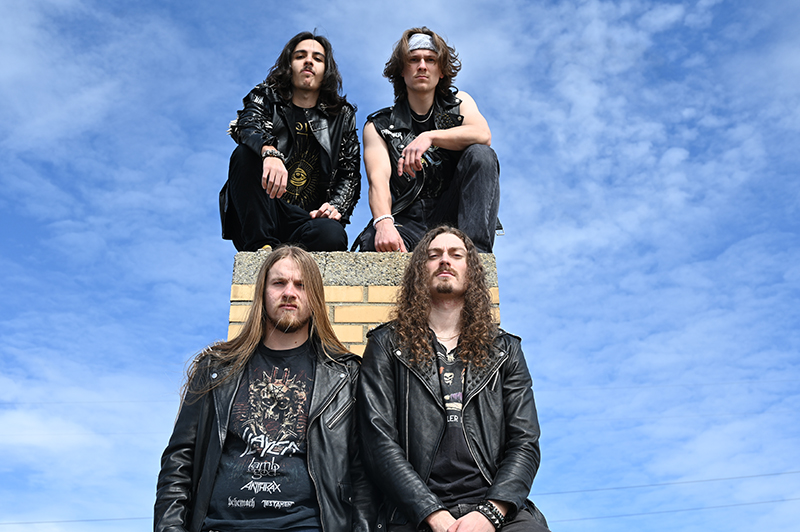
KILL THE KING
A CONVERSATION WITH PRISONER VOCALIST & GUITARIST MURRAY EMERY
Someone once said, “Music is the literature of the heart; it begins where words fall short.” For the band Prisoner, music has been an enduring medium through which they express their profound love for classic hard rock, seamlessly blending influences of metal and blues that echo their deep-rooted heritage. Since their formation in 2022, the journey to shape their unique sound surrounding their latest release, Kill The King, has been both challenging and transformative.
Over the past three years, Prisoner has refined their sonic identity by drawing inspiration from the legends of rock, including titans like Black Sabbath, Megadeth, AC/DC, Alice in Chains, and Metallica. The result is a powerful amalgamation of styles that evolves from every track on their new album. Kill The King represents not just a confident step forward in their blossoming careers, but a rich narrative tapestry woven from current events, personal struggles, and an earnest quest to uncover the meaning of life amid turbulent times.
For vocalist and guitarist Murray Emery, this moment is the culmination of countless hours of hard work and introspection. It marks not only the band’s growth but also a celebration of artistic freedom and expression that feels increasingly scarce in today’s complex social and political landscape. Despite the myriad challenges they’ve faced along the way, Prisoner stands resolute, exemplifying artistic resilience and an unwavering commitment to their craft.
“If you listen to Prisoner’s entire discography, from the first record to what we are putting out now, it’s always kind of been that way where we take influence from varying subgenres, if you will, from hard rock to heavy metal,” says Emery. “Me personally, I like 60s folk music like Nick Drake up to modern tech death like Allegaeon. So, you have a little bit of everything in terms of what I personally enjoy. It’s kind of the same for Trevor [MacDonald], Marco [Cioffi], and Karl [Pflug]. So, when you take all those ideas, we just write music that we enjoy making; it’s this overarching sound that is Prisoner. But if you sit down, I’m sure you could sit and subcategorize almost every single song that we have put out into, you know, five or six different subgenres, from classic rock to heavy metal. A song with thrash elements like “Stress Fracture” or even some more traditional metal elements like “Double Vision.” So, I think for us, I don’t think there’s a band out there right now that’s trying to do something like this, because everybody just sort of picks a kind of genre and sticks with it. For us, that has always been different, and if you look at our music, you see that development from album to album. When you look at bands like Bring Me The Horizon or Motionless In White, they were both very intense metalcore bands. Now, they’ve gone a more modern, open-ended production approach, rather than just doing like the heaviest possible thing that the mid-2000s was doing at the time. So, I think for us, it’s very much just a development throughout our career as musicians; from point A to point B, we just make stuff that we’re enjoying, and it still has that overarching sound. So, it always keeps it fresh. So, if you really like a certain vibe, one day, it might actually be something different than the next. You still always have something that you can listen to from us.”
In a remarkable feat, their latest album, Kill The King, was crafted over an impressive five-month period. This timeline is particularly striking for a band that has evolved significantly from its humble beginnings. Prisoner has transformed from a group of eager teenagers, still in the process of discovering and shaping their unique sound, into a confident ensemble that has truly found its artistic voice.
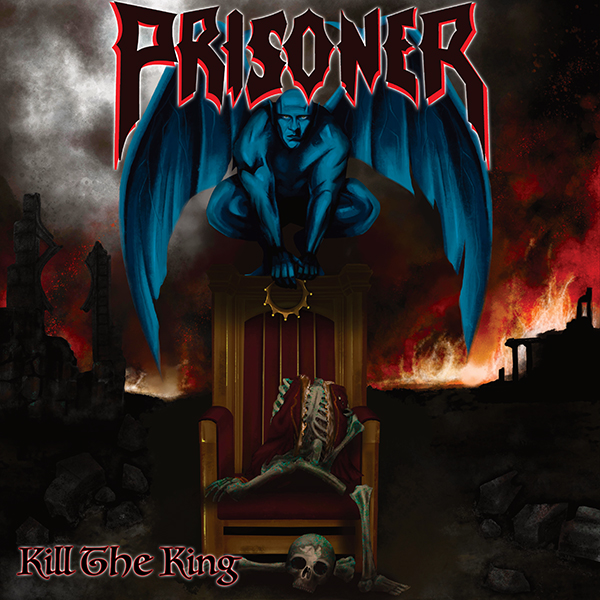
PURCHASE KILL THE KING
For Emery, this journey has been an exhilarating ride, one where his primarily guitar-driven path has taken an unexpected turn, as he embraces the dual role of vocalist. Although he could never have predicted such a dramatic shift in his musical identity, Emery has wholeheartedly welcomed this evolution, diving into the challenge with passion and determination.
“Honestly, leading up to the tracking itself, everything that has been done for Prisoner previously, all the way up to the past two singles, was written by me when I was a kid. Basically, I was 15 to 18 years old, and I had just picked up a guitar. I was still learning my instrument. Everything that had come out from me writing music was influenced by the things that made me want to play guitar in the first place,” Murray expresses candidly. “It was all very guitar-driven because I was not supposed to be a vocalist. I became a vocalist three months before we tracked vocals for the first record. So, it was just me yelling into the mic, hoping for the best,” he laughs. “I was like, ‘hey, guess I gotta do it.’ That’s how it happens for a lot of people. But now it’s developed into another passion on top of everything else that is going on in the musical realm of things for me as a guitar player, songwriter, and lyricist. Having Trevor, Karl, and Marco’s influences has been massive. We have all these ideas, and we get together and create something. We have a set period of time that we go to do this. For a lot of other artists and musicians, it takes years to make a record, and there are some that just pump out music super quick. There is nothing wrong with either method. For us, we are influenced by bands like Led Zeppelin, Black Sabbath, and things like that. They would just go into a space and just record whatever came out. There are not a lot of bands nowadays that I think get together in an intimate space like that anymore. Where you sit in a room and jam the songs out because we have technology. Stuff like Zoom and whatnot—a lot of musicians will get together that way or build their stuff in Guitar Pro or MIDI to make beats and everything. For us, we give ourselves a timeframe. It’s motivating. We are there in the studio, where we are sleeping and working for days on end. For this, it was pivotal, and I think for our friendship and even as human beings, we just really developed into what we and what we wanted this to be.”
Through this transformative journey, Prisoner discovered their authentic voice. Kill The King emerged as a daring and unapologetic declaration, crafted with the intention of serving as a powerful platform for the band to articulate their social commentary and personal challenges. With an unwavering desire to make a lasting impact, Prisoner aimed to create a piece of art that would not only define their identity as a band but also resonate profoundly with listeners, making it impossible to overlook.
“Kill The King” was the last song that was written. It was something that I knew was going to be a good song, but it wasn’t there yet, if that makes sense,” Murray reminisces. “So, this song was actually written in 2018. I had created this kind of concept for our character, and what I wanted to do was build basically this narrative for the band itself, rather than doing a concept record. It’s kind of hard to misinterpret three strong words in that regard, you know? For us, I think it was just the perfect fit to be the title track of the record because it was also a defining part of us as a band. Lyrically, Kill The King is based on the idea that there is something above you that you obviously don’t like, and you want to make a change. Whether that’s, you know, talking politically or interpersonally with relationships with family, boss, co-worker, or whoever it is. There is always something in terms of what we see ourselves as in terms of status because, honestly, it’s inherent to us as people with social media and stuff. Nowadays, you don’t really have the opportunity to see everyone as an equal, because everything is about status. That’s why marketing works. It’s why people want certain cars or certain items in life so they can be on a certain level. To prove their worth and how they compare to someone else. That is what I am trying to convey with this album. I am definitely discussing very deep and personal topics that I believe in, things that resonate with me profoundly.”
Artist Links




SPILL FEATURE: SURVIVING THE COLLAPSE – A CONVERSATION WITH CODY QUISTAD OF WAGE WAR

SPILL FEATURE: NEW CHAPTERS, WRITTEN IN ICE AND LIGHT – A CONVERSATION WITH LEFT TO SUFFER GUITARIST PETER HIGGS

SPILL FEATURE: A REBIRTH THROUGH VINYL – A CONVERSATION WITH YOUNG MEDICINE

SPILL FEATURE: A CROWN MADE OF TEETH, NOT GOLD – A CONVERSATION WITH JACK UNDERKOFLER OF DEAD POET SOCIETY