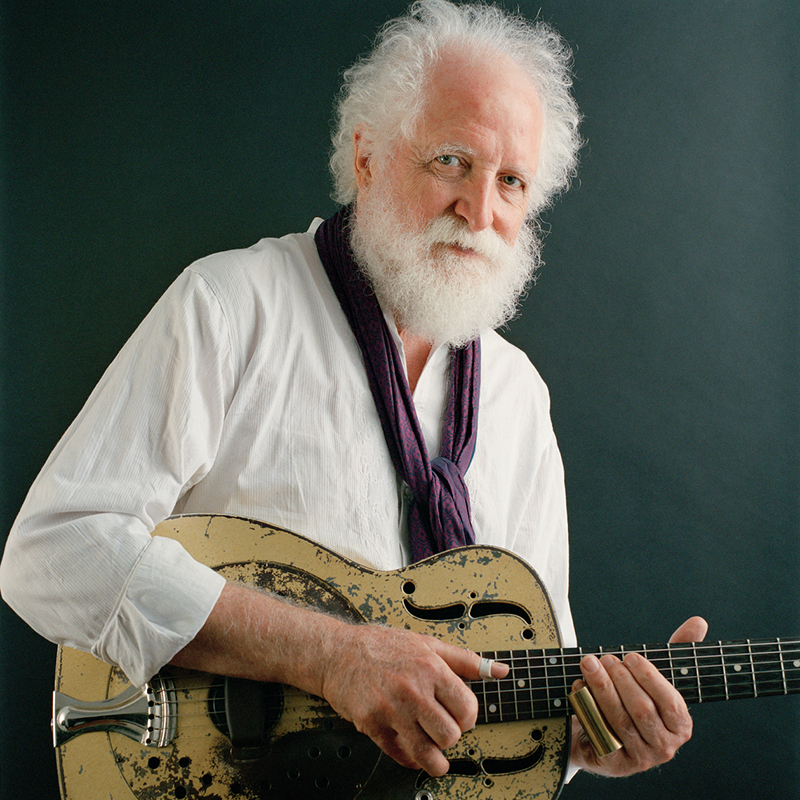
WHEN I’M DONE, I’LL KEEP GOING
A CONVERSATION WITH CANADIAN FOLK LEGEND KEN WHITELEY
“The folk tradition, the oral tradition, precedes recordings and all that kind of stuff. We do live in a modern age, but I think that, looking at the challenges, I know some people in the professional music community are concerned about the misuse of AI and having their music ripped off and so on. It’s a very legitimate concern and speaks to the need for guardrails, etc. But I think that there will remain a space for people like myself who do something that is very much about the immediate and the more personal connection, and I don’t see that being replaced by AI.”
In modern music culture, the term ‘legendary’ is bandied about fairly liberally. But that is a legitimate term, when referring to Canadian artist, producer and multi-instrumentalist, Ken Whiteley. From the 1970s onward, his live performances and recordings with The Original Sloth Band, Junior Jug Band, The Whiteley Brothers, the trio Scarlett, Washington & Whiteley, and as a solo artist, Ken Whiteley has forged a solid career over the years. Additionally, his production work with the likes of acclaimed artists like Raffi and Fred Penner solidified his reputation as the godfather of Canadian children’s/family music.
As he approaches the age of 75, Whiteley is still active as a performer and recording artist, having released his 37th album, a collection of blues and gospel-inspired originals (and a few covers) called Keep Going. The project was initiated in February of 2025, after the artist sustained an ankle injury, and found himself with some unexpected free time, when he could focus on writing songs. As he describes it, “It kind of evolved organically. I mean, I didn’t break my ankle and say, ‘Okay, I can’t walk for four weeks. What am I gonna do? Okay, I’ll make an album!’ No, it wasn’t like that. It was like, you know, first, it’s like frustration – ‘Are you sure I can’t walk?’ – denial, or whatever. And then it’s like, ‘Okay, here I am. So, okay, so I just pick up the guitar, and start playing. And, oh, that’s a cool little riff. Oh, let’s play that again. Oh, hey, I should remember that little riff. So, I make a voice memo of it. And then, there’s a phrase that that would go with that little riff.’ So, the next thing you know, I’m writing songs, and then a theme begins to emerge, this whole idea of perseverance. Also, as I’m sitting and playing, I started thinking about some of the old blues songs as well. A lot of them also have that same idea of keeping going, and how do we find comfort in this crazy, mixed up world?”
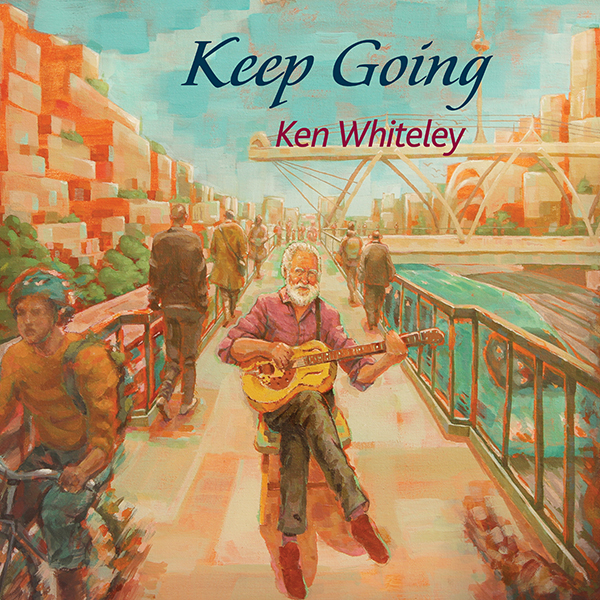
PURCHASE KEEP GOING VIA BANDCAMP
As both an artist and producer, Whiteley’s recorded output has been quite prolific over the years. When it came to the creation of Keep Going, he notes, “This is now the fifth album I’ve done in the last five years. So it wasn’t that it was time to do one! (laughs). It’s not like there’s an unmet demand that’s pent up for Ken Whiteley products in the vast world, but I don’t work that way anyway. I mean, for me, it’s writing songs and making recordings that is one of my art forms. That, as well as performing and working with other artists producing albums. But making an album, for me, is a really fun project. An art project, if you will.”
While in his 30s, Whiteley drew inspiration from the visual artist Victor Tinkl, who had taught printmaking to Inuit folk in the Arctic. Tinkl’s point of view favoured the spirit of creativity in art, rather than it being a commercial pursuit. Of this idea, Whiteley states, “I was like a light bulb went on. Because when you’re in your 20s and your early 30s, there is this sort of impetus to kind of chase this ‘something’, this ‘je ne sais quoi’ – fame, fortune, whatever you want to call it. I know I’m not in the pop world, so it’s not at that level. But all of a sudden, it’s just sort of like, ‘Okay, exhale. You know, just relax. You’re an artist, this is what you do.’ For me, that was a really important life changing moment. Making an album now, for me, is the same. And if I don’t have the idea, the inspiration, something that’s stirring me artistically, it could go for two or three years, or whatever, between albums.”
Given that Whiteley primarily works with the genres of blues and gospel, the idea of perseverance in the face of desperation and hope runs throughout the album. The artist relates that the album’s thesis emerged gradually, “Really, I began to see this pattern. It wasn’t like, ‘Okay, I’m gonna write, you know, eight songs about keeping going.’ I mean, sometimes that is the way it happens. Sometimes you have a concept that you want to explore, and then you find different ways to explore it. But this happened a little more organically for me, where I sort of discovered it in the in the work, as I was going. You know, they often say you discover the journey by taking the steps.”
It will come as no surprise to long-time fans of Whiteley’s music that he plays the bulk of the instruments on Keep Going, including acoustic guitar, resophonic guitar, mandolin, Hammond organ, and piano, to name a few. Whiteley is also joined by Bucky Berger on drums, his brother Chris Whiteley on harmonica and cornet, Gord Mowat on bass, and vocalists Ciceal Levy, and the late Betty Richardson. Guest vocalists Pat Patrick and Eve Goldberg appear on the song “At The End Of The Day,” which was co-written by Goldberg and Whiteley.
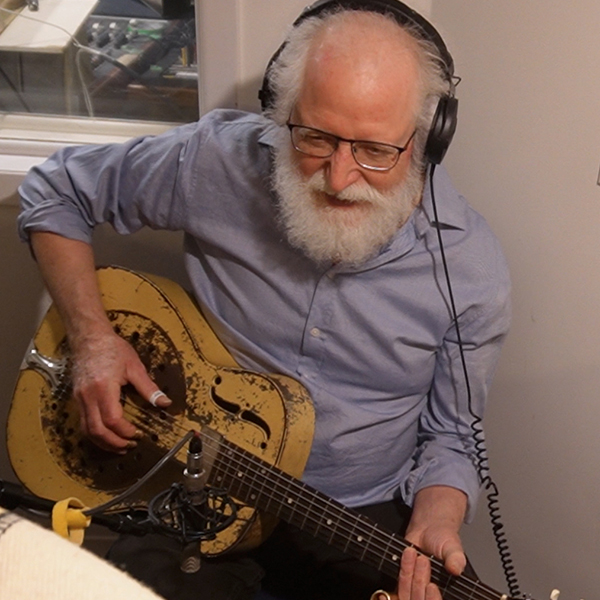
KEN WHITELEY RECORDING KEEP GOING
Whether playing an original ragtime piece like “I’ll Just Say I’m Fine,” or another, such as the old-timey Noah Lewis cover “Going to German,” Whiteley presents his work with conviction and honesty. Of the latter song, the artist comments, “‘Going to German,” is a song from Cannon’s Jug Stompers. Noah Lewis was the harmonica player with that group, and it’s about being sent to prison. ‘German’ is one of the state penitentiaries just near Memphis, but he’s saying, ‘You know, I’m going to German, but I’ll be back someday.’ So, there’s adversity here, and there’s even the implication that some of that adversity isn’t really fair. He’s addressing someone and saying, ‘You know, when you were in trouble, I paid your fine. Yeah, you didn’t have to go to prison. Now, no one’s paying me any mind, and I’m getting sent off.’ It’s not an overt expression of protest against what we know was a racist justice system for blacks in the South in the 1920s and ’30s and continues to this day, but it’s kind of implied in there. For me, that isn’t my experience directly. Thank goodness I’ve never been sent off to prison, but I can relate to this feeling of not being held up by your community in some way or other and still keeping going. And I’m going to come back. I’ll be back.”
In support of the album, Whiteley has a number of tour dates planned in Ontario and Quebec this spring, including his 75th Birthday Bash and Album Celebration, at Toronto’s Hugh’s Room Live, on May 2nd. It is in performing live that he gains some of the greatest rewards from his work. He elaborates, saying, “I know that music is incredibly powerful. Getting a bunch of people to sing together is a profound act of connection that is, in and of itself, as important as whatever words you’re saying. And when you combine that with an intention, a positive intention, in whatever way, to make your lives or the world a better place, that is an irreplaceable value in this world, and I don’t see that going away. I think that the power of song is to touch us and give us that connection, and allow us to keep going, whether it’s expressing our own heart’s sorrow or joy. Even in expressing the sorrow you then acknowledge it. You can look at what happens when you do that, sort of from the Buddhist perspective: you’re recognizing what is, and then you are connecting with what actually is. And that gives, in that connection, an acceptance of that by virtue of singing about it, you can then move forward. So that really is so much of what the theme of the album is about.”
As for what motivates Ken Whiteley after all of these years, albums, and tours, he reflects, “I think of my friend, Blind John Davis, who was this great Chicago blues and jazz piano player. He had been the house piano player for Bluebird Records in Chicago with literally over 1000 records he made for them in the late ‘30s and ‘40s. We got to play with him and record with him in the ‘70s. And he would stay with me when he came to Toronto, or when we toured around Canada. He died on his way to a gig. He was in the back seat of his son’s car, going to the Chicago airport, going to O’Hare. They get there, and his son turns around, to drop him off, and realizes his dad is gone. I mean, he was just going ’til it was done. To me, that is such a great story and an inspiring thing. Not everyone can do that, and we’re all going to have to accept what is. But as long as I’m still able to sing, and still able to play a guitar, I gotta keep going.”
Ken Whiteley Spring 2026 Tour Dates
May 1 – Ottawa, ON – Gil’s Hootenanny ‘Songs of Protest, Songs of Hope,’ First Unitarian Church, 30 Cleary Ave., 7:00 p.m. – gilshootenanny.ca
May 2 – Toronto, ON – Hugh’s Room Live – 75th Birthday Bash and Album Celebration with Bucky Berger, Ben Whiteley, Jesse Whiteley, David Wall, Ciceal Levy, Pat Patrick – Tickets: showpass.com/ken-whiteley-75th-birthday-bash
May 16 – North York, ON – Afro Metis Anthem Peace Concert, Don Heights Auditorium, 18 Wynford Dr., Suite 103, 2:00 p.m.
May 23 – Caledon, ON – Whole Village Eco Village Concert
May 28 – Burlington, ON – Retired Teachers’ Luncheon Concert
June 7 – Orangeville, ON – Orangeville Blues & Jazz Festival, Orangeville Opera House with Ben Whiteley, Bucky Berger, Ciceal Levy – orangevillebluesandjazz.ca
June 23 – Roseville, ON – Detweiler Meeting House Concert, 3445 Roseville Rd., Ayr
Artist Links



SPILL FEATURE: STRIPPING AWAY A LOT OF THE VENEER AND THE RETROGRADE NOSTALGIA AND REPLACING IT WITH SUBSTANCE – A CONVERSATION WITH ART D’ECCO

SPILL FEATURE: WHERE HISTORY RESONATES – A CONVERSATION WITH PÄR SUNDSTRÖM OF SABATON ON COMPOSITION, COMMUNITY, AND HEAVY METAL’S FUTURE
SPILL FEATURE: WE’RE GOING ON TOUR, SO WHY NOT HAVE A LITTLE BONUS – A CONVERSATION WITH WES MARSKELL OF THE DARCYS

SPILL FEATURE: HOPE AND LOOKING UP – A CONVERSATION WITH CAROLINE MARIE BROOKS