
LEANING INTO IT
A CONVERSATION WITH RIK EMMETT
Triumph guitarist and vocalist Rik Emmett is following up his debut poetry book, Reinvention: Poems, with Leaning Into It. Recently, I chatted with Emmett about his upcoming poetry book.
“I write all the time as I’m one of those people who always has a file going in my laptop, and if anything strikes me, I’ll put things in, so I’ve got a whole other book ready to go,” Emmett says. “I never lack for things that piss me off or stimulate me or provoke me.’”
Emmett shares that there is a different mindset between writing poetry and writing a song. “Poetry gives you a little more licence,” he says. “It allows you to have a much more poetic use of language. There are words in a song lyric that I wouldn’t choose to use: three or four syllable words or words that are going to send someone off to their thesaurus to try and find out what you were talking about… Poetry can be elliptical and sometimes almost impossible to discern what the writer is on about – it can be much more provocative. If you do that with song lyrics, you’re probably screwing yourself over.”
There are multiple poems about Emmett’s family in the book. “My whole nuclear family has passed away, and from a personal point of view, as I wrote, those are things I’m going to deal with and come to terms with,” he says. “[For my Dad] the poem is actually what I read at his gravesite when he was buried. That was the eulogy… My brother Robert had a tough life. He was an alcoholic, and he had gone through The 12 Steps a lot of times… My mom kept all her diaries even when she was a pre-teenager, and there had been a flood in my dad’s basement, and he said, ‘I don’t want to have to read them. I want you to read them, and you tell me if they’re worth saving.’ I read them, and I’m not sure it was all healthy necessarily… Reading her diaries was enlightening, but it is also horrible to get to the point where I’m reading stuff that she wrote where I was being a fucking monster to her because I was a teenager, and I was asserting my rebellious desires to be my own person, and I was her little boy. To see that written out in my mom’s handwriting – it is terrible to see yourself as a monster… I think, in the end, my mom hoped I would read it and get the lesson I needed to learn, even though it was killing me.”
One of Triumph’s most well-known songs is “Fight The Good Fight.” Leaning Into It features a poem called “The Good Fight.” “To me, a good fight is that you have to stick to your own sense of self-empowerment – the warrior spirit inside [of you],” Emmett states. “Don’t take on the whole world, just take on the little one that you have… A lot of folks nowadays will show me a tattoo that they got and say, ‘Your music pulled me through something. I was going through a bad time, and your music was the thing that gave me wings and lifted me when I was down, and I just want to thank you for that.’ That’s been a beautiful thing about my life.”
The poem “Alvaro Follis” (and the character Alvaro Follis) is described by Emmett as sort of his alter ego. “Alvaro is like a watchman or a guardian, and I think of poetry and poets in particular [like that],” he states. “Follis is like a court jester. In a king’s court, he had a valuable function because he was the one who could make jokes about the king’s farts or the queen’s burps – they could make these stories, songs, plays, and jokes. That’s kind of what my life has been. I dressed up in spandex jumpsuits, and I leaped around, and I’m going to do it again. We’re going back on tour, and I got my Flying V guitar, and I’m gonna be the court jester all over again.”
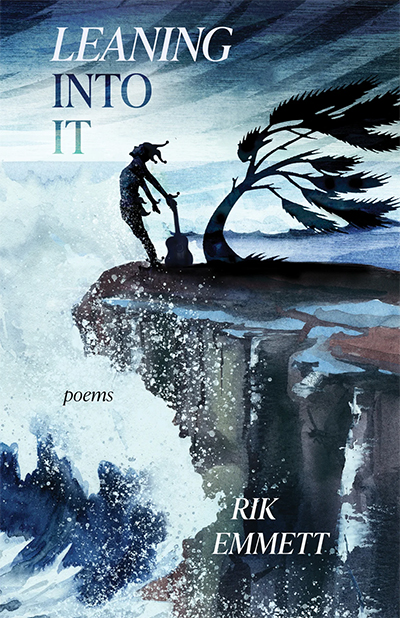
LEANING INTO IT: POEMS BOOK REVIEW
The inspiration behind “The Magic of 3” came from Emmett’s time teaching songwriting at college. “Three is the magic number when it comes to trying to make something happen,” he explains. “I used to tell songwriting students about a thing commonly used in songwriting called a refrain. For example, you tell a little story, and then at the end you go, ‘The answer, my friend, is blowin’ in the wind / The answer is blowin’ in the wind.’ You establish that, and you tell some more story. The second time you come to it, you encourage everybody to sing… By the time you get to the end of the third chunk of your story, you won’t even have to sing the refrain. The audience will sing it back to you, which is the magic of three.”
In the poem “Fixations,” Emmett writes “I’d vote for a Bertrand Russell or a George Carlin.” Quotes from Carlin and Russell also appear elsewhere in the book. “I like guys who don’t allow themselves to get sucked in by the perversions of religiosity,” he explains. “I’m disappointed that we live in a world where guys like that can’t run for public office because they would never get elected, because they will not profess ‘One nation under God.’ I’m that kind of guy who, as soon as you start getting into this God stuff, you are going down a road where you’re making decisions based on faith that are going to have consequences for people who don’t share your faith, and that’s not necessarily in my humble opinion a very good way to try and run a society. We see that now written in huge bloody letters with [Donald] Trump and what’s going on in the States. I wish there were more humanists that were involved in the process of political power. I think it would be so much better for our world… Do I believe there should be a respect for history? Absolutely. Do I believe there should be a respect for certain cultural traditions? Absolutely. There are certain things of value that deserve our respect, but I don’t want you to have to use your cultural belief system or your heritage to then start discriminating against other people. That’s not right. That’s not just.”
The poem “Currency” is in both English and French. There are many reasons why Emmett decided did this. “That poem is about a river, and I think language is kind of like a river – finding other rivers of expression [through language],” he says. “I studied French in school a lot, and I wasn’t very good at it, but I did understand its value – it is as poetic as romance languages get,” he says. “I have a lot of respect for their language… I’m Canadian, and in our country, we are bilingual. We are actually multilingual, but we are officially bilingual. I have nothing but strong, great memories of visiting Quebec City when I was a schoolkid and going to Montréal for Expo 67… I had a friend who studied at McGill, and I would go up there and hang with him, and we watched Deep Purple at the Forum.”
Most of Leaning Into It was written during the pandemic, though some poems are very recent. “I said to Michael [Holmes, editor] at a certain point, ‘It just seems so dated to me. Can I put some new ones in,’” Emmett recalls. One of these is “Paris 3 Am – April 26, 2025,” which Emmett wrote while he and his wife were in Paris. “If you are going to call yourself a poet, I’m not sure there isn’t anything more poetic than Montparnasse at 3 am. All those painters, poets, and writers who echo on the streets there. We were staying at a hotel that was right across the street from the places [Ernest] Hemingway used to hang out. [Paris] does have that kind of timelessness – it just feels like you are always in the bosom of its history.”
Leaning Into It is set to drop on April 7. “I would want people to read it and walk away and go, ‘You know what, I should do some writing of my own today,’” Emmett reflects. “I hope my books, poems, and music give people a sense of why we should be humble about this great adventure we have called life, and that humility should find its way into artistic expression.”
Additionally, later this year Triumph will embark on a 50th anniversary tour. This will be their first tour in over 30 years. “I’m hoping it’s going to be an adventure that isn’t even like the old ones,” Emmett says
Artist Links


Photo Credit: John Blacker


SPILL FEATURE: SURVIVING THE COLLAPSE – A CONVERSATION WITH CODY QUISTAD OF WAGE WAR

SPILL FEATURE: NEW CHAPTERS, WRITTEN IN ICE AND LIGHT – A CONVERSATION WITH LEFT TO SUFFER GUITARIST PETER HIGGS

SPILL FEATURE: A REBIRTH THROUGH VINYL – A CONVERSATION WITH YOUNG MEDICINE

SPILL FEATURE: A CROWN MADE OF TEETH, NOT GOLD – A CONVERSATION WITH JACK UNDERKOFLER OF DEAD POET SOCIETY