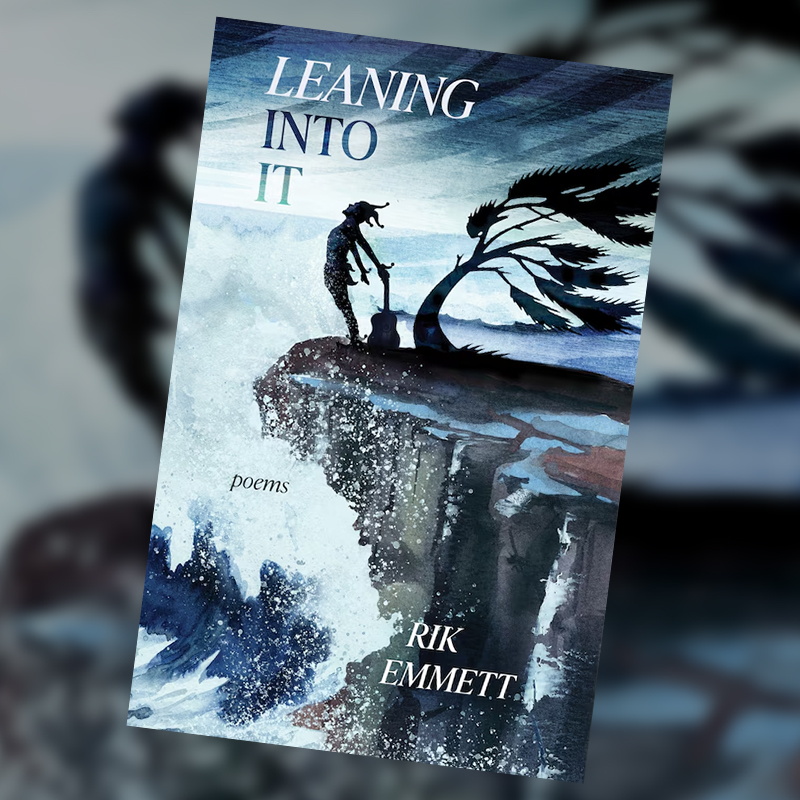
RIK EMMETT – LEANING INTO IT
MISFIT/ECW PRESS
BOOK REVIEW BY AARON BADGLEY
Besides being on third of the power rock trio, Triumph, Rik Emmett has had a successful solo career and is also an accomplished author. Not only has he written his memoirs (the excellent Lay It On The Line: A Backstage Pass to Rock Star Adventure, Conflict and TRIUMPH), he has written a book about the Telecaster (Ten Telecaster Tales: Liner Notes for a Guitar and Its Music) and a collection of poetry (Reinvention: Poems). He has just written a second volume of poems, Leaning Into It, and he firmly establishes himself as a poet and a writer. It is a creative book, divided into five sections, all of which deal with his observations and frustrations with the current state of the world. Make no mistake, Emmett is not shy in expressing his views and anger, and he does it very eloquently.
Reading Leaning Into It, one thing is clear, Emmett has read a great deal of poetry in his life, and he is well acquainted with style, patterns, allegories, and different ways to express himself. He doesn’t copy anyone, but he does use poetic tools very effectively. The first part of the book is titled “The Book Of Alvaro Follis,” poems written about and from Follis’ point of view. He is a jester in the classic sense of the word, and of course, he makes wry observations and more sense. By part two, “Venting,” Emmett does not use a jester, but rather expresses himself. Here, some of the poems bring to mind Bob Dylan at his poetic best (whom Emmett does reference in a poem). He is angry, and questioning. He vents about politics, organized religion, and the hopelessness that is fed to the public. “Democracy is being murdered,” he concludes the poem “Cry Freedom.”. “The cause of death…is ten thousand cuts of ignorance.” It is very powerful and poignant, given the vast amount of information at one’s fingertips.

SPILL FEATURE: LEANING INTO IT – A CONVERSATION WITH RIK EMMETT
The other three segments are arranged to form an arch. Once he has vented, he tries to cope with Part 3, “Outside In – Coming To Terms.” The poems here explore the notion of God and organized religion. Again, the poems are structured and written in almost a conversational manner. This leads to Part Four, ‘Inside Out – Exercising, Exorcising’ (a brilliant title and play on words). Again, religion rears its head, but in a much more personal and painful manner. It makes for intense and emotional reading. He ends the book with part 5, “Beyond Me.” The poem “The Magic Of 3” is a powerful and hopeful exploration or plea for the future. In this segment of the collection, he attempts to make sense of it all and yearn for a happy ending. But there really isn’t a happy ending, not in the traditional sense of the word, but there is solace.
Like all great collections of poetry, Leaning Into It is a series of poems of its time. Years from now this will be a strong indicator of the world in the 2020s. Emmett does point fingers, but he does ask direct questions without really expecting an answer, or at least an answer that is honest or makes sense. He has used the form of a poem to express a great deal. Poetry is so different from lyrics of a song, and he is a brilliant lyricist. Few composers write poetry instead of lyrics. Lennon, McCartney, Dylan, and Leonard Cohen come to mind and all have published poems outside the realm of their song compositions. One can add Emmett to that list. Leaning Into It is moving, thought provoking, provocative, interesting, and extremely well written. Leaning Into It is the perfect company for a quiet night.
ISBN-10: 1770418288
ISBN-13: 978-1770418288
PURCHASE LEANING INTO IT VIA


SPILL NEW MUSIC: RUSH CONTINUE ‘FIFTY SOMETHING’ CELEBRATION WITH ‘2112 (50TH ANNIVERSARY)’ AND ‘THE SPIRIT OF RADIO: GREATEST HITS 1974-1987’

SPILL NEW MUSIC: CANADIAN ROCK LEGENDS RUSH COMMEMORATE THEIR CLASSIC ALBUM ‘GRACE UNDER PRESSURE’ WITH EXPANDED REISSUE

SPILL FEATURE: A CELEBRATION OF ALL THE PEOPLE WHO BROUGHT US TO THIS POINT – A CONVERSATION WITH DAVE BIDINI OF RHEOSTATICS

SPILL ALBUM REVIEW: RHEOSTATICS – THE GREAT LAKES SUITE