


WE COULDN’T LET THE GRASS GROW UNDER OUR FEET
A CONVERSATION WITH CHRIS CONNELLY OF FINI TRIBE
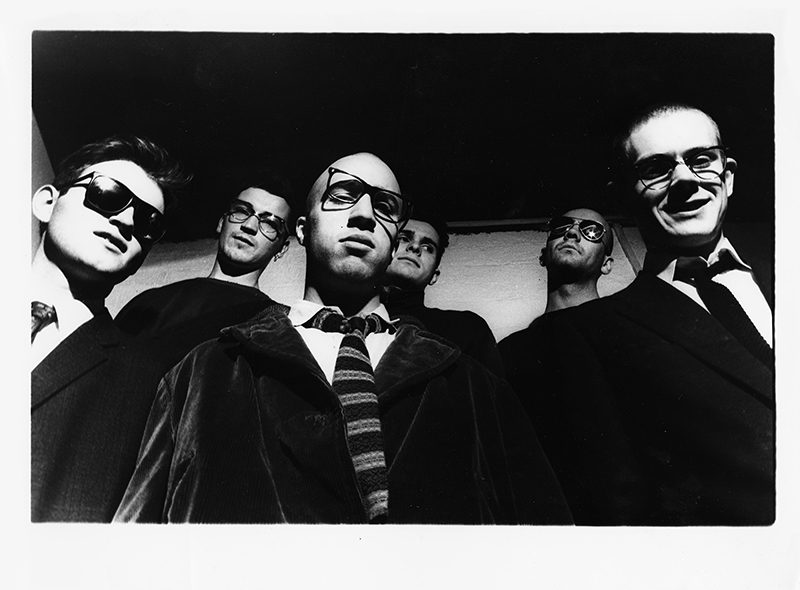
When Chris Connelly and David Miller formed Fini Tribe in 1984, they could not have predicted that over 40 years later they would not only still be a going concern. In 2025, the band is still influencing yet another generation of musicians. Hailing from the picturesque city of Edinburgh, the band released their debut EP Curling and Stretching on their own Finiflex label in 1984. The band and the EP caught the attention of the famed UK DJ John Peel. Not only did he play the EP but invited the band to record a session for his influential radio show.
Chris Connelly of the band remembered that the music producer for John Peel had quite a sense of humour. The band was given a day to record 15 minutes of music for The John Peel Show. Although the band had no real problem accomplishing the task, Dale Griffin, the producer, liked to play some small pranks.
“I do remember when Dale Griffin was having us do the hand claps. Our hands were red and swollen and agony. He made us do them over and over again. And then at the end of it, he said, OK, let’s start recording them. And we’re like, he’s just with us, you know, he didn’t record any of that. He did. He was just messing with us. We were like, oh, you know, we did a lot of hand claps that day.”
Recently, a new three CD set, The Sheer Action of Fini Tribe: 1982-1987 has been released, collecting the band’s singles and EPs recorded during that period. Also included is their first Peel Session as well as live material and previously unreleased songs. The band also allows fans to hear early versions of some of their most loved songs. It is an incredible compilation.
“Well, it’s been something that I’ve wanted to do for a long time. There was so much that we did as a band, as a six-piece band between when we formed and when we split up and the new Fini Tribe was born,” said Chris Connelly. “So, you know, we’re talking sort of 1980, -81 to 1988. And it just was never a good time for everyone to accumulate tapes.”
Connelly is clear that it was due to being interviewed by an author for a book that the new compilation took shape. “There’s a writer called Grant McPhee,” Connelly recalled. “He’s a great writer. He wrote a book called Postcards from Scotland. And it’s just a wonderful read. “He interviewed the Fini Tribe for it.”
The Sheer Action of Fini Tribe: 1982-1987 is not the first compilation of Fini Tribe material. “There was also a compilation called New Gold Dreams, which Cherry Red released, which was a five-CD set of independent music from Scotland, which we were on. And I realized there’s a ton we released, you know, a couple of 12-inch EPs. And we had the Peel session. There was a ton of stuff that just never saw the light of day. And after Grant’s book, I just got really aggressive about finding the stuff and started nagging my bandmates. And we came up with a lot of not only audio content, but visual content, too, photographs and stuff like that. And there was plenty to get on with.”

THE SHEER ACTION OF FINI TRIBE: 1982-1987 ALBUM REVIEW
With his own new Shipwrecked label, Connelly decided to “just go for it and put it together.” And Connelly truly enjoyed putting the project together. “Listening back to it, I had the privilege of being able to listen to some soloed tracks from four track demos and listen to some of that guitar playing that Andy McGregor did and how it worked with the bass. And whatever we were doing, we were good at it. And we invented it ourselves. It was really kind of mind blowing to hear how we played, because none of us except Simon, the drummer, who’s a real musician, none of us were, you know, we just got together with nothing when we’re about 15 and just started trying to do it.
“’I’ve heard that there were a lot of bands at that time who did the same thing after punk, when we were told that you don’t need anything to start a band. You know, a lot of people took that to heart. I mean, I remember reading an interview, I think with Bernie [Bernard Sumner] from New Order saying the same thing, like they didn’t know how to play. And they just got together and worked at it till they could, and they developed their own style.”
The original ‘punk’ movement influenced a lot of bands, especially with the DIY attitude. But Edinburgh was a bit special, as the city attracted a lot of bands to play there and as a result many bands formed. “If you read Grant’s book, there is a whole part of the book which tells you why a lot of bands in the mid to late ‘70s could not play in Glasgow. And it was something to do with not enough clubs or something like that,” said Connolly.
Edinburgh had a club, nightclub, that supported many bands, both local and national. “It was this small club on top of a theatre called the Playhouse Theatre, where touring bands would go. As far as local bands, we had bands like Josef K, The Fire Engines, and a very important band to us was Visitors, who, you know, like us, made three singles and then disappeared, and a couple of Peel sessions.”
Sadly, a number of these bands just could not last, and, according to Connelly, “we were kind of left with this wilderness. There wasn’t an awful lot of local bands that we found kinship with. And then it just seemed to me that we just sort of annoyed everybody. Because we refused to play any kind of game. People were sick of post-punk music and wanted to make funk and sign to major labels. And so a lot of that was happening. And that just didn’t apply to us. We were just weirdos on our own.”
“They weren’t going to try and turn us into Frankie Goes to Hollywood,” laughed Connelly. “And then once that started, something else happened. And we started to get bands like Test Dept. I suppose the only constant band for us was Wire, because although they did take a break in 1980, the solo components of Wire, like Graham Lewis and Bruce Gilbert and Colin Newman, all made these really radical records during the period that Wire were on hiatus until they came back again.”
With The Sheer Action of Fini Tribe: 1982-1987, Connelly has put together an impressive compilation. “Apart from just really enjoying the music for what it is,” Connelly said. “I think it’s a really great overview of progression and change and six people who just wanted to move forward all the time. We couldn’t let the grass grow under our feet. We’re still like that. It’s funny. For us, it’s an exercise in looking back, but I still think it sounds fresh. And I still think there’s stuff to be learned. And I hope it inspires people to do something cool.
Artist Links


Main Photo Credit: Bili Tennant | Background Photo Credit: Andy McGregor

SPILL MUSIC PREMIERE: THE JOY THIEVES – “I’LL BE YOUR HAMMER” (FEAT. CHRIS CONNELLY)
SPILL MUSIC PREMIERE: THE JOY THIEVES – “NO ANCHOR” (FEAT. CHRIS CONNELLY)
SPILL MUSIC PREMIERE: FINI TRIBE – “WE’RE INTERESTED”
SPILL NEWS: DERISION CULT ADDRESSES MASS MANIPULATION & STIMULATION IN NEW EP

