


TRAVELING INTO ANOTHER SPACE
A CONVERSATION WITH SUZIE UNGERLEIDER
“I’m sort of realizing that I need to just trust that my brain has this kind of narrative pattern to it, and that my songs are quite narrative. So, of course I’ve got this story in my head. We all do. We carry around our narratives as we’re walking around. Some people look at it and some people don’t. I’m that kind of person that always is looking at it.”
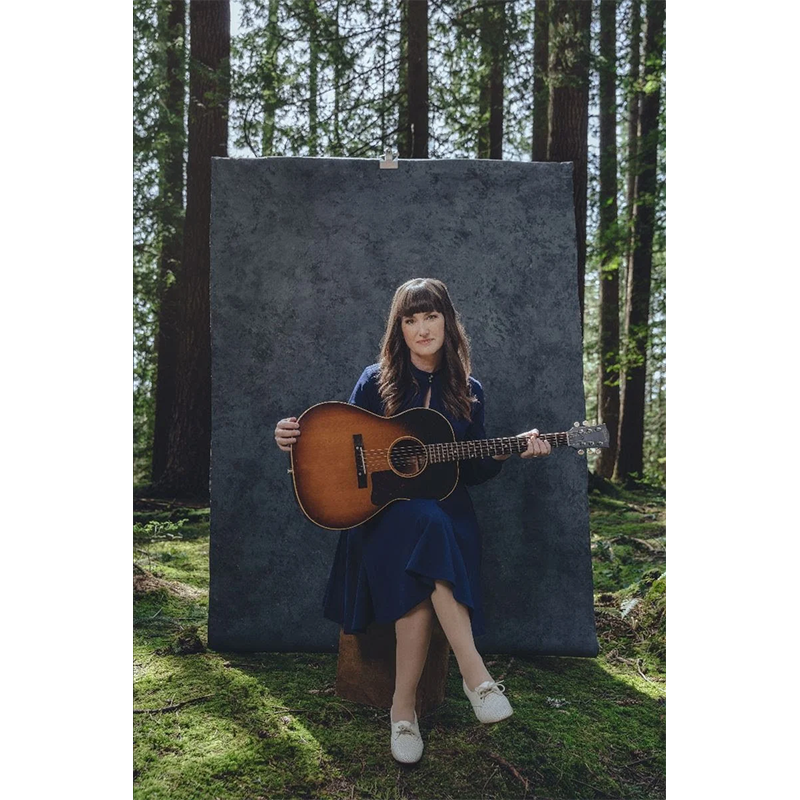
Suzie Ungerleider is a born storyteller. The veteran roots/Americana artist from Vancouver has been weaving musical tales for decades, and with the release of her eleventh studio album, Among the Evergreens, has created some of her most personal work to date. The creation of the album revealed some true ‘full circle’ moments for Ungerleider, whose songs straddle the fence on either side of worldly wisdom and the enthusiasm of youth.
Speaking about the songs on Among the Evergreens, and how the album came together, Ungerleider notes, “There have been records that I have made that were more of a concept, but for this one, the songs gradually came out. I just wrote about what I was either feeling, or thinking about, or experiencing. I could tell that there were songs about different chapters of my life, like being a teenager in Vancouver.”
“I had returned to Vancouver. After living in Toronto for 23 years, I moved back. So, of course, every street corner has a little story associated with it, or I see a piece of sidewalk that’s got moss on it, and it will trigger a memory. So, I started writing some songs about living there as a teenager, and what that was like. For example, with the song called ‘Cicadas’, I was walking through this tunnel and there were these lights buzzing intensely. I was reminded of cicadas that I would experience, especially living in Toronto. This area of town is very industrial and has railroad tracks, and it made me think of this person, and a whole story of someone I used to know. So, I started to write into my phone. I kind of captured some things about ‘the buzzing of the lights sounds like cicadas in the night’. And then I’d attach it to some other memories later on.”

Tapping into memories for inspiration and turning them into art, is something that has served Ungerleider well, through the years. Interestingly, the over-arching theme of this album did not reveal itself until late in the creation of the recording. Ungerleider realized that the songs fell into one of two categories. The artist explains, “I started to write these songs of the past, and then I was moving kind of concurrently, more and more to the present. Doing the crowd-funding campaign really made me look at the record, to see what it was, as a series. I was like, ‘This is a record of return – to my hometown, to the trees, to the city that is among the evergreens’. When I was sequencing the album, I started to see that there was this narrative arc of me, first as a teenager, then moving to Toronto, away from home but wanting to be away from home, meeting a musical community, meeting my husband, having a kid, and then returning [back]. And now my daughter is the teenager that I once was, experiencing Vancouver in the way that I was.”
All 10 songs on Among the Evergreens are strong, and they cover a lot of ground, stylistically and emotionally. Two singles have been released from the album, thus far: “Juniper” and “Mount Shasta”. Both were written by Ungerleider for her husband, and they reflect two sides of the relationship coin. As she relates it, “‘Juniper’ is that young love, very romantic time when you meet somebody and you connect with them. ‘Mount Shasta’ is the flip side of when you’ve been in a long relationship with somebody and having the same fight over and over in different contexts, but also, trying to learn from that and trying to do it better, each time. It was weird. ‘Juniper’, I was kind of planning it as kind of a fun present for my husband, because we had celebrated our 20th anniversary together. And then ‘Mount Shasta’ was kind of like, oh… the line of ‘we fought all the way down to Mount Shasta’, which is actually something that happened. That was just playing in my mind – that melody and the words – and then I just built the story around it, which is essentially what I feel when we fight, kind of this destructive force. Trying not to speak the script that you always speak, because sometimes that can be very destructive. I think that my husband and I are trying to re-write the conversation.”
When referencing the song, ‘Cicadas’, Ungerleider comments, “As a teenager, a lot of my friends and I were drawn into the idea that this was kind of cool, that the darker side of life felt sort of romantic and different from our privileged backgrounds. It was at the time of punk rock, and it was sort of badge of honour to come from a working -family, although we did not. We were a lot of academic types – my dad’s a prof, and my mom was an educator, and so there was this feeling like that was kind of this truth, a more gritty, honest truth about the world. We made friends with people who were from that world. Then, as you grow older, you realize that the advantages that you have can save you from a terrible destiny. That’s what I was exploring, I think, in those songs. Again, I wasn’t really conscious of it. It was just a memory in a story. Some people escape, some people get lured into this and they don’t escape, and some of us do. I feel lucky and grateful, but it’s complicated. I think the curiosity of being a teenager can lead you into dark corners that you can’t get out of.”

AMONG THE EVERGREENS ALBUM REVIEW
Like much of Ungerleider’s work, ‘Cicadas’ evokes a strong visual sense, and is almost cinematic in its presentation. “I like how music can make pictures in your mind,” she says, “That’s the thing that’s so interesting about art is that the medium that you’re working in is actually triggering another sense that isn’t there. If you see a painting, maybe you hear the sound. If you’re writing songs, I feel like the magic of music is to be able to transport you and to have this experience that actually is not here. It’s like a movie in your head.”
Recorded in Ottawa and Vancouver, Among the Evergreens features Ungerleider on guitar and vocals, the album’s producer Jim Bryson on guitar and bass, and Cam Giroux (who is Suzie’s husband) on drums. Sessions in Vancouver included performances from bassist Jeremy Holmes, and multi-instrumentalist Paul Rigby. Additional vocals were provided by singer-songwriter Keri Latimer.
Ungerleider truly values her work with collaborator Jim Bryson, saying, “I would say he’s the producer, and he’s also someone that really encouraged me to write in a way that was much more personal. I think I’ve always been exploring my feelings through music, but he was like ‘Go for it, whole hog’. It’s interesting, because Jim, when we make songs together, he doesn’t have a plan. In fact, this one we just did, ‘Okay, lets just get together, and we’ll play the song, and then we’ll figure out what it’s gonna be like.’ We always joked that we’re gonna do demos, but we know that it’s really not maybe a demo. We recorded many of the songs, the bed tracks, at his studio in Ottawa, and then some of them we maybe re-did or tweaked or filled in at a studio in Vancouver.”
“It was more just which songs felt ready to record. I really love doing that, because it informs and inspires me to write more. A lot of times I’ll be writing, and I’ll go (feigning confusion) ‘I don’t know… (laughs)’ I have this funny moment of ‘I don’t know if it’s good, I don’t know how to sing, I don’t know what it feels like’. And so, when you get it recorded, it helps me to go, ‘Oh! Okay, there’s something there. Or, this song might need another section, or you’re on to something. It helps me, instead of waiting to have all the songs ready, it just feels better.”
Although Among the Evergreens was recorded in two different studios, there is a wonderful consistency of sound across the whole album. To this, Ungerleider remarks, “Jim mixed it as well, and it’s Jim’s over-arching sounds—the sounds he likes. That’s why I like working with him. He has this certain taste of the sounds he likes. That’s not to say that he doesn’t stretch and grow, and challenge himself, but I just love that he doesn’t really play to genre. He likes to experiment, he’s very creative and he makes weird sounds on his guitar or synth, or whatever.”
In support of the album, Ungerleider has tour dates scheduled in Quebec and Ontario in the fall of 2025. She plans to tour Alberta, as well as the UK, The Netherlands, and Germany, in early 2026.

It is impressive to witness an artist like Suzie Ungerleider performing, writing, and creating new music almost 30 years after she first came on the scene. More impressive are the ways in which she has adapted, matured, and re-invented her art. Reflecting on the idea of taking risks as a songwriter, and creating more personal work, Ungerleider remarks, “I was really following some things that (American folk/roots artist) Mary Gauthier has said. She talks a lot about songwriting as kind of a healing practice. She says that if you write something and you think, ‘Maybe I shouldn’t say this,’ that’s a sign that you should say it. Or, if it feels scary or risky, or if you feel fragile saying it, that’s probably a good thing. So, I was going with that. There were certain things where I was like, ‘Am I really gonna write about that, or am I really gonna say this? Are people gonna really listen to it?’ I was also giving myself permission to write things that maybe I wouldn’t put out into the world – I would just write them because they would help me. So, I mean, it’s tricky because you don’t want to exploit the people around you, or exploit your own memories or feelings, and make it into a product. But I think when you do something that means something to you, it will resonate with certain people.”
Artist Links


Main Photo Credit: Trevor Cornish


SPILL NEWS: SUZIE UNGERLEIDER BEGINS TOUR THIS FRIDAY | ANNOUNCES DELUXE LP INCLUDING NEW SINGLE “AMSTERDAM” (FEAT. WHITEHORSE)

