I AM STILL SURPRISED THAT YOUNGER LISTENERS SEEM TO BE TOTALLY UNAWARE OF BRIAN
A CONVERSATION WITH MARK LINETT
Although the name Mark Linett may not be instantly recognizable, if you go to your record/CD collection, you are going to see his name on several records. He worked with Red Hot Chili Peppers, Los Lobos, Jane’s Addiction, Rikki Lee Jones, Randy Newman and The Beach Boys. He is a brilliant engineer/producer who not only was responsible for remastering and remixing pretty much the entire Beach Boys catalogue but also worked with Brian Wilson as a solo artist. In fact, from Wilson’s self-titled debut album, released in 1988, Linett was Wilson’s principal engineer. Brian Wilson liked what he heard from Linett, and most importantly, trusted him.
Although I have said this before, it bears repeating. Brian Wilson’s solo career/recordings/tours have been criminally overlooked and underrated. Linett has also been given the task of preparing some previously unreleased live material by Wilson, and a new album is being released on Record Store Day. On Tour 1999-2007 is a collection of live material recorded during several shows over the eight years. I had the chance to speak with him about the new album and working on The Beach Boys material.
“With Brian, in 2002, when he was playing locally, I would record the shows. I recorded three of the Carl Wilson benefits, which is where several of these tracks come from. I did another show in Royce Hall, which was a one off for Brian. Then I went out and recorded the 2007 Pet Sounds tour. I just figured somewhere down the line, these would be worth having, if only for history. The interesting thing is that on those shows, Brian tended stuff that may have gotten into his touring repertoire but were much less common. Songs like “Busy Doing Nothin’” and “The Night Was So Young.” So, on this release, I tried to draw from those shows and pick as many lesser-known songs.”
Besides performing some deeper Beach Boy songs, along with the hits, Wilson performed some cover versions that took me by surprise when I listened to the new live compilation. Wilson performs the Harry Nilsson song “This Could Be The Night.” Nilsson had written the song in 1967 as a tribute to Brian Wilson, and Wilson recorded it. Wilson recorded his version for the Nilsson tribute album For the Love of Harry: Everybody Sings Nilsson. “That’s actually from Brian’s very first live performances in 1999 in Chicago. There wasn’t even a tour. One other thing that happened is during the pandemic, with virtually no work going on, I used the time to try and organize Brian’s archives. Get all of his digital recordings archived properly so it could be accessed.”

MORE INFO ON BRIAN WILSON ON TOUR 1999-2007 VIA OGLIO ENTERTAINMENT
And digging in the archives meant not only some digging, but some transferring of tapes to digital. “Getting all those tapes, and getting everything transferred, which was the case for the Chicago recordings and Carl Wilson recordings. It seemed like a good idea, so I have everything in one place. It made it possible to go back and review all of this stuff and find the best performances that we could fit on this record.”
One of the other surprises on the album was Wilson’s version of The Beatles’ “She’s Leaving Home.” “Well, that’s a funny one. I didn’t remember archiving that. I did propose it once before. There was talk, a few years ago, of doing a project for Paul McCartney’s birthday. I had suggested using this song, but it didn’t happen. But I found it, it was from a series of RFH, Royal Festival Hall, shows. If memory serves me well in 2007, and the weird thing is, unless something has happened with the files, I only seem to have that one performance. I don’t even have the rest of the show.”
While Linett may not have that entire show, digging through the archives has provided him with enough material for this album and many more in the future. The songs have been well recorded and sound great. “There’s all kinds of gems hiding. The other thing I realised is that when we did earlier projects, like SMiLE Live and Pet Sounds Live. Brian always did two sets. He did the featured set, and then he did a whole other set plus encores. And some of that never got transferred because we weren’t looking at it or considering using it. And there are some that I still haven’t listened to. There are so many shows. I have a whole run of shows from around 2008.”
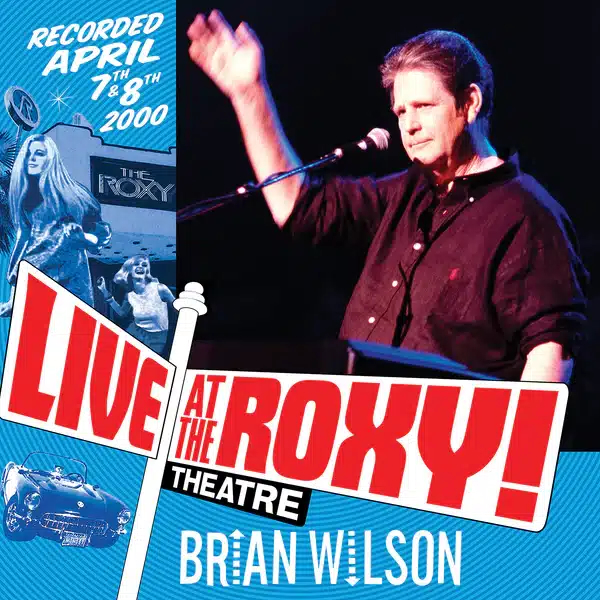
LIVE AT THE ROXY (25th ANNIVERSARY EXPANDED EDITION) ALBUM REVIEW
And although Wilson waited a while before launching his own solo career, once he got going, he kept up with new technology and new recording techniques. “He adapted pretty well, for someone who started out by putting a bunch of musicians, either The Beach Boys, or later The Wrecking Crew, in a little tiny room and making a coherent sound. He adapted pretty well to the later approach of recording, which I like to call the layer cake approach. He did pretty good with that, some did not. It is a very different way of working and thinking. I am impressed, having listened to all the Beach Boy Sessions, up to the 1980s, the earlier stuff that Brian was producing. How he would rearrange a track and put it back together. Recently I went back and listened to a session for “California Girls,” which as you probably know, when he cut it, it didn’t have a title, melody or lyric. He had the feeling in his head. Listening to that stuff, with very few exceptions, when he got to where he wanted to go, he always knew when he had it. There is only one instance that I know of where he didn’t use the last take, but rather the second to last take. When you compare this to his idol Phil Spector. I had the good fortune of getting access to all of Spector’s master recordings 30 years ago. It was the opposite, he almost never knew where the magic take was. For example, “Be My Baby,” the release is take 17 and it has one interesting mistake in it. Spector would have a rough mix, take it home and that was when he was able to decide what the master take was.”
And Linett is quick to point out that much of what you hear, when listening to older Beach Boys albums, is really not doctored or overdubbed. While not quite off the floor, the music is certainly without a great deal of studio trickery. In almost every instance, no music got overdubbed. Lots of vocals, but in the early recordings there were hardly any instruments overdubbed. Trying to fix something by adding something else. Even Pet Sounds, there were few overdubs. The song “Pet Sounds” is a construct that one got done in three different passes.”
With the release of On Tour 1999-2007, what one hears is the live concert. There are no rehearsals or soundchecks. But some of that was recorded. “We have sound checks, but by and large I want to say, unless we were making a live record, we would record soundchecks in case something sounded better without an audience, but if we were just recording regular shows, one off or a tour. The soundchecks prove to be less valuable, because Brian is not going to waste his voice. It was more about arranging going on.”
“I am still surprised that younger listeners seem to be totally unaware of Brian, and a lot of music from that era. It is just nice to be able to keep his memory alive and honour him and the band in this way.”
Brian Wilson Links


Main Photo Credit: Paul Natkin


SPILL FEATURE: A QUARTER CENTURY MUSICAL MEMORIAL – IN MEMORIAM OF MUSICIANS LOST IN 2025
SPILL ALBUM REVIEW: BRIAN WILSON – LIVE AT THE ROXY (25th ANNIVERSARY EXPANDED EDITION)

SPILL BOOK REVIEW: DAVID LEAF – GOD ONLY KNOWS: THE STORY OF BRIAN WILSON, THE BEACH BOYS & THE CALIFORNIA MYTH

SPILL ALBUM REVIEW: BRIAN WILSON – AT MY PIANO