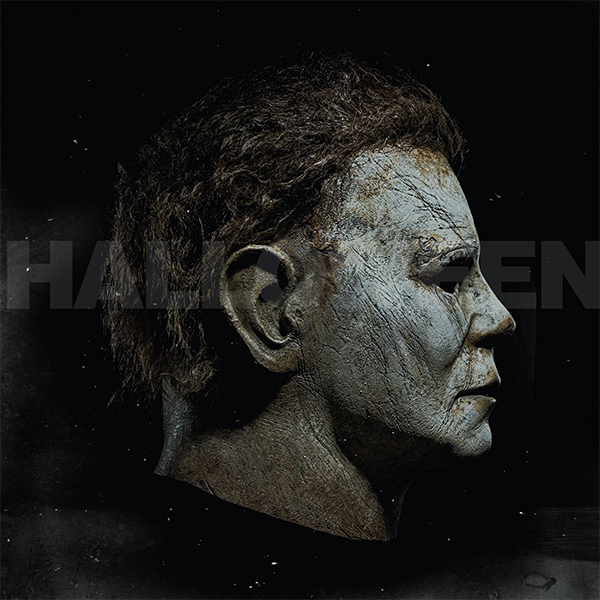
JOHN CARPENTER, CODY CARPENTER, AND DANIEL DAVIES
HALLOWEEN: ORIGINAL MOTION PICTURE SOUNDTRACK (EXPANDED EDITION)
SACRED BONES

When looking back on John Carpenter’s Halloween, there is more to this iconic film’s identity than just Michael Myers. The music of Halloween functions as a character in and of itself, having long been a symbol of iconography not just of film but of Halloween itself. Composed and performed by Carpenter himself, Cody Carpenter, and Daniel Davies, the film’s score is not just your standard spooky background filler in a horror film. It is an integral structural element that defines the mood, Michael Myers himself, and the palpable tension and suspense within. As the years have gone by, there is a clear reason why such a film has stood the test of time among horror cinema and among fans of the franchise. While Michael Myers has inspired many films in contemporary horror, it is the scoring that has saved the film time and again from fading into obscurity, and it remains one of the best musical achievements in cinema to this day.
Coming into the release of the expanded edition of Halloween: Original Motion Picture Soundtrack (Expanded Edition), we are instantly reminded yet again why Carpenter is one of the best composers in the genre. From beginning to end, something about Halloween’s scoring makes it feel like an entity all on its own. This isn’t to say that Michael Myers isn’t important to this grisly masterpiece. Yet if Myers is removed entirely from the equation, there is still a sense of dread and helplessness throughout. This feeling comes not just from a killer that can’t be extinguished, but from the mood created by the scoring. Death is something that can’t be escaped and is always lurking, in and out of the shadows. Part of this comes from Carpenter’s use of melody and simplicity in many of his arrangements. While the central theme of the Halloween franchise has always been memorable, Carpenter lets each part of the film’s score function in its own unique way, yet the way he creates each piece remains consistent throughout. He uses repetition and creates melodic cadence through atmospheric tension and synths. Each track hooks the listener at every moment, forging edge-of-your-seat experiences that capture fear and dread beneath the surface. Every shifting accent, coupled with subtle repetition, creates a sense of unease. He avoids overcomplicating or saturating each piece with bombastic elements. Carpenter doesn’t rely on complex harmonies. Instead, he relies on the space he creates within the ethereal structure for moments of dread to blossom and build up. He uses as few notes and instruments as possible, creating an abstract, economic approach to his songwriting. This tightens and underscores the deep-seated tension, sadness, and inevitability of loss that pervades throughout.
Rather than employing flowery, overly opulent structures to create a world where death and hell coexist, Carpenter uses minimal electronic elements and sparse piano lines. Deep, thick drops of constricted atmospheric environments create moments of intimacy and immediacy. This makes each moment feel human yet disturbingly impersonal, mirroring Myers’ musical persona perfectly. Myers never speaks. Silence and sound coexist, giving every moment of trepidation room to breathe. Each movement and musical choice feels calculated and finite. There is a beauty in Carpenter’s minimalist approach. It anchors the overall narrative. Both Myers and the scoring piggyback off of each other, signaling death is near or a threat lingers within the still air. Many moments evoke isolation, molding ordinary places into a hellish nightmare from which no one can escape. These psychological and emotional musical shifts turn visual horror into an internal, closed-in space of fear and panic. There is unease, vagueness, and unpredictability behind Myers’ character. This prevents the space for logic or time for emotional balance, leaving one in a constant state of alertness and never allowing moments of clarity or catharsis to sink in.
Halloween: Original Motion Picture Soundtrack (Expanded Edition) achieves an overwhelming state of terror and menace with minimal means. It proves that a film soundtrack, especially in horror, does not need orchestrated opulence to have an impact. While this decadent release has become synonymous with Michael Myers and Halloween, the musical experience also shows that less-is-more has become a cultural standpoint in horror cinema. Fans worldwide love the Halloween series, and the soundtrack has earned its place in both cinema and film history. For those devoted to the film and franchise, the soundtrack creates constant anxiety and disquiet. These traits make the franchise’s soundtracks among the most purposeful listening experiences. Halloween: Original Motion Picture Soundtrack (Expanded Edition) is more than a memorable piece of music. It is consistently the measuring stick by which other horror scores are judged.
Artist Links


SPILL ALBUM REVIEW: JOHN CARPENTER, CODY CARPENTER, AND DANIEL DAVIES – HALLOWEEN: ORIGINAL MOTION PICTURE SOUNDTRACK (EXPANDED EDITION)
Samantha Andujar

SPILL ALBUM REVIEW: ANN WILSON & TRIPSITTER – CONSECRATED GROUND

SPILL ALBUM REVIEW: REUBEN AND THE DARK – IF YOU KNOW ME, YOU KNOW MY BROTHER
SPILL ALBUM REVIEW: TEENAGE FANCLUB – DO NOT DARE TO DREAM
SPILL ALBUM REVIEW: GROWING PAINS – DANIEL LOVES MANDY FOREVER