I NEVER WANTED US TO STAY STILL
A CONVERSATION WITH GLENN TILBROOK OF SQUEEZE
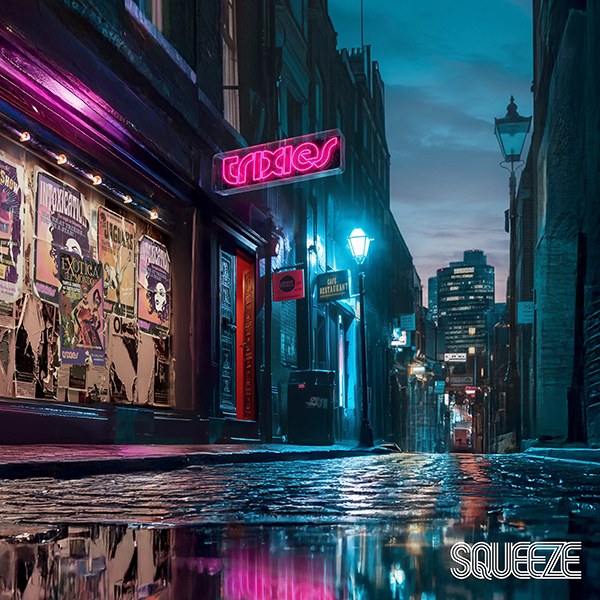
The last studio album from Squeeze was released in 2017 (The Knowledge). It was their 15th album, and the world has waited long enough for a new album from Squeeze. Eight years is far too long, but they have released a new album, Trixies. And they accomplished a pretty neat trick.
I had a chance to chat with Glenn Tilbrook about the business of the brilliant new album, Trixies. “It is great, everything could not have gone better, really. We worked very hard on the record. The gift to us all is that we wrote the songs all that time ago (the album was written in 1974 when Tilbrook was 16 and fellow Squeeze member Chris Difford was 19). And it sounds like it. It has worked out really well for us.”
Although the album was written over 50 years ago, it does not sound like an old album. It sounds like a current album looking back at a nightclub circa 1974. “Yeah, I think we made a conscious decision to use a few things like the RMI Electric Piano and an old string machine thing. A few things that tie it to what would have been available to us. Indeed, “Trixies” was written on an RMI piano. So, it was very much the sound of it 1974. But then again, we didn’t want it to be a recreation of a 1974 record. I think we want to give a nod to that without being tied to not using what you can do today.”
It is hard to imagine just how young the two were when they came up with this work. “I know it’s us, but you can’t go back into your mind at that point. That is really what came out. The point in its favour is that it is a sophisticated body of work that we created then, and the thing that counts against us is that we couldn’t really play or sing it properly, at that point. We could do a very enthusiastic version of all the songs, but we weren’t that great of a band at that point. I couldn’t sing properly then; Chris had a better voice in those days. But it was mostly written for me to sing.”

Although it must have been tempting for the band to revisit songs from that album over the years, they really didn’t. “When you have written as many songs as we do, you don’t tend to dip back into things. Although, I used the chorus chords from “The Place We Call Mars” on the last track on Domino called “[Time For A] Short Break.” But it is vastly inferior to “A Place We Call Mars”, but it is a great chord sequence, and I thought at the time, ‘that’s not going to be used, so might as well use it’. I don’t like throwing food away, why should we throw chords away,” laughed Tilbrook.
The question that comes to mind is how this material has been stored and saved for all these years. “Well, there were some demos of me playing the songs myself on an RMI piano. The songs Chris wrote by himself, there are demos of him playing guitar and singing that and then there is a few songs that we had band versions. I think we had “Trixies Part One” and “Part Two”, and we also had “The Jaguars.” There aren’t that many band versions of the stuff, because there were a lot of chords, as usual in Squeeze songs, and we couldn’t get our heads around it, so we moved on.”
“The other thing about Trixies, is that it is so of its time, so by the time we did make records, the whole musical landscape had changed, and a lot of those songs would not have been pertinent in 1978 or 1979. It was such a different musical landscape. I think harsher and faster music out.”
That also meant that the band, especially Tilbrook and Difford, were being influenced by the music they were hearing and loved. “You can hear Bowie in there, you can hear Sparks, you can hear Paul McCartney and Wings. You can hear Stevie Wonder, especially in “What More Can I Say?” Almost all the songs, musically, have one person or one band influence that song. And that is also weird. I don’t really think like that anymore. My thinking at the time was I was paying attention to what was happening in those years in ’72, ’73, and ‘74. It all came out in these songs.”
PURCHASE SQUEEZE
For Trixies, their bass player, Owen Biddle produced the album. “He did a really great job. He joined us in 2020 and then COVID happened, and we didn’t get to see him for a year and a half after he joined. Then he came in, and he is just great. He has such enthusiasm for the band and the songs and an incredible sense of musicality. And also, he is a brilliant bridge between me and Chris. That is an important thing for the band to thrive and survive.”
As well as Trixies, Squeeze will be touring featuring the album, with their new line-up. Stephen Large (keyboards, backing vocals), Simon Hanson (drums, percussion, backing vocals), Steve Smith (percussion, rhythm guitar, vocals), Melvin Duffy (pedal and lap steel guitars, dulcimer) and Danica Dora (backing vocals, keyboards). Tilbrook’s son, Leon, has also joined the band for the tour.
“What we are thinking about is doing the whole record, because that is 45 minutes, so half of our set. We can do that, as long as we make it clear that is what we are going to do. That way, you don’t get people frustrated because you are not straight in with some other stuff they know more. That stuff will come later.”
The band can also be seen on the BBC programme, Radio 2’s Piano Room. The fantastic performance features a cover of Paul McCartney and Wings’ “Junior’s Farm,” a song not often covered by bands. The fact that the single was released in 1974, ties it in with Trixies. “The reason we did it was, I think, our second gig in 1974, we didn’t have many gigs, so our second gig we did “Junior’s Farm” because it was their current song. It was part of our influences back then, so it felt pertinent to do that.

There is also a view of turning Trixies into a musical for stage. The album practically cries out for a production (besides seeing Squeeze perform it live) on a stage. It is not the first time Squeeze has had a musical on stage. “Yeah we had a musical called Labelled With Love (1983) which was good. We haven’t done anything like that since. I think it would make a terrific musical, I really do. It has everything in it, so if we manage to find the right person to do the book, I think everything is there and ready to go.”
Although both Tilbrook and fellow Squeeze member, Difford, both have successful and brilliant solo careers, Squeeze has never taken a backseat, and their goal was always to keep Squeeze interesting and vital.
“I never wanted us to stay still, and I think the band fundamentally changed in 2020. I had been mixing a live record we had recorded in Liverpool, and there were a lot of things we did in 2019 and I listened to it. I thought there is a lot that is right but there is a lot that is wrong. So, I wanted to tackle everything that was wrong. I think we then paid attention to things that we weren’t paying attention to. And since that point, we have gotten better as a band. As we got better the reaction has been growing and growing steadily. Everything is getting bigger for us and the response is bigger than ever before. I think people know when you pay attention to all the little details, and we worked hard to now be the best we have ever been.”
And as for Trixies, Tilbrook views it as another step forward from Squeeze, even though it was achieved by looking backwards. He even joked that maybe next year they “can do an album of songs written in 1975”. Trixies is a brilliant work, and Tilbrook has every right to be proud of the new album. “I hope the story gets through to them and they are interested. If they are intrigued to see it, we can deliver that and we can deliver something really great. I think it is an exceptional piece of work, and we can give it the legs it needs to knock people out. There is a lot of apportioning out things, and vocals for people, and all the stuff we can do now because our vocal line-up is impeccable. That’s the thing Squeeze was not able to do, but now we do. We do vocal arrangements and it is magical.”
Artist Links


Photo Credits: Dean Chalkley

SPILL MAGAZINE ILLUSTRATION: JOHNNY MARR
SPILL NEWS: A PERFECT CIRCLE RELEASE NEW SINGLE “TO WHOM IT MAY CONCERN” | EXTENSIVE 2027 NORTH AMERICAN TOUR ANNOUNCED INCLUDING CANADIAN DATES IN VANCOUVER, CALGARY, EDMONTON, WINNIPEG & NIA...
SPILL NEW MUSIC: MOTÖRHEAD PROUDLY ANNOUNCE THE 40th ANNIVERSARY EDITION OF ‘ORGASMATRON’
SPILL ALBUM REVIEW: DRAGONFLIES – DRAGONFLIES