


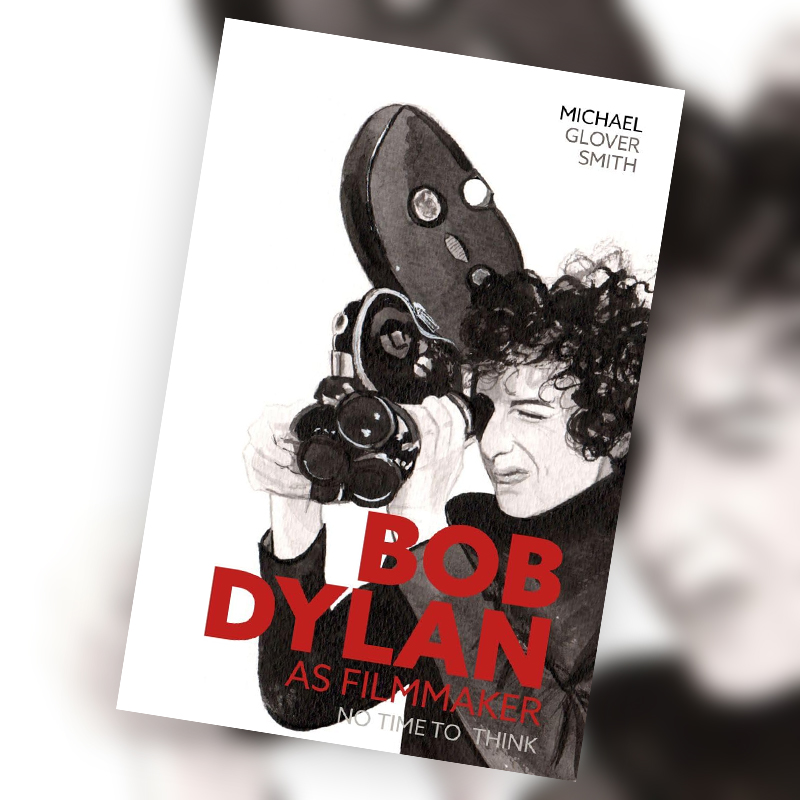
MICHAEL GLOVER SMITH – BOB DYLAN AS FILMMAKER: NO TIME TO THINK
MCNIDDER & GRACE
BOOK REVIEW BY JULIE CORRELL
There is a particular thrill in watching someone as famously elusive as Bob Dylan step behind a movie camera. It’s like catching a glimpse of a wild animal in unfamiliar territory: the same instincts are present, but the behaviour shifts, mutates, becomes something stranger. Bob Dylan as Filmmaker: No Time to Think embraces that strangeness, offering a sharp, deeply researched and unexpectedly lively examination of Dylan’s cinematic ventures – a body of work long overshadowed by his music. What the book argues, convincingly, is that Dylan’s films are not side projects. They are extensions of the same creative engine that has been firing since the early ‘60s.
The author approaches Dylan’s filmography with a seriousness usually reserved for his albums, and that alone marks the book’s first major victory. Rather than treating Eat the Document or Renaldo and Clara as indulgent tangents, they are framed as deliberate experiments in form and identity — cinematic cousins to the non-sequential storytelling of Blonde on Blonde or the mythic haze of John Wesley Harding. For readers who have long suspected there was more going on in these films than critics allowed, the study feels like overdue validation.
The early chapters on Eat the Document are particularly strong. The film functions as a kind of visual Rorschach test: for some, it is an incoherent mess; for others, a trippy, pre-MTV collage of sound and motion. The book looks past the surrounding mythology, focusing instead on the abrupt edit cuts and the intentional refusal for clarity.
Rather than chalking the film up to Dylan’s post-motorcycle crash disorientation days, the author argues that Eat the Document mirrors the collapse of Dylan’s mid-60s public persona, the folk hero turned electric agitator turned reluctant icon. It is a grounded, persuasive read that lends the film logic that is seldom afforded.
The heart of the book, however, and the point at which the author’s passion most fully asserts itself, is the deep dive into Renaldo and Clara. Long dismissed as a four-hour act of self-indulgence, a filmic puzzle with no attached instructions, is now treated as a sprawling and adventurous exploration of identity, performance, and the boundary between art and life. The parallels drawn between the film’s improvisational structure and the Rolling Thunder Revue’s playful energy are especially compelling. The analysis of doubling, Dylan playing Dylan, actors playing Dylan, Dylan playing not-Dylan, stands out as one of the book’s most incisive threads, reframing the film as a deliberate attempt to fracture the idea of a singular “Bob Dylan,” a recurring concern throughout his entire career.
The chapter on Masked and Anonymous is another highlight. Released in 2003 to widespread critical confusion, the film has since aged into a cult object, and the book reads the film as a conscious political statement, rather than a misfire or oddity.
Situated within the anxieties of the early 2000s, media saturation, political decay, and cultural splintering, its fractured chaos is read as intentional rather than accidental. Dylan’s performance as Jack Fate emerges as a meditation on the role of the artist in a collapsing society: weary, puzzling and yet somehow defiant. It is a reading that feels both timely and long overdue.
One of the book’s greatest strengths lies in its ability to connect Dylan’s visual instincts with his musical urges. Recurring themes are traced across mediums, showing how film becomes a space for Dylan to pursue ideas that resist the confines of a song. This cross-medium analysis is where the book truly earns a spot on the bookstore shelves. Dylan’s filmmaking emerges not as a hobby or ego project, but as another outlet for the restless creativity that has driven his continual reinvention for more than six decades.
The writing itself is marked by welcome clarity. It is intellectually demanding without lapsing into no-nonsense jargon or excessive name-dropping. Instead, the writing reflects a genuine affection for both Dylan and cinema, inviting readers into the conversation rather than lecturing them. The research is extensive, but it never overwhelms; production details, behind-the-scenes anecdotes and historical context add texture without bogging the narrative down.
If there is a weakness, it lies in the book’s occasional tilt towards sympathy. Dylan’s films are undeniably fascinating, but they are also uneven, and the author’s admiration can sometimes soften the critique. Renaldo and Clara may be more ambitious than its reputation suggests, but it remains a demanding experience, and the defense of its length and looseness may not persuade skeptics. Still, the book’s aim is not to convince the unconvinced, but to take Dylan’s filmmaking seriously, and on that front, it succeeds.
Bob Dylan as Filmmaker: No Time to Think is a vital contribution to Dylan’s expertise and a refreshing entry in the broader discussion of musicians who cross into cinema. By challenging long-held assumptions and drawing attention to a neglected body of work, it invites readers to reconsider Dylan not simply as a songwriter or performer, but as a visual artist with a distinctive cinematic voice. Whether you love his films, loathe them, or never made it past the first twenty minutes of Renaldo and Clara, this book offers a new way of watching them – and in the process, a new way of seeing Dylan himself.
ISBN-10: 0857162993
ISBN-13: 978-0857162991
PURCHASE BOB DYLAN AS FILMMAKER: NO TIME TO THINK VIA


SPILL FILM REVIEW: A COMPLETE UNKNOWN

SPILL NEW MUSIC: CRAFT RECORDINGS AND TRAVELING WILBURYS UNVEIL NEWLY RESTORED 4K VERSION OF THE ICONIC MUSIC VIDEO FOR “END OF THE LINE”
SPILL ALBUM REVIEW: BOB DYLAN – THE COMPLETE BUDOKAN 1978
SPILL ALBUM REVIEW: BOB DYLAN – SHADOW KINGDOM

