


LET’S TAKE THIS SOMEWHERE ELSE
A CONVERSATION WITH ANDY MACKAY
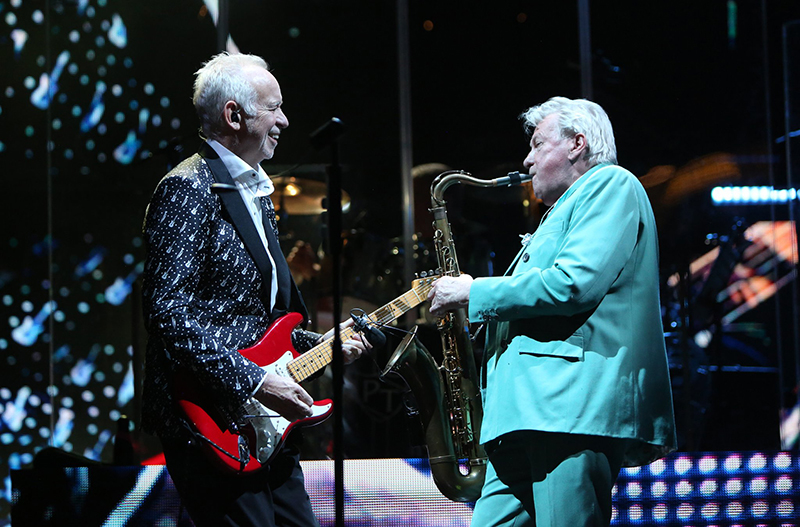
London, 1972. It was two years since The Beatles split, Bob Dylan had turned to country (sort of) and the music world was waiting for something new. When Roxy Music debuted with “Virginia Plain” in 1972, the rock ‘n’ roll landscape changed forever. This is what rock needed. A new sound. Here was a band that incorporated art rock, avant-garde, and pop music into one single and people took notice. It firmly established the band and for the next 10 years they produced landmark, influential, brilliant, and groundbreaking albums. Saxophonist Andy MacKay and guitarist Phil Manzanera were two members of the band (which included Bryan Ferry on vocals and keyboards, Paul Thompson on drums, and Brian Eno on synthesizer), which helped define the Roxy Music sound. Last year, the two performed three sold-out shows, performing much of the music of AM.PM, and one of the shows has been released as a live album, AM.PM Soho Live. Recently, I had the opportunity to speak with Andy through Zoom about the new live album. Before the shows, there was the album AM.PM in 2023.
“This all started during the lockdown, 2020 or 2021. I obviously hadn’t seen Phil for some months. I was living out of London at the time, in a seaside town in Brighton, South coast, and Phil sent me some stuff he had been working on, out of the blue, and he said ‘listen to this and tell me what you think.’ So, I put it on, and it was very nice, and I hadn’t been playing much. I played some sax on my own, but nothing much. All I had was a laptop and a Wurlitzer electric piano and my sax. So, I just played some sax straight on to Logic Audio, and sent it back to Phil. And this project developed from there, really. It was great and an inspiration having these tracks available.”
That album, AM.PM, was very experimental and may have taken some fans off guard. But it should not have been. Roxy Music, including Phil Manzanera and Andy MacKay, were no strangers to creating cutting edge music. “It was different. Strangely, it felt more like a performance than being in a studio. Some of the experimental stuff we had done was in a studio where you have some sort of sound or loop or something and you think ‘that’s great, I can work on that,’ which is the way most ambient music gets made. You get a very good echo or synth sound, or something you recorded that you think, ‘well, that sounds different’. Whereas this AM.PM was more spontaneous. It was more first take stuff. There was nothing really to work to except to add to what was there. So, in a way, the first thing I was going to play, was going to be as good as the last thing I played,” chuckled MacKay. “So, in that sense, it was spontaneous. It sounded great. That was the thing. Phil was very enthusiastic. Then he sent me some stuff, and I would say ‘that sounds great. And then we left that until after we were all back in circulation in 2022.”
At that point, the duo rejoined Roxy Music before they could finish their album. We did the Roxy Music 50th Anniversary Tour and after that Phil and I had been playing a lot together. We went into the studio for a day, with Mike Boddy, our engineer, and with Paul Thompson and we did a bit more work, added a few bits and pieces. But mostly, we then let Mike, who was also our producer, just work on it and put it together. I stood aside from it really, unlike a lot of projects, sitting for hours and hours in a studio and you hear it until it becomes over familiar. This always sounded fresh to me. In fact, now I forget the names of the tracks,” laughed MacKay. “If someone says I like “Newanna”, I think ‘hang on, which one was that?’ Which is good, it is always fresh.”
The announcement of concerts of the duo performing the album live came as somewhat of a surprise. How does a duo recreate the sound of that album, live? “It wasn’t difficult, actually, because we did use some bits and pieces from the recordings, we used some tapes, so it was a mixture of live and a few loops here and there. I could never tell which was which because using some echo and effects as well. It was not a difficult project, except sometimes one number melted into another in my brain, and I would be playing it. But it didn’t really matter, actually,” laughed MacKay. “It sounded good, and it was very good to have Paul there [Paul Thompson, drummer of Roxy Music] because that gave us a terrific grounding.”

AM.PM ALBUM REVIEW
Oddly enough, MacKay admitted that there was not a lot of rehearsing before the shows.
“We did a couple of short rehearsals, but nothing like Roxy. The place we did it used to be the Warner Brothers studio, viewing theatre and sound dubbing studio in Soho, in London. It recently closed and Warner Brothers moved out, it was called Delany Studios. Their old building, with one or two sound studios, is now an Arts pop up. And I have a little studio there, where I keep my instruments and do some rehearsing. We did three nights, seated, so it wasn’t like standing around in a club, it was more of a concert hall or theatre performance. The show was spontaneous, I guess it is what jazz players have always done. It wasn’t jazz, but it had elements of that kind of improvisation and integration of listening and performing.”
The shows proved to be more fun than the two had planned. “It was a lot of fun. Particularly, doing the Roxy numbers (“Tara,” “Love Is The Drug,” “Out Of The Blue”) because we could take the Roxy songs, obviously like any band we played thousands of times, and Roxy Music tours are not, like most arena tours, are not terribly spontaneous. We are using quite a complicated lighting rig and projection and quite a lot of musicians on stage. Also, partly the way Bryan likes to work, so, there were not many surprises for us on the stage. There was no nodding at Phil and saying, ‘let’s take this somewhere else’. The tour was a huge pleasure to do, but AM.PM it was a nice relief after that. I mean when the Roxy tour ended in London, it was one of the nicest nights of my musical career. But it was fun being spontaneous.”
In some ways AM.PM was a chance for MacKay to go full circle with his music and career. “In fact, this was more or less what we did in Roxy many years, like before Eno left. If you caught Roxy Mark I, or maybe Roxy Music Mark II, the pre-Island Records Roxy was even stranger. We didn’t have that many songs. Like many bands, we had one album’s worth and if you are playing support, you only have half an hour anyway. But when you are getting to the point when you headline, you need to play for maybe an hour and a half or longer. In 1972, Bryan was not the kind of performer who wanted to go right out and dominate the stage, which he did very well. He would tend to play at the side of the stage. Eno on the other side. Phil and I would fill in long sections of instrumental music by just improvising, Phil would play tape loops and effects, and I would add to it. We didn’t do that again until AM.PM. It was quite like feeling like we were back in 1973, at some European venue, seeing what was happening. Playing treated saxophone and Phil doing his bit of strange stuff and Eno twiddling on the synthesizer. It was nice to be remembering that.”
AM.PM proved to be the opportunity and chance the two had to play together once again. The studio album was a critical and commercial success, and the three sold-out shows demonstrated to the duo that fans were attracted to their new work. “Yes, we have played together on and off, for over 50 years. But apart from Roxy, it wasn’t that much. The Explorers was a band that disappointedly didn’t quite go the way we wanted it to. After two albums we didn’t carry on with that, we did do a tour which was great. I love the Explorer stuff, I think it was brilliant production and some very good songs. But apart from that, we worked on albums and guested at gigs, so this is the first time we have gone out routinely which I think is good. It has kept it exciting and fresh.”
Andy MacKay Links


Phil Manzanera Links
Photo Credit: Mathew Becker


SPILL ALBUM REVIEW: PHIL MANZANERA & ANDY MACKAY – AM.PM SOHO LIVE

SPILL ALBUM REVIEW: PHIL MANZANERA & ANDY MACKAY – AM.PM

