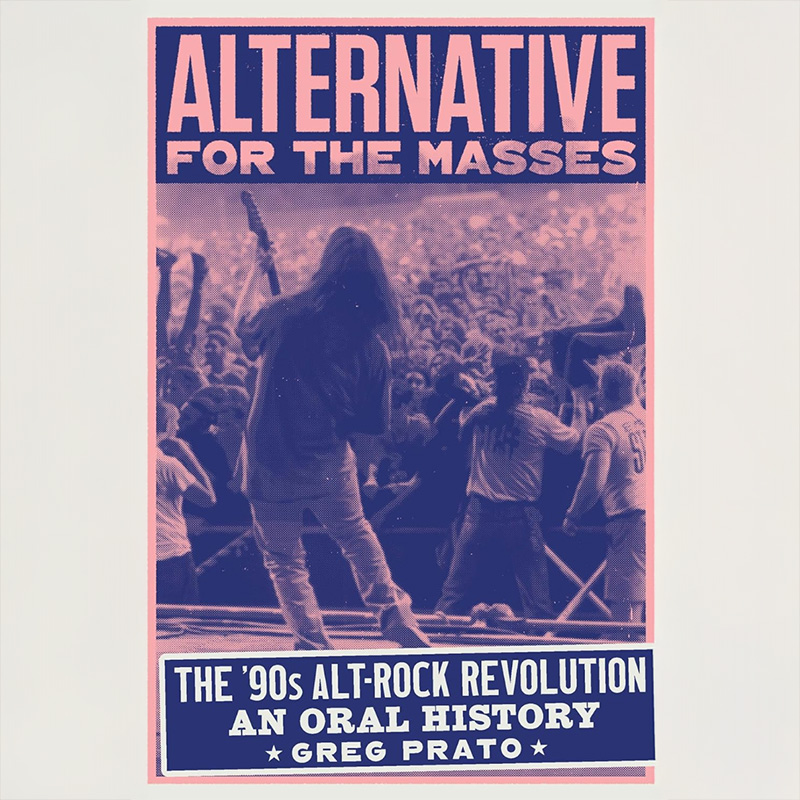
GREG PRATO – ALTERNATIVE FOR THE MASSES: THE 90s ALT-ROCK REVOLUTION – AN ORAL HISTORY
MOTORBOOKS/QUARTO
BOOK REVIEW BY GERROD HARRIS
Perhaps best known for Grunge Is Dead: The Oral History of Seattle Rock Music, acclaimed author and journalist, Greg Prato, has returned with his 40th book, Alternative For The Masses: The ‘90s Alt-Rock Revolution – An Oral History. Like many of his previous releases, Prato’s latest book seeks to tell the story of the alternative music scene throughout the decade. Prato tells this story through a collection of interviews from members of the community, including Ian MacKaye (Fugazi), Les Claypool (Primus), Corey Glover (Living Colour), Frank Black (Pixies), and Al Jourgensen (Ministry), among many more.
From the very beginning, Prato does his best to mark the alternative wave that swept through the decade as a distinctive movement from that of Seattle grunge. While a near-impossible task, due to the vast overlap between the two genres, the book strives to explore the impact alternative music (primarily rock, but also punk, industrial, and electronic) would have in shaping the course of pop culture during the ‘90s and beyond. There is a wealth of primary evidence from a stellar cast of contributors eager to tell their stories, making Alternative for the Masses: the ‘90s Alt-Rock Revolution – An Oral History a valuable collection of stories and varying perspectives. In this sense, Prato has delivered a strong spiritual successor to Grunge Is Dead: The Oral History of Seattle Rock Music. However, his latest effort struggles to escape the looming shadow of his previous work. While necessary to understand the cultural shift that dominated the decade, much of Alternative for the Masses: the ‘90s Alt-Rock Revolution – An Oral History is directly tied to Nirvana, making some segments feel as though Prato and company are treading through familiar territory, rather than telling a new story.
Despite this, Alternative for the Masses: the ‘90s Alt-Rock Revolution – An Oral History is an exciting read, especially when the book features its contributions from MacKaye, Claypool, and producers Butch Vig and Steve Albini. The book is organized thematically, which proves to be a double-edged sword. On one hand, Prato is able to curate the interviews to explore different genres, along with albums, fashion, festivals, music videos, and much more, while still keeping the book arranged in an organized fashion. On the other hand, the book suffers from its lack of a chronological throughline, creating a deficit in its ability to provide a clear narrative that progresses through the decade.
While Prato may struggle to successfully tell the alternative story separate from that of the Seattle grunge movement. Alternative for the Masses: the ‘90s Alt-Rock Revolution – An Oral History, despite its shortcomings, is an important book. By collecting a wide range of first-hand accounts, Prato provides a detailed account of alternative music’s rise and the countercultural shift that defined the decade effectively. This solidifies Prato’s latest book as an enjoyable read.
ISBN – 9780760398425
PURCHASE ALTERNATIVE FOR THE MASSES: THE 90S ALT-ROCK REVOLUTION – AN ORAL HISTORY VIA


SPILL BOOK REVIEW: GILLIAN GAAR – GRUNGE! THE STORY OF THE MUSIC THAT REDEFINED ROCK
SPILL BOOK REVIEW: MIKE DALEY – YORKVILLE: HOW A 1960s COFFEEHOUSE SCENE REWROTE POPULAR MUSIC
SPILL BOOK REVIEW: RICHARD BOWES – GARY NUMAN: A PEOPLE’S HISTORY
SPILL BOOK REVIEW: KELLY CATLIN – KURT COBAIN: FOREVER IN BLOOM: THE LEGACY BEYOND THE TRAGEDY