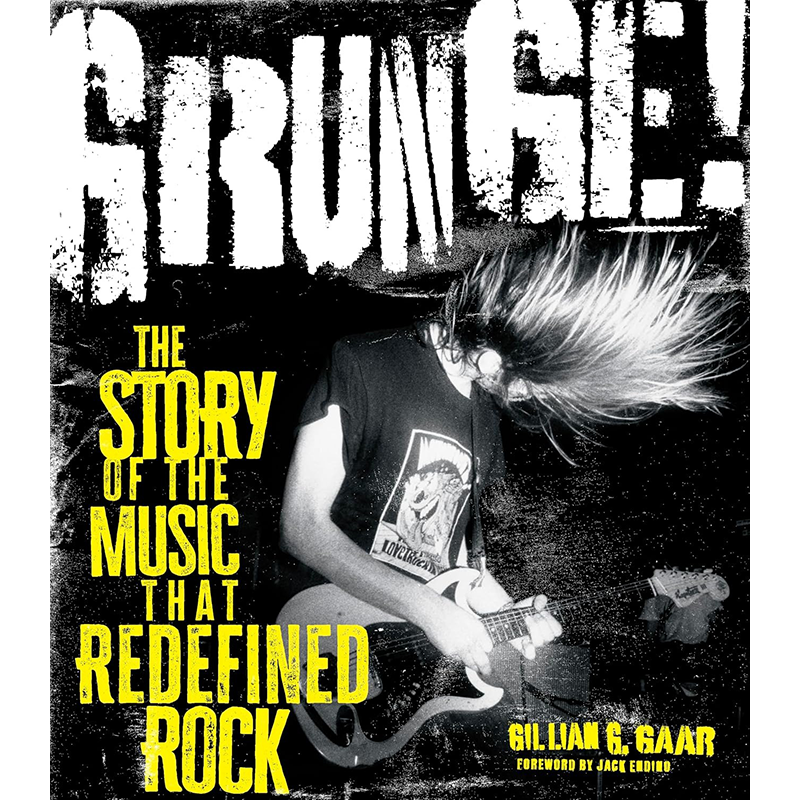
GILLIAN GAAR – GRUNGE! THE STORY OF THE MUSIC THAT REDEFINED ROCK
MOTORBOOKS/QUARTO PUBLISHING GROUP
BOOK REVIEW BY CHRIS X
I never stood a chance of ignoring this book.
The striking cover didn’t invite me in so much as it pinned me to the floor and waited for the oxygen to run out. Driven by a compulsive fervour, I turned past the hardcover flap, and the raw, unfiltered pulse of the Grunge era hit me with the force of blown-out speakers humming with rust-caked, ungrounded static. I would literally feel the full story of the sound that ate the 90s.
Gillian Gaar’s book, Grunge! The Story of the Music That Redefined Rock, isn’t a speculative descent. It is a rigorously documented inventory of a reality that actually happened, drawn from her own direct, eyewitness chronicles, then violently dragged through a distortion pedal and poured right back out on a raw, fuzz-drenched frequency.
Gaar’s timeline spans from 1986 to 1996, meticulously mapping the underground’s ascent from wet-basement Aberdeen rehearsals and damp Seattle practice spaces to the blinding glare of mainstream assimilation. Through her unsparing lens, she tracks the sound from its earliest blistered guitar lines and Sub Pop singles, when a few flannel-clad outcasts were just playing to empty rooms, straight through to the terminal implosion that fundamentally ruptured the ontology of rock and roll. From there, she captures how the local underground caught fire through indie singles and word-of-mouth, building a defiant community before the inevitable crash. That momentum catalyzed a high-velocity paradigm shift into global mainstream hegemony, dragging an unwilling subculture into corporate spotlights and packed stadiums where the gain knob snapped past the red and the circuit finally blew. Gaar maps this trajectory with clinical precision, laying bare the crushing realization, traced across every chapter, that the movement’s destruction wasn’t an accident of history, but a mathematical certainty built into the high-gain feedback loop of American capitalism. Every raw, bleeding chord and defiant anti-establishment anthem was systematically weaponized by the culture industry, transformed into a high-yield commodity designed to feed the very machine it swore to dismantle. What began as a localized, visceral rejection of corporate gloss was inevitably flattened into an aesthetic, proving that the market invariably metabolizes its own undertakers. By 1996, the tape had run out and the stages were empty again. The movement that briefly owned the planet ended in a tragic collapse into silence and hollow echoes, burning out from the crushing weight of fame, addiction, and a scene that had finally eaten its own young in a slow-motion wreckage of dead heroes.
Grunge! is richly illustrated with gorgeously raw, unearthed photography, concert flyers, and backstage memorabilia, serving as a visceral time capsule that bleeds authenticity. Every turn of the page drags you right back into the lower levels where a broken-chord revolution was quietly, yet fiercely born. While most rock biographies treat the ’90s Seattle explosion like a lightning strike; Gaar’s work reminds us that it was a slow-burning fuse lit years earlier in independent record shops and basement venues. She doesn’t just chronicle the grunge era; she pulls you face-first through the damp basements, broken promises, and the tinnitus-riddled squalor that forged an insurrection in the dark before the corporate suits even learned how to spell Seattle. This was a brutal, systemic execution of authentic art, gift-wrapped and sold back to the kids as a commemorative t-shirt before the corpses were even cold.
ISBN-10: 1577156293
ISBN-13: 978-1577156291
PURCHASE GRUNGE! THE STORY OF THE MUSIC THAT REDEFINED ROCK VIA


SPILL BOOK REVIEW: MIKE DALEY – YORKVILLE: HOW A 1960s COFFEEHOUSE SCENE REWROTE POPULAR MUSIC
SPILL BOOK REVIEW: RICHARD BOWES – GARY NUMAN: A PEOPLE’S HISTORY
SPILL BOOK REVIEW: KELLY CATLIN – KURT COBAIN: FOREVER IN BLOOM: THE LEGACY BEYOND THE TRAGEDY
SPILL BOOK REVIEW: NIGEL DICK – MUSIC VIDEO MISCHIEF: OZZY TO BRITNEY, OASIS TO GN’R, McCARTNEY TO CHER: A LIFETIME OF ROCK AND CHAOS