


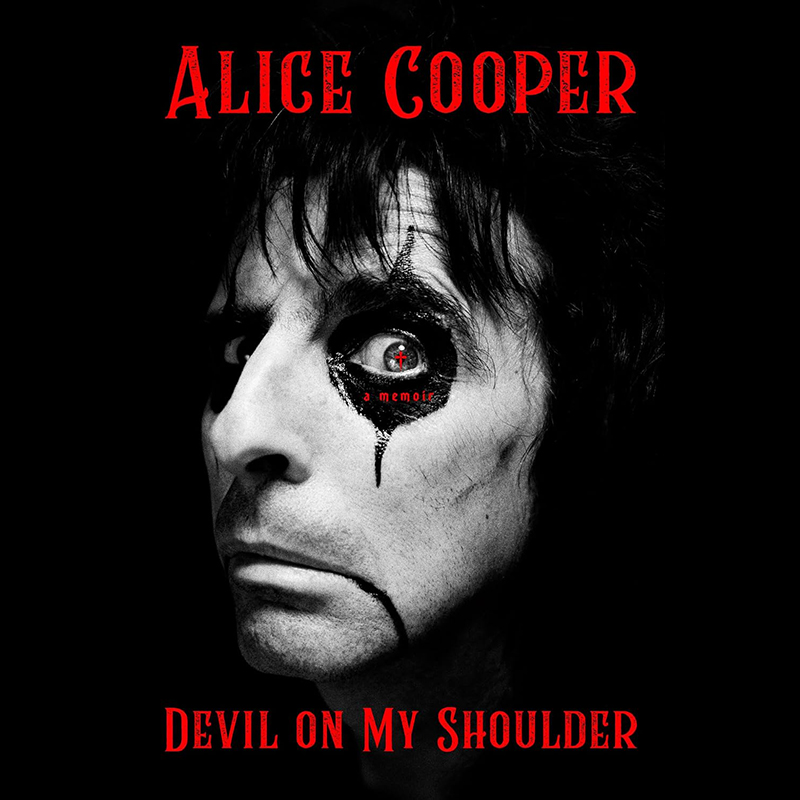
ALICE COOPER AND DANIEL RICHLER – DEVIL ON MY SHOULDER
DE CAPO/HACHETTE BOOKS
BOOK REVIEW BY JULIE CORRELL
For more than six decades, Alice Cooper has blurred the line between reality and illusion. With blackened eyes, a snake around his neck, and a stage show built around guillotines, electric chairs, and theatrical executions, he became the Godfather of Shock Rock by giving audiences something they had never quite seen before. But behind the blood, the theatrics, and the carefully cultivated image of rock’s favourite villain is Vincent Furnier, the man who created Alice Cooper. In Devil on My Shoulder, written with Daniel Richler, Cooper attempts to separate the man from the monster and, in the process, confronts some uncomfortable truths about his own past.
Perhaps the most striking revelation is Cooper’s willingness to admit that his previous autobiography, Me, Alice, didn’t provide the accurate details his readers had hoped for. Looking back on the book, he acknowledges that he was drinking heavily, that he was indifferent to other people’s feelings, and that he made stories up on the fly. He even recalls the moment with embarrassment, admitting he would invent details and congratulate himself with the thought, “Oh, I got one!” It is an extraordinary confession from someone whose life has been surrounded by outrageous stories for decades. When the man behind the mythology admits he sometimes fabricated it himself, it naturally raises questions about what we thought we knew.
One of the more intriguing elements is how Cooper presents conversations between Vincent Furnier, the man behind the makeup, and Alice Cooper, the larger-than-life stage persona. They speak to each other as though they were two separate people, each with a different perspective on his life and career. The contrast between the two identities is at the heart of the memoir. Through lively, sometimes challenging conversations between Cooper and Furnier, Richler explores how they look back on the same experiences, question each other’s memories, and confront the stories they have told themselves and the world. These exchanges bring humour and energy to the book while revealing just how difficult it can be to face the truth about yourself.
Cooper’s candour is refreshing, even if it comes with an obvious word of caution: a lifetime of storytelling, especially during years affected by alcohol, doesn’t make separating fact from fiction easy. He acknowledges that memories can be unreliable and that some details remain uncertain, even after spending hours with Richler attempting to reconstruct events. Rather than pretending to remember every incident perfectly, Cooper tries to distinguish what he remembers from what may have been embellished, exaggerated, or invented. For an artist who spent much of his career cultivating a shock-based image, his latest act of rebellion feels fitting: an attempt to tell the truth.
The book traces Cooper’s journey from his childhood as Vincent Damon Furnier to creating one of rock music’s most recognisable characters. His early fascination with horror films, comic books, baseball, and music shaped the imagination that would eventually turn a group of young musicians into a theatrical phenomenon. The original Alice Cooper band challenged the prevailing expectations of rock performance, combining hard rock with twisted humour, controversial imagery, and a stage production that made concerts feel more like a horror show than a conventional concert.
The breakthrough success of “I’m Eighteen” helped establish the band as a voice for young people struggling with uncertainty and the awkward transition into adulthood. “School’s Out” became an enduring anthem, while “No More Mr. Nice Guy” demonstrated how effectively Cooper could marry provocative imagery with sharp songwriting. Beneath the theatrical excess was a musician who understood that a memorable song mattered just as much as the spectacle surrounding it.
Cooper also revisits the stories that helped build his reputation, including the infamous chicken incident, when he reportedly ripped the bird’s head off and drank its blood on stage. The episode became one of rock’s most enduring legends. Cooper offers a more grounded account, explaining how the story grew far beyond what actually happened. Over time, the details became exaggerated, turning an unexpected moment on stage into one of rock music’s most infamous tales.
These corrections are among the memoir’s most entertaining elements, revealing how media attention, public outrage, and decades of retelling can turn an incident into something almost unrecognisable from what actually happened. It reminds us that the real stories behind rock legends are often more complicated than the tales passed down over the years.
Yet the book does more than set the record straight about stories from his past. Cooper also examines the darker years when alcohol and drugs threatened to destroy him. His addictions affected his judgement, his relationships, and his ability to function outside the carefully constructed world of Alice Cooper. The excesses of rock stardom may make for compelling stories, but Cooper does not present them as glamorous adventures without consequences. Instead, he confronts the damage his behaviour caused and the reality that the character who brought him fame could not protect the man who inhabited it.
His eventual sobriety and renewed Christian faith marked a profound turning point. Cooper’s life today stands in striking contrast to the demonic figure who once terrified audiences and fuelled public controversy. He remains committed to performing, but his relationship with his creation has changed.
Cooper’s story also has a more personal side, particularly in his reflections on his marriage to Sheryl Goddard and the faith that has become an important part of his life. His longevity in an industry notorious for excess and fractured relationships offers a different perspective on the traditional rock-star narrative. Behind the elaborate stage persona is a man who has had to reckon with his mistakes, rebuild his life, and find a way to live alongside the character that made him famous.
At times, the sheer volume of stories and career recollections makes the memoir feel like a tour through six decades of rock history. Readers unfamiliar with Cooper’s catalogue may find some musical details less compelling, while longtime fans will appreciate the chance to revisit the origins of familiar songs and performances. What distinguishes the book, however, is its willingness to question the very mythology that has sustained Cooper’s reputation.
Devil on My Shoulder is ultimately a story about identity, addiction, and the complicated relationship between who we are and who the world sees. Cooper’s admission that he fabricated stories in his earlier autobiography adds a layer of significance to this memoir. He cannot promise that every memory is perfect, but he is willing to acknowledge where he went wrong and attempt to set the record straight.
For an artist who built an empire on shock, spectacle, and the art of keeping audiences guessing, that may be his most revealing performance yet. The devil on his shoulder helped create a rock legend, but Vincent Furnier’s willingness to confront the truth is what makes this story worth hearing.
ISBN-13: 978-0306838040
PURCHASE DEVIL ON MY SHOULDER VIA


SPILL ALBUM REVIEW: ALICE COOPER – THE REVENGE OF ALICE COOPER

SPILL ALBUM REVIEW: ALICE COOPER – ROAD

SPILL FEATURE: FILTER HAS BECOME THE EXHAUST PORT FOR MY CREATIVITY – A CONVERSATION WITH FILTER’S RICHARD PATRICK

SPILL FEATURE: HEY, LET’S PUT ON A SHOW – A CONVERSATION WITH DIRECTOR RON CHAPMAN & CONCERT PROMOTER JOHN BROWER

