


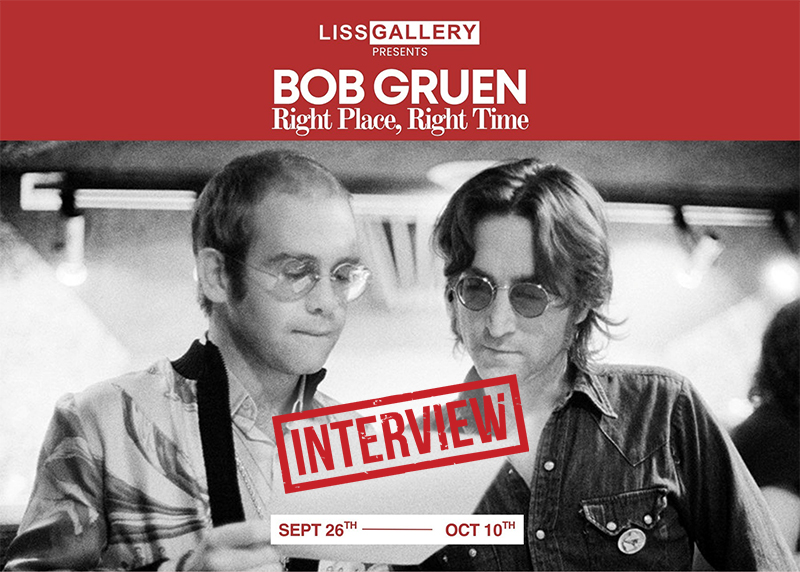
THE STORIES BEHIND THE IMAGES
A CONVERSATION WITH PHOTOGRAPHER BOB GRUEN
If you are a record collector, I guarantee that you have several albums with the name Bob Gruen on it. Bob Gruen has been taking iconic photos of rock and music stars since the 1960s. He garnered attention with his original and thrilling photo of Tina Turner in 1970. Since then, he has aimed his camera at Bob Dylan, Alice Cooper, The Rolling Stones, The Sex Pistols, Chuck Berry, Blondie, Deborah Harry, Kiss, Led Zeppelin, Ozzy Osbourne, The Ramones and many more. He is also responsible for that photo of John Lennon wearing the New York City T-shirt. In other words, he has photographed the history of rock ‘n’ roll since 1970.
He is coming back to Toronto for a new exhibition at the Liss Gallery which opens on September 26, 2026. I recently had the opportunity to speak with him via Zoom about the show and a very brief overview of his incredible career. “It’s different each time,” he said about organizing this new exhibit. “It is really, just what we like. And over time different artists take on different popularities. Some are more popular. It depends on the time. But these are pictures we like and we hope the public will like them.”
Gruen does not need worry. This exhibition at The Liss Gallery is sure to attract many photography and music fans. Gruen has captured some fascinating photos, such as the classic shot of the four members of Led Zeppelin in front of a jet bearing their name.
“That was a very simple thing that took me about 30 seconds. I was invited to go with them on their plane. I think we were going to Pittsburgh, and we were getting on the plane, the journalist I was working with, Lisa Robinson, said ‘let’s take a picture with the plane.’ They just sort of walked over by the wing, and I took a quick picture, and we got the plane and that was that. No one had any idea that was going to be the iconic moment that it was. But it kind of sums up the excess of the 70s. Here are these guys, who don’t even button their shirts, and they have their own airplane.”
And, for the record, not just an airplane. Gruen described the jet in detail for us to enjoy. Just imagine, your entire jet with such comforts as included with the rented plane. Gruen is clear, “they rented it, bands rented, you didn’t own the plane. It is way too expensive to own a plane, most people just rent it.” But this is not your average rental, and how could it be if people like The Rolling Stones, Elton John, and even Alice Cooper rented it. “It was quite an impressive plane,” Gruen explained. “It had first class seats in the front, and a big brass bar in the middle, couches around it, and two bedrooms in the back. One of the bedrooms had an eclectic fireplace. Those were the times when a lot of money was rolling in and people were spending it. By the 1980s, things became more corporate and you had people counting the money and that sort of thing.”
Gruen is equally well known for his wonderful photos of Deborah Harry and of Blondie, such as the famous photo of Harry in front of a roller coaster. Again, this photo came very easily to Gruen. “It was just a moment in a day. There was no stylist, no catering, no makeup or costume people. Debbie was walking across the street, and I took a picture and that was that. You didn’t need a catering truck to take a picture. And Debbie did not need a stylist to look good. She always looked good; she still looks good. Things were a little easier back then. There wasn’t a discussion over every little thing. It was a lot easier to take pictures of bands back then, not every band had a lawyer,” laughed Gruen. “In those days, bands were happy to have their picture taken. They were thrilled to have their photo in a magazine, nowadays, with the internet no one needs it. It is a different landscape than what I experienced.” And that included working with John Lennon and Yoko Ono, including the shots of the Lennons with Mick Jagger. “We were just hanging out,” recalled Gruen. “They just asked me to be there to take pictures, so I did because I could.”
And let’s not forget that famous rooftop shot. “John had called me to come to his apartment, he was still separated from Yoko, and he asked me to come over and take portraits of his face. He had an idea for the Walls and Bridges album cover where he wanted a whole series of pictures of his face, all the same size and they could become flaps that you can fold over, like a little toy. You could change his expression. So, we did that, we did a whole series, and then he said, let’s take some more pictures so we have pictures for the publicity kit. So, we went to the roof. A year earlier, I had given him a shirt that said New York City and I asked him if he still had the shirt. Now, this was the year of the lost weekend, and he was back and forth from Los Angeles, but he still had the shirt, knew right where he was and the fact that he still had it with him I figured he liked. He got a lot of things and not everything stayed with him.
“It still fit him pretty well and we took the photo on the roof. He looks like he was in the middle of a conversation, which he was. The first time it was published was about a month later because he had done an interview with Interview magazine and he had sent it in and they published it full page. So, I knew he liked the photo. It was five years later after he passed away,”
And that day has stayed with him ever since. The world lost a rock icon, Gruen lost a friend.
“I spent time with John the day before he died and took pictures. I was in the darkroom developing those pictures when he died, actually. One of the worst things I ever experienced. Losing a friend like that…suddenly, just the worst call I ever got, and you didn’t ever get over something like that but you do get used to it. And you go on.”
Gruen, unlike some photographers, found the transition from film to the early digital cameras to be an easy move. “It was just changing cameras, and it was easier to work with photoshop than work in a darkroom.” It allowed Gruen to not only keep up with the times but allowed him to continue his work. In talking with him, he does not even have a favourite camera, as he said, “they all take pictures.” But he did start working with a Minolta, which happened to be his father’s camera. “My dad wanted to take great pictures so he bought a Minolta. It was not expensive, but it was better than a point and shoot. He felt if he had a good camera, you would take good pictures. I said, ‘but Dad, you have to set the exposure, set the focus, set the speed of the lens to the speed of the film.’ And he didn’t know what I was talking about. I said ‘if you don’t do those things, you won’t take good pictures. Why don’t I get you a good point and shoot, and you give me that camera.’ And that was the camera I took to Newport and took those photos of Bob Dylan with his electric guitar.”
And that camera led to Gruen being discovered via Tina Turner. “I used that camera to take that multiple exposure picture of Tina Turner when she was dancing under a strobe light. And I got one picture that captured five images and that was the one that really started my career. Tina was dancing with the strobe flashing, and I thought maybe if I open the camera to one second exposure, I can get a few of the flashes and I was at the end of the roll of film. I took about five shots, four of them were useless but one of them fell together perfectly. It shows the power and energy that was Tina Turner. A couple of days later they were playing a theatre in the round in New Jersey, so we went there and brought the pictures to show other friends we were meeting there. When we came out of the theatre my friend noticed Ike Turner was walking from one dressing room to another, and she said ‘show Ike the pictures,’ and I showed him the pictures and he thought they were good pictures and wanted to show them to Tina and he took me in the dressing to show Tina the pictures I was having problems breathing and she liked them and showed them to her publicist who then introduced me to another publicist who talked to a record company and I kept meeting more people.”
“My next book is going to be a Debbie Harry book. We’re just finishing it now. All the pieces are in place. Both Debbie and Chris [Stein, of Blondie and Harry’s one time partner] did extensive interviews for the book. There will be a lot of quotes about events we went to. I have known Debbie for over 50 years now and it is about time I made a book,” Gruen laughed. “You can’t take a bad picture of Debbie Harry. I was lucky enough to see her in many different places, so the book is very interesting and the things she supports. She is very supportive of a lot of charities. And it is nice to have all of her comments throughout the book.”
The artists with whom Gruen has worked, clearly trust him and his judgement behind the camera. Gruen has been able to capture that perfect moment. “I get along with people. I’m like Switzerland. I get along with people. I have taken a lot of photos in the dressing room just before a band goes on stage. A band is like a gang, they are ready to go on, and when they are told they got to go, I ask for 20 seconds. At that moment the band is pumped and ready, you can never reproduce that in a studio…that moment. They are ready to meet the crowd and be a band. I keep it simple. I think because I enjoy the music, I feel the music and so I know what moment is hitting because I want to capture the feeling of what is going on, not just the facts.
In talking with Mr. Gruen, one thing is clear, the stories behind these historic photos are just as important as the images themselves.
Bob Gruen Links


SPILL NEWS: ‘BLONDIE: AGAINST THE ODDS 1974-1982’ OFFICIAL BOX SET ANNOUNCED | PRE-ORDER AVAILABLE NOW

SPILL FEATURE: LET IT ROCK! LET IT ROCK! LET IT ROLL! – A SPILL MAGAZINE BREAKDOWN OF SOME OF THE TOP 2021 CHRISTMAS RELEASES – THE SINGLES + EPS

SPILL NEWS: BLONDIE + HACKATAO PARTNER TO RELEASE CRYPTO ART SERIES “HACK THE BORDERS”

SPILL VIDEO PREMIERE: CAPITOL – “BLONDIE”

