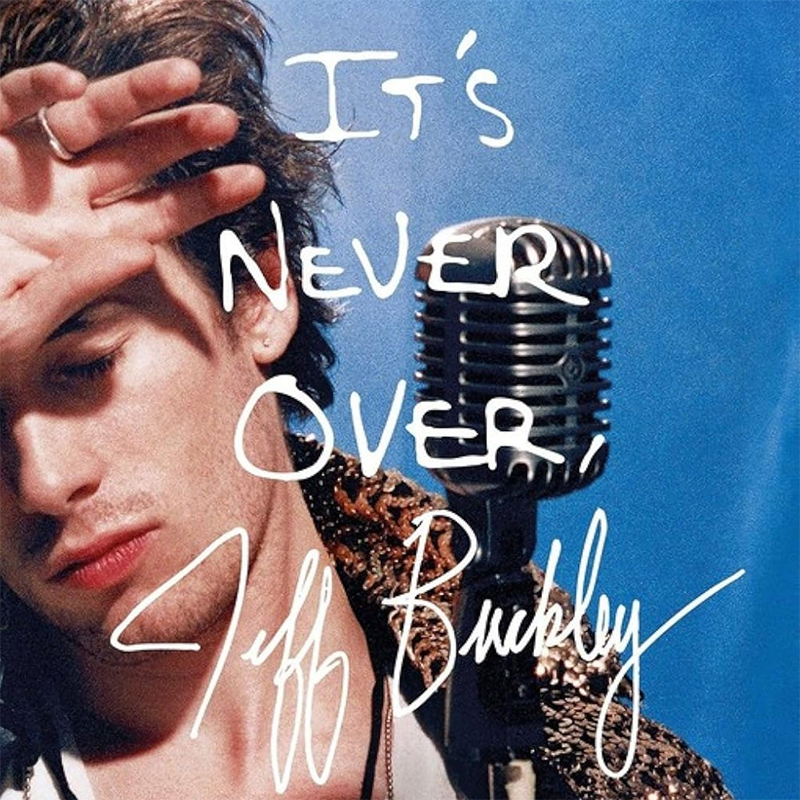
IT’S NEVER OVER, JEFF BUCKLEY
MAGNOLIA PICTURES
AUGUST 8, 2025
“He would be deified by his death, and I would be trivialized…by the work he did and the rabid expectation for me to live or die by it.” ~Jeff Buckley
It was probably late 1998 when a friend first passed along the album Grace to me during a work shift with very little word other than the promise that it would blow me away. She knew my tastes well and so I trusted her word and took the album home and listened to it that very evening. What transpired was almost like a sermon. The sheer magnitude of the man’s voice, the way he placed words so delicately, so romantically, was beyond anything my ears had ever been subject to. I kept replaying certain parts of songs, wondering how he could possibly hit a note so high and sustain it for so long. Listening to that album was almost as exhausting as it was exhilarating. Soon after, I was turned on to the Live from the Bataclan and Live at Sin-é Eps, and again the mind was almost unable to wrap around the fact that this kid had such an insane ability to pull from so many mighty musical ghosts from the past and present while being such an undeniable phenom in his own right, and questioning how he could have possibly died at such a young age doing something as seemingly “harmless” as swimming.
It’s Never Over, the now widely viewed documentary from filmmaker Amy Berg, is a beautiful watch. It tells the tale of a fragile and vulnerable human being who was born with the ripping raging torrent of music in his soul. It paints Jeffrey Scott Buckley as a child born to mother, Mary Guibert, and father, Tim Buckley, 60’s musical troubadour, who left the scene before Jeff was born. The film fleshes out Jeff’s early childhood with an absent father and a very young mother doing her best to raise a child during what were probably unsteady and turbulent times in the world.
Amy Berg does a service to keeping things relatively light as the 106 minutes easily roll by, giving glimpses into Buckley’s most early inklings of being a musical sponge, be it him as a toddler, harmonizing to music on the radio, or as a young boy, laying face down on a speaker while Led Zeppelin loudly pushes out, jiggling his little body through sound vibration.
We hear much about his personal life and personality through the three humans who were among the biggest figures in his life, his mother and the two women who were his most prominent romantic partners, Rebecca Moore and Joan Wasser, both musicians themselves. Through these voices we learn that Buckley was a complicated soul who was bright, witty, romantic (obviously), incredibly talented, but also wounded. A wounded young man who sunk himself into his music as a means of not only letting out what he had within but also rearing up out from the shadow of his father, a task that seemed to unnecessarily haunt him as Jeff was already a force unto his own.
And it’s this haunting, this darkness, that the viewer is generally spared from. It is touched upon, be it the hurt he carried from his father’s absence and premature death or the extreme pressure Buckley put on himself to write another Grace. We hear about erratic behaviour and the typical rock star road stories, but we are spared the substance abuse and spiralling mental health that quite likely was a contributing factor to his untimely death.
But perhaps we the viewer don’t need these gritty details of something we knew but didn’t want to believe. In a world that’s seemingly coming apart at the seams, perhaps a lovely snapshot of a beloved human who touched the lives of both the listener and musical peers alike, is more than enough. He was only human, after all. A beautiful human who held a massive musical torch in his fractured soul, who briefly offered grace in his words and his music.
It’s Never Over, Jeff Buckley is truly a beautiful watch. For the casual listener and diehard fan, this is a glimpse into the spirit of a mystery white boy who rolled in like a storm and went out like candle flame.
Artist Links


SPILL FILM REVIEW: PULP: WHAT DO YOU DO FOR AN ENCORE?

SPILL FILM REVIEW: ANN WILSON – IN MY VOICE (FILM SCREENING AND Q&A WITH ANN WILSON AND DIRECTOR BARBARA HALL)
SPILL FILM REVIEW: POWER TO THE PEOPLE: JOHN & YOKO/PLASTIC ONO BAND WITH ELEPHANT’S MEMORY AND SPECIAL GUESTS – LIVE AT THE ONE TO ONE CONCERT, NEW YORK CITY, 1972
SPILL FILM REVIEW: PAUL McCARTNEY – MAN ON THE RUN