WONDERING WHY HUGE, HUGE MOMENTS FROM THE PAST AREN’T ALWAYS CARRIED WITH YOU IN PERPETUITY
A CONVERSATION WITH KEITH MURRAY OF WE ARE SCIENTISTS
Since the 2000s, one band that you can count on for delivering good quality punky indie-rock dance tunes is We Are Scientists. Tracks like “After Hours,” “Nobody Move, Nobody Get Hurt,” and “Rules Don’t Stop” are absolute gems and bound to make you move on the dance floor with their infectiously anthemic choruses, energetically upbeat instrumentation, charming vocals, and fun vibes. Their newest album, Qualifying Miles, sees them going with a slightly different sound and tackling some themes that they seldom touch upon.
“The way the songwriting worked on this record was that we had written a huge number of songs, and we kind of paused to say, ‘We should probably stop writing and actually make a record right now,’” says frontman Keith Murray. “We went through and noticed that there was a crop of songs that, most importantly, we liked. Also, there was a specific subset of those that touched on similar themes of, not even just nostalgia, but relitigating old issues that don’t really matter. Just wondering why huge, huge moments from the past aren’t always carried with you in perpetuity… I mean, we wrote a bunch of songs that had nothing to do with that idea. But I think a difference on Qualifying Miles is that we thought it was sort of interesting to collect the songs that at least even marginally touched upon that and make an album that holistically is at least an umbrella theme to a bunch of songs that approach it in different ways.”
This nostalgia factor is a main reason why Qualifying Miles has such a ‘90s feel to it. “The idea of nostalgia retroactively informed the way we approached the recording of the record,” comments Murray. “We decided to make the record feel like a little more of the albums of our youth that we were listening to when we were the characters that are depicted in these songs.”
One way We Are Scientists leaned into the ‘90s sound is the addition of many dope guitar solos, such as in “At The Mall In My Dreams.” “An idea we had for the record was that we wanted a lot of guitar solos, which is a very nostalgic element,” shares Murray. “I kind of feel like the guitar solo is coming back a little bit now. Bands like Turnstile and Wolf Alice will have guitar solos.”
Additionally, The Smashing Pumpkins, one of the most popular bands of the ‘90s, were a significant influence on Murray when he created “Starry-Eyed”. “I definitely, very specifically, was thinking of The Smashing Pumpkins when I wrote that song,” states Murray. “I don’t think it really sounds like The Smashing Pumpkins, but it’s sort of the mix of like the verses kind of feel like the Gish era of The Smashing Pumpkins, like really spacey and notey guitar and really open, loopy vibe. The choruses are very Siamese Dream Smashing Pumpkins with really tight and really loud fuzzed-out guitars.”
Another example of We Are Scientists embracing a ‘90s sound is in “The Big One.” Similar to the alternative rock and grunge scene of the ‘90s, “The Big One” utilizes the iconic loud/quiet dynamics. “Part of the ‘90s format of rock, ushered in by the Pixies and then really exploited by bands like Nirvana or The Smashing Pumpkins, was the famous quiet verse and super loud chorus, and we were pointedly wanting to play with that,” reflects Murray. “There’s a little more Jimmy Eat World feeling to me on the verses. But I definitely did not want to make an emo song. I guess the approach I brought to it was ‘What if Pavement were performing a Jimmy Eat World song?’”
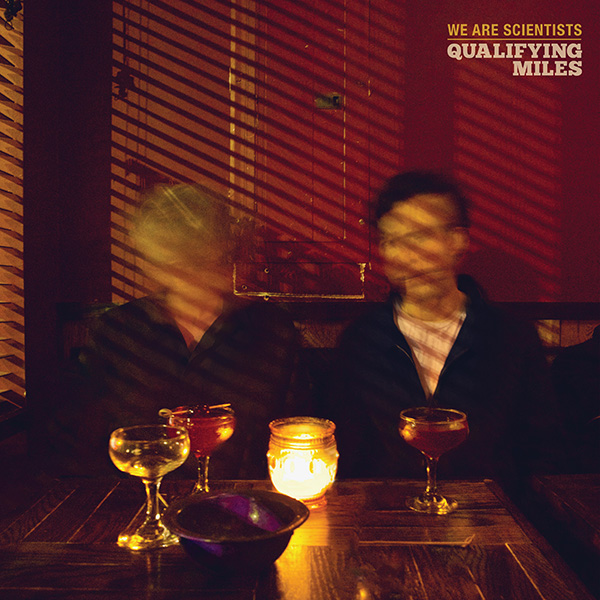
PURCHASE QUALIFYING MILES VIA BANDCAMP
Even ‘90s movies influenced the record, such as Noah Baumbach’s directorial debut, Kicking And Screaming, partially inspiring “The Big One.” “Two of the main characters are a couple who have broken up because she goes away to a writing program in Prague, and a conversation that they’re having at the very beginning of the movie is that each of them is always like cannibalising their arguments for their stories,” shares Murray. “I think about that moment a lot, just in general when I’m writing songs. Thinking about stealing bits of my own life to put it into a song, and whether or not that feels very good to do, but it is just how I approach songwriting.”
However, not all songs fit into the ‘90s aesthetic, most notably “Please Don’t Say It”. “It’s a quintessential We Are Scientists song,” says Murray. “We are always wanting to write dancey synth-driven tunes. I think ‘Please Don’t Say It’ would have fit very well on our last record, Lobes. Part of the reason it was our first single, I think, is that it acts as a pretty good bridge between our last album and this record.”
We Are Scientists decided to open the record with “A Prelude To What” after a conversation they had with a friend sparked them to do something different. “We were talking about another band’s record, and he had complained that they began their record with a fairly boring version of their usual style,” recalls Murray. “His opinion on that conversation was, ‘I think, the first song on a record should do either one of two things: be the best version of the thing people expect from you or be a curveball.’ We’re like, ‘Oh, that’s interesting.’ We’d rather do the curveball and have people a little confused or aware that the thing we’re doing isn’t just going to be normal We Are Scientists. Then make the next couple of songs big pop singles that follow up. I like the idea of starting out the record with a declaration of intent, even if we don’t necessarily follow through with that declaration.”
Another unexpected moment is the saxophone solo in “I Already Hate This”, which replaced a guitar solo. “The song slows down and gets really quiet and loses its propulsion, so the guitar was just noodling,” says Murray. We Are Scientists were inspired to add the saxophone solo after going on tour to celebrate Brain Thrust Mastery being rereleased on vinyl, as the song “That’s What Counts” features a saxophone solo by Kamasi Washington. “The friend who we had playing keyboards on the tour was like, ‘You know what, I played saxophone in high school. I haven’t played it since then. Do you want me to try playing that saxophone solo?” adds Murray. “We are like, ‘That seems insane, but yeah, if you want to try.’ He learned the saxophone solo and played it every night on tour, and that was right around when we were finishing Qualifying Miles. We’re like, ‘There are many guitar solos on this record, it would be cool if we swapped it out on this already pretty jazzy spacey moment and just added an instrument that people would not be anticipating.’”
Qualifying Miles dropped on July 18. “It’s not a coincidence that it’s coming at the same time we’re being forced to look back at We Are Scientists’ career,” reflects Murray. This year marks the 20th anniversary of their debut record, With Love And Squalor. Last year, it was the 10th anniversary of their fourth album, TV En Français and their second album, Brain Thrust Mastery, was rereleased on vinyl. “In the past year or so, we spent a lot of time looking back and taking stock. I don’t generally traffic in nostalgia; I don’t think of 20 years ago as being the good ol’ days. We are a very forward-thinking band and always just want to do the next thing, but I think it’s interesting to take this time to, for once, look back and be like, ‘What does that mean right now?’”
We Are Scientists are embarking on a North American tour to promote Qualifying Miles. They are very excited to play their new songs to fans, as they have been really enjoying playing them. If you want a good night of indie rock music, be sure to see one of their shows. “Normally, when a new record comes out, we’ll play four songs from it, but we just really enjoyed playing these songs so much that we kind of don’t want to stop playing them, so I think we’re gonna play a lot of songs on this new record,” smiles Murray.
Artist Links


Photo Credit: Sari Murray


SPILL FEATURE: 30 YEARS OF HEMI-VISION – A CONVERSATION WITH GORDIE JOHNSON OF BIG SUGAR

SPILL FEATURE: GENERATIONS LATER: FOUR DECADES OF UNSTOPPABLE RHYTHM AND LEGACY – A CONVERSATION WITH PHILIP OAKEY OF THE HUMAN LEAGUE

SPILL FEATURE: KISS OR KILL ME TONIGHT – A CONVERSATION WITH MICHAEL DES BARRES

SPILL FEATURE: BEATIN’ LIKE A DRUM – A CONVERSATION WITH MARC JORDAN