THE FREEDOM TO EXPLORE CRAZY RECORDING STUFF
A CONVERSATION WITH ASHER CASE AND ISAAC LOWENSTEIN OF LIFEGUARD
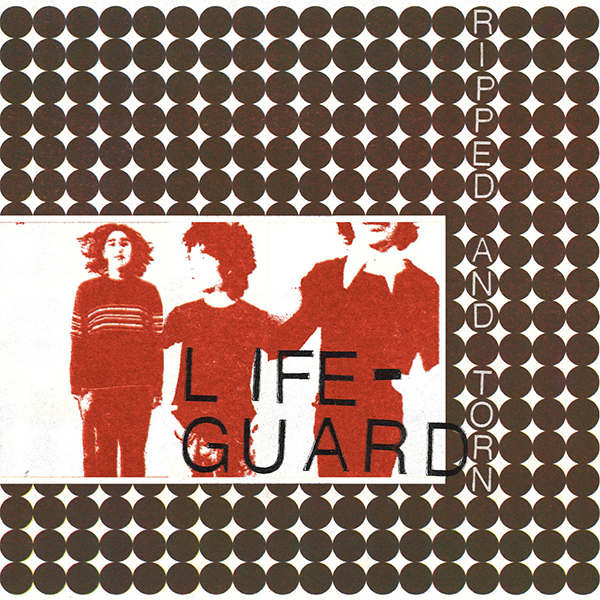
Lifeguard, the Chicago rock trio consisting of Asher Case, Isaac Lowenstein, and Kai Slater, is one of the most exciting new bands. With a fiery combination of thrashing intensity, a gritty punk attitude, explosively noisy, howling instrumentation, and earworm choruses and hooks, Lifeguard’s music is super electrifying to listen to. Plus, they have made a name for themselves with their thrillingly energetic live shows. Their debut album, Ripped And Torn, is one of the best garage punk records of the year. Recently, I chatted with Case and Lowenstein about Lifeguard’s new record.
Ripped And Torn marks a new direction for Lifeguard. “One of the primary things for me was getting very experimental and involved in the recording process in that, like, for both EPs, we had Mike Lust do them, and we were all very interested in getting a very accurate and documentarian vibe of capturing what our live sound sounded like,” says Lowenstein. “One of the large creative statements in the record is that it doesn’t sound like the live show and that there are things you just can’t recreate, and it won’t sound like the live show ever. That, I think, gave us the freedom to explore crazy recording stuff – using lots of echoes, embracing the tapey quality, and introducing all kinds of crazy percussion, organs, and synthesizers.”
The experimental songs, like “Music For 3 Drums”, originated from Lifeguard’s live shows. “When we were playing shows and writing the record, we would do these longer experimental breaks where we had some of the parts that ended up being collaged into what became those songs like “Music For Three Drums” in a way that that served us in a live setting that we really liked,” shares Case. “We were trying to figure out how to communicate that into the record without having this 10-min long, super abrasive and noisy thing that made people want to stop listening to it. We broke it up into the ‘best of the best’ in terms of the amount we recorded of the experimental stuff, and then that became refined to those three tracks that are on the record.”
Despite being more experimental than their EPs, Ripped And Torn still features plenty of chaotically wild and aggressively harsh noisy garage punk tunes with in-your-face energy, as seen in the opening two songs, “A Tightwire” and “It Will Get Worse”. “Once we placed ‘A Tightwire’ in there and then put ‘It Will Get Worse’ right after things clearly worked out like ‘This is what the record deserves,’” comments Lowenstein. “What better way to start the record with what this record really is, which is this sonic attack at the start.”
Additionally, Ripped And Torn sees Lifeguard writing shorter songs than previous records. “For the past few releases for us, I feel like we would always lean to more drawn-out five-minute songs or eight-minute songs,” comments Lowenstein. “We fell in love with the idea of these like really tight and concise garage songs and obviously trying to throw our own spin on it, really sort of doing, I think, like a raw pop energy that you can imagine a crowd responding really well to or some sing-along aspect through the chaos that I think that is really easy to fall in love with.”
One of the best examples of this is “(I Wanna) Break Out”, an intense, short, hardcore song that hits the listener with full force, thanks to its chaotic energy and wild instrumentation. Unlike other tracks, it never lets up, as Lifeguard goes all in for the entire runtime, resulting in kinetically thunderous sonic mayhem. “I remember talking about just wanting to write a hardcore song,” reflects Lowenstein. “We loved the idea of a less than two-minute song. It’s always been our dream to try and smash a song into that little length… No filler – just pure fun all the way through.”
RIPPED AND TORN ALBUM REVIEW
Throughout the record, there are many anthemic, catchy sing-along parts, such as “Under Your Reach”, which has melodic vocal harmonies between Case and Slater. “It just made sense to do that, and me and Kai were getting more comfortable with it and like how it turned out,” says Case. “The thing about ‘Under Your Reach’ is it’s pretty consistent the whole time like the whole part is a harmony, so it’s hard to tell which one is the main line, and which one is not the main line. I think it’s an interesting way to use doubling vocals.”
With “Under You Reach” Lifeguard is also exploring dub elements, especially in the intro. “We started with the intro as like ‘How can we set the mood for the rest of this,’” explains Lowenstein. “That noise over the whole thing is this synthesizer called the Arturia MicroFreak that I integrated next to my kit. I think we actually started with that noise. We all started jamming over that… That intro clearly has the dub influence. There are echoes all over it, and it’s pretty spacey. But I think we didn’t exactly know that the rest of this song should have had those kinds of effects and mood throughout the rest of it. I think initially, as we wrote it that the rest of the track would be a switch to something else, this kind of like tight poppy dance song, but then in the studio, it turned out like, ‘Oh, why don’t we keep all these spacey effects just hopping in through that.’”
Another super catchy tune that is sure to get the crowd going at live shows is “It Will Get Worse.” “We were trying to use more distinct beats that were recognizable with more historical punk music or like more in line with our influences where we weren’t trying to overcomplicate it or make it something entirely original,” comments Case. “The vocal part of the chorus was written completely during soundcheck before a show, and then the instrumental for the chorus took so long to figure out. There were so many different versions of it.”
They tried a half-time version of the chorus, but it didn’t work out. “I feel like it was all my problem like Asher and Kai had it locked down,” remarks Lowenstein. “I would try keeping that double-time rhythm, and we tried half-time stuff, and then it sounded like Blink-182, and it was like, ‘Fuck. No. This isn’t what this is.’ I think we just needed to strip it down to the barest kick drum, and then that just sort of little snare bit.”
Most of Ripped And Torn is a combination of noise rock, garage rock, and punk. “That music is just what makes me want to dance, whether it’s seeing it live or putting on a record at home,” comments Case. “When I approach making music with other people, that’s what I’m trying to achieve as well. Most of the time, I think the three of us have a pretty locked sense of getting to that point with each other.”
“Like You’ll Lose” is the perfect example of a danceable song, with its hazy ‘80s post-punk feel, frantic guitars, moody atmosphere, rhythmic bass, and the dreamy vocals. “Instrumentally, that song is pretty ‘80s in the sense that I think it’s very post-punk and very dub-influenced punk music because it’s slowed down, obviously dubbed out, and the bass line is really constant throughout,” states Case. “You don’t really get a chorus until the second half of the song. Then it goes back and turns around and does this dance break thing… The way that the guitar sits is that its job is not really to make chords. It’s more to be serving as a texture element, I think, much like the electronics that are happening and the dubbing out. I also think with the lyrics I am pretty inspired by ‘80s dreamy lyrics like The Stranglers or ‘80s pop stuff that is really melodic but also low key and can sit nicely within music that is both dubby and post-punky but also very different from that.”
Lifeguard loves how Ripped And Torn turned out. “I feel really proud of it in a way I haven’t been proud of records we have made in the past,” smiles Case.
“Being involved in like every step of this means that you get really attached to what has been my baby for a year now,” adds Lowenstein. “It’s been really meaningful to spend all this time on something, to sit on it for so long, and to really feel like I’ve been in it for every step of the process.”
Artist Links


Photo Credit: Grace Conrad

SPILL FEATURE: 30 YEARS OF HEMI-VISION – A CONVERSATION WITH GORDIE JOHNSON OF BIG SUGAR

SPILL FEATURE: GENERATIONS LATER: FOUR DECADES OF UNSTOPPABLE RHYTHM AND LEGACY – A CONVERSATION WITH PHILIP OAKEY OF THE HUMAN LEAGUE

SPILL FEATURE: KISS OR KILL ME TONIGHT – A CONVERSATION WITH MICHAEL DES BARRES

SPILL FEATURE: BEATIN’ LIKE A DRUM – A CONVERSATION WITH MARC JORDAN