
BEATIN’ LIKE A DRUM
A CONVERSATION WITH MARC JORDAN
Marc Jordan is a legend in the world of music. Born in Brooklyn but raised in Toronto, Marc Jordan has had an incredibly successful career as a singer/songwriter. Besides having his own hit singles (“Survival,” “Marina Del Rey,” “I’m A Camera,” “New York City,” to name just a few) and hit albums (Waiting For The Sun To Rise, Mannequin, This Is How Men Cry, COW, and Blue Desert, for example ), he has also written huge hits for artists such as Rod Stewart (he wrote one Stewart’s biggest hits, “Rhythm Of My Heart”) , Cher, Josh Groban, Chicago, Kansas, and so many other artists. He has even written songs for his wife, Amy Sky. Although he is known for his incredible music and talent, what is not known is his fascinating life story.
Thankfully, he has told his story to songwriter and author Don Breithaupt, and his authorized biography, Rhythm of My Heart: The Authorized Biography of Marc Jordan is now available. Some may be surprised that Jordan didn’t write the book himself. “Well, I am dyslexic,” Jordan states. “I find it hard…I can write a song because it is a vision. I write visually. I find it hard to organize in a linear way. So, Don is a friend, and I have worked with him, and he offered to help me. He is such a good writer. I was a bit reluctant to do it, and I didn’t know whether I had the time or skill to do it.”
Jordan clarified it further with his skill as a songwriter being different from writing a memoir. “My inspiration comes in short tightly knit visions and packages, so a pop song is a perfect thing for me.” Jordan worked closely with Breithaupt to come up with a biography that did not pull any punches.
“Well, there’s no point in having a book if you are going to bullshit,” laughed Jordan. “It was kind of cathartic in a way. It actually helped me. I never really had gone through my life like that, in a linear way and looked at the patterns. It was very organized the way Don did it and it helped me see my own journey. It was wonderful. We went up to my cottage. We sat on the dock for days and we went over things. I talked to him, and he recorded me. Rather than write about my life, it is easier for me to talk about it, because I can see it. It goes away when I write it.”
Throughout the book, Jordan discusses his challenges, some of which came from his family. From his mother openly criticizing his debut album (“that’s no good,” Jordan remembered her saying) to his father coming to Canada because he was a self-declared communist, which was not widely accepted in post-war America. Both of his parents were musical, with his father having had a successful career in his own right.
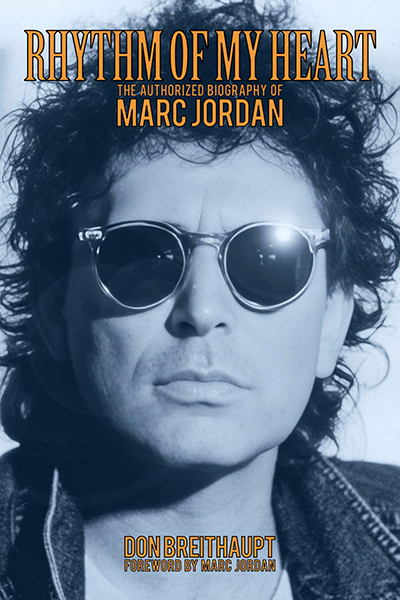
PURCHASE RHYTHM OF MY HEART: THE AUTHORIZED BIOGRAPHY OF MARC JORDAN VIA AMAZON
“My dad was not a songwriter, he was a singer. In those days, before Bob Dylan, singers did not write songs. My dad moved when I was three, I think we lived all over the place. Living on the farm in Bowmanville was formative for me, I have always loved the country. I learned to ride our neighbour’s horse, and I drove a tractor with my brother. It was a magical time for me and then we moved back to Toronto. The downward slide began,” laughed Jordan.
Before embarking on a career as a singer/songwriter, Jordan tried his hand at the Toronto stage and auditioned for the play Hair.
“I knew I wanted to do something, and Hair was so amazing, that musical. It was about my generation, so I auditioned and became an understudy and learned about four or five parts. It was crazy.”
All the while, Jordan was developing his own skill as a singer/songwriter, which led to the huge move from Toronto to Los Angeles.
“Somehow, someone had heard about me, because I used to do clubs in Toronto. I played the El Mocambo and all those places. The A & R guys would look to where the lineups were in the clubs and go in and see if they liked it. Somehow Marty Cohen heard about me. He was a talent scout for Warner Brothers, called ‘talent scouts’ in those days. He flew to Toronto, saw me and told Mo Ostin (head of Warner Brothers at the time) to sign me.”
Warner Brothers did sign Jordan, and his debut album, Mannequin was released in 1978.
“The thing that really changed me was when I was about 13, my mother bought me a radio and I ran a wire from the antenna, and I attached it to the drainpipe of our house, and I could get friggin’ Mars on that radio. I got big band concerts from New York, live, if there was a storm. I would get Maine, if there was a storm in Cincinnati, I would get the gospel hour in Louisiana. I heard music that they did not play up here in Canada. I heard Black music, R&B, and church music, it was formative for me. I heard Sam Cooke for the first time, and I was mesmerized by him. If you think about it, I would say Rod Stewart was influenced by Sam Cooke too.”
And all these sounds came together for Jordan, who connected with the music. And he was equally influenced by the debut of Bob Dylan. “That was another thing, another moment. Because up to that point, singers did not write their own songs. But Bob Dylan wrote his own songs, recorded them and had hits. Although he is not a great singer, he was an amazing poet and wordsmith and songwriter. He is a genius. So, the singer/songwriter thing took off. And I knew I could write songs…or think them up,” chuckled Jordan. “I couldn’t write them down. And I could sing, so I learned to play the guitar. I bought a guitar in a pawn shop and I learned to play.”
All of this led to one of his biggest songs, “Rhythm Of My Heart” recorded by Rod Stewart.

“My father was a classical singer, and he also loved folk songs. In fact, he did a record, when he was older, called Folk Songs Of Canada. And I also heard the early Alan Lomax stuff, where he would go into a little motel room and record somebody on a small tape deck, with a cheesy microphone. And I loved Pete Seeger. My dad was a communist, and he loved Pete Seeger. We had that around the house. I had everything from classical music to Bob Dylan. And my father also said a great thing to me, “if you really want to sing lyrics, listen to how women sing…they sing differently than men”. And he was right.”
And later in the book, Jordan is very open about his dyslexia.
“I didn’t know what it was. I only figured it out in my 30s. I didn’t know, there was no name when I was growing up. It was hard but it was my superpower as well. Because, if I was a good reader, I would probably be a lawyer, or something like that. But it was because…I had a record, Talking Through Pictures, in the mid-1980s. That is what I did. I saw the world, I didn’t learn about the world, I observed it, and that is what I wrote about. I saw the poetry of life and I wrote it down.”
Equally interesting is that, although several recording artists have had hits of songs written by Marc Jordan, he did not write specifically for any singers.
“I never write for anybody. Except, Rod Stewart does send me tracks, and I write stuff for him, but I never write for a person. My publisher was very smart and knew I could not write for people. If Diana Ross needed a song, I could not write a Diana Ross song. But Diana Ross recorded one of my songs. All I could do was to write songs that were some way true to something in my life. I thought, if I am feeling that, or seeing that, other people are too. I am not unique, or different…I am just a person and looking at the world. Everybody else is doing the same thing, I was just able to write it down.”
“Melody is lyrics. The melody has to say the same thing as the words. So, in L.A., guys would get a track and write a lyric over it, but the melody and lyric have to be one thing. If the melody is not saying the same thing as the words, the song goes away or it dissipates, because it is not as powerful. But because I was used to not doing things normally, I was able to just do it and feel it, rather than understand it.”
And thankfully, he has felt a great many songs. Rhythm of My Heart: The Authorized Biography of Marc Jordan is an open, honest account of a talented artist who has contributed so much to the music world. The book takes the reader everywhere (including the odd coincidences with his then future wife Amy Sky) and provides an insight into this talented individual, who not only survived but became one of the most successful songwriters of the rock era.
MARC JORDAN: RHYTHM OF MY HEART BOOK LAUNCH | APRIL 19, 2026 @ HUGH’S ROOM | TICKETS AVAILABLE HERE
Artist Links


Photo Credits: Marc Lostracco


SPILL FEATURE: CELTIC MUSIC IS SO MALLEABLE, YOU CAN DO REALLY ANYTHING WITH IT – A CONVERSATION WITH IRISH MILLIE

SPILL FEATURE: A MOMENT TO REFLECT ON THE PAST FOUR YEARS – A CONVERSATION WITH AYSANABEE

SPILL FEATURE: TWENTY YEARS OF BIRTHING THE GIANT – A CONVERSATION WITH CANCER BATS’ LIAM CORMIER

SPILL FEATURE: PICK UP THE PHONE – A CONVERSATION WITH JACOB TSAFATINOS AND DAVID WOOD OF GOOD KID