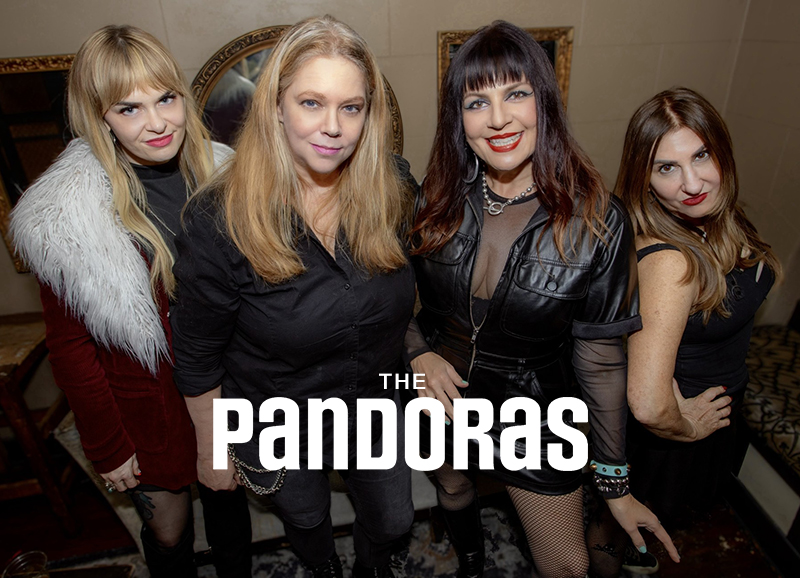
WE ARE A BAND, NOT A GIRL BAND
A CONVERSATION WITH KAREN BLANKFELD & MELANIE VAMMEN OF THE PANDORAS
The Pandoras burst on the garage/punk scene of Los Angeles in 1981. Within three years they had recorded their debut album (It’s About Time) which firmly established them in the scene in L.A. However, the band never really fit into one genre or crowd. They incorporated pop music with punk and mixed in garage rock with power pop. This all came together with their second long player, Stop Pretending, produced by the very respected Bill Inglot. That album changed everything for the band. They were not just part of the scene, they were forging their own path.
“We did a lot of preproduction before and remember doing the preproduction, and I have cassette tapes of the preproduction,” said Melanie Vammen, during our recent conversation. “Do you? I want to hear them,” added Karen Blankfeld. Vammen added “we picked songs from the tapes and then we just did our thing. There weren’t a lot of changes.”
And through the recording and mixing they were able to meet Chick Corea, although perhaps not in the way they had hoped.
Vammen said, “I remember one thing, the mixing and the ending parts were done at Chick Corea’s studio in L.A., called Mad Hatters. Bill [Inglot] really wanted me to play piano on “Stop Pretending” [“on the bridge” helped Blankfeld]. “The piano was Chick Corea’s.”
“I have a Chick Corea story,” said Blankfeld. “Chick Corea’s studio, upstairs, is where the big studio is for mixing and recording and downstairs, he has rooms where he can go and work on stuff, his keyboard set-up. We were upstairs in the lounge area. We were watching TV and being loud and obnoxious [“and playing strip poker” added Vammen]. Yes, and playing strip poker and he apparently complained about us, and we got in trouble from Chick Corea for being obnoxious and loud. I guess he was trying to write music or something.”
Karen Blankfeld was the original drummer for the band and was on Stop Pretending. Melanie Vammen played keyboards, and both provided vocals. The Pandoras were very big on harmonies. The remaining two members of the band at the time were Paula Pierce (lead vocals, guitar) and Kim Shattuck (bass, vocals). Sadly, Pierce and Shattuck are no longer with us [Shattuck passed away in 2019 from complications of ALS, Pierce passed away in 1991 from a fatal aneurysm).
The four members of the band had written and worked on the songs long before they went into the studio and so, the basic recording went quickly, and this is why the album has a definite live sound to it.
“We recorded the songs how we played them,” said Blankfeld. “There are some double tracked guitars and a few overdubs, but the raw bits are there. Drums, bass, guitars, vocals and backing vocals. There is not much of a stretch from the record and how we sound live.”
And when we recorded it,” added Vammen. “We recorded it at Crystal Sound, and Bill Inglot said we were going in after hours, like at midnight and we stayed up for 24 hours. Karen was a good girl and had a sleep, but we did it. We had to record for 24 hours straight, all the basic tracks, so they are done live. We did it man!”
“We did it after hours because we got a better rate. Crystal Sound Studios is where Stevie Wonder recorded Songs in The Key of Life,” added Blankfeld. And Crystal Sound Studios used to be a post office. The cool thing is we borrowed Sid Griffin’s amp, Vox AC30. That is the sound of Paula’s rhythm guitar for the entire record. The amp was put out in the hallway, just outside the door. The hallway was of the post office, basically, with the hard floors. Still the remnants of the post office. The amp was put out there, and we were scared because it was out there, not in an isolated area and we were recording late at night, and we worried that the neighbours would complain. But no one complained.”
Thankfully Chick Corea did not live next door.
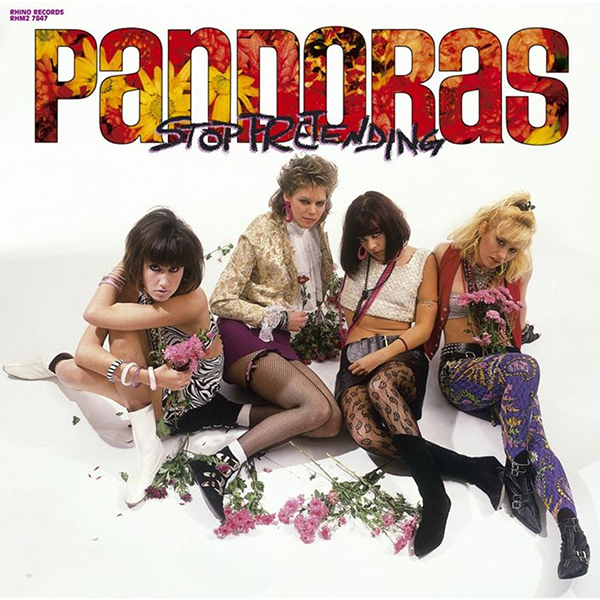
PURCHASE THE PANDORAS – STOP PRETENDING (40th ANNIVERSARY DELUXE EDITION)
The band acknowledged their 1960s garage rock roots, but there was and is a lot more to The Pandoras.
“We just did our thing, and you can hear that Stratocaster guitar with the Vox AC30, and that is the sound of Paula on that record,” said Blankfeld. “It is a really cool sound.”
“We were part of the 60s garage scene, but we broke away from that. We did our own thing, and I feel like The Pandoras never really fit in with other people. We were just us, we did our thing, which I think personally was cool,” said Vammen.
“The band started out as pure garage but then by Stop Pretending we threw in some pop and power pop into the mix.
“Paula really got into Madonna at the time. So, the songs are garage/punk but they are very melodic,” pointed out Vammen. “Paula was an amazing pop songwriter, and she really got into Madonna. It was a no-no. But you can’t be stuck in one genre. We were listening to a lot of influences, but we were still 60s.
And the band really worked hard with the album. They put in a lot of hours recording and touring.
“It is so exciting that this record is coming back out,” said Vammen. “It is unreal. This is actually happening again. And at the time, we had the same feeling. Recording it was such a big deal. KROQ played it, and a lot of college and university stations. A lot of college radio. And we toured right when it came out, we toured three months and then came back and we were back on tour again.
“We were on the road a long time,” agreed Vammen.
“I never felt being in an all-girl band was an advantage or disadvantage,” said Blankfeld. “I just felt that we were just a band. I am not a female musician, I am a musician. We are a band, not a girl band. We are a garage band.
“You can look at old interviews of Paula, and she says the same thing,” Vammen added. “I personally don’t think we ever treated differently because we were women. We got signed to a major label; we did a lot of things through all these years. And here we are now. We are with Wicked Cool Records, who we absolutely love. I agree with Karen, there was no difference, we would get up and rock and do our thing. Not because we were girls or whatever.”
“And another thing,” added Blankfeld. “Guys are never labeled as an all-male band. Maybe it was a novelty back then because we were all girls and people like to see girls on stage and dressed up. But we were just a band, we were just a band. Having fun.”
“I think they will get the essence of who we were and who we are. The music has not dated, and it still sounds fresh because we didn’t use dated reverbs or drum sounds. We recorded it raw, with a slight bit of polish. I just want people to sit and enjoy it. We thought very much about the order of the songs, what songs were going to be on it. It was curated by us to reflect what we thought was the essence of the band.
“When we play live, it is us, we sound like us,” said Vammen. “We still sound the same. I know Paula isn’t here anymore or Kim, but I feel we are still us. It is never going to go away.
Artist Links


Photos Credits: Greg Gutbezahl


SPILL FEATURE: IT GIVES ME PURPOSE AND I LOVE IT – A CONVERSATION WITH KIM MITCHELL
SPILL FEATURE: BILL NEEDS TO FINISH HIS SONGS! – A CONVERSATION WITH MILO AUKERMAN OF THE DESCENDENTS
SPILL FEATURE: STEVEN’S GREETINGS – A CONVERSATION WITH STEVEN PAGE

SPILL FEATURE: LEARNING TO STAND IN THE DARK – A CONVERSATION WITH CHANEY CRABB OF ENTHEOS