THE QUIET POWER OF ROARING WAVES
A CONVERSATION WITH STEVE HACKETT & STEVE ROTHERY
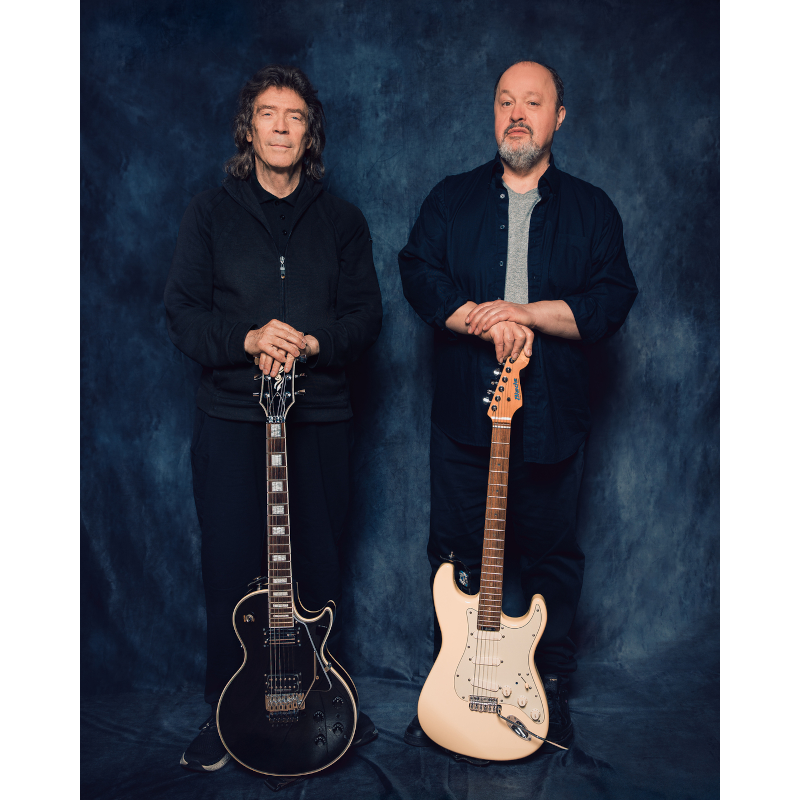
The Roaring Waves is an incredible album from Steve Hackett (one time guitarist for Genesis but solo since 1977) and Steve Rothery (guitarist for Marillion, who has also carved out his own distinct solo career). The long-time friends have finally come together to record a thematic, instrumental album that reflects their talent and ability to create so much art while remaining somewhat minimal. Recently, I had the opportunity to speak with both of them via Zoom, to talk about the new album, their friendship, and life by the sea.
“We were pals already. And we had joined each other on stage in different ways, with our respective bands. It just seemed like a natural thing to do,” recalled Hackett. “We got together to break bread, shared ideas, and we were talking about the idea of the two of us doing something. And we were thinking ‘should we involve another guitarist named Steve as well and have three Steves. But we ended up with two. I think it was best this way. I think two people can have a conversation as we did musically, three to have an argument and more you are in a band.
“I think you’re right,” agreed Rothery.
“I know I’m right. With a band, you have an argument, even the great bands. That’s the way it goes. We have a duo here. We were joined by Steve’s friend and collaborator Riccardo Romano and that was very important because he helped to gel everything. So, two guitars, plus a keyboard, can’t go wrong. Plus, we replaced things that were chained up so we could play along with them and replaced them with real stuff. Real musicians. A couple of drummers and I think it worked very well. I think less is more, certainly less in personnel. It makes things much easier, especially with room to move.”
Rothery was on board. “It was the perfect amount of creativeness between the two of us, without getting a third party involved.”
The Roaring Waves is a project that has taken some time for the duo to put together. “Four of the seven songs came from the two-day session at The Racquet Club, the Marillion studio back in 2019,” said Rothery. “It was obvious that once we started working together and we were relaxed and in the zone, there was a great natural chemistry between us. It was like finishing each other’s musical sentences. We had enough in common to have a common vocabulary, but we were different enough…Steve a more classical influence and me a folk influence, but in combination we weren’t fighting each other. It was a lovely musical conversation between two friends. I don’t recall any other album I have made that was quite so effortless in many ways. When Ricardo came on board, he just brought out the best in what each of us did. He is a fantastic engineer, programmer and he played bass on most of the album. All round amazing find, really. But ultimately, it came down to Steve and I understanding each other and because we are friends we could concentrate on trying to paint amazing pictures with the music. It was not a competition. We didn’t get into the fastest gun in the west, nonsense shred fest,” both Steves laughed.
“A bit of that is ok, every now and again,” added Rothery. “But for me, the music is as much about the space you leave around the notes as well as the ability to play.”
Although the album is instrumental, it is a very visual album. An album that can be described as aural paintings.
“We jammed the initial ideas together and then we would take it away and develop them. Steve did a lot of work with Riccardo in his studio and I did a lot of work in my studio here at home. It is like doing a charcoal drawing, an outline of an amazing scene you want to create, and gradually you go in and fill out the details, giving it colours and textures until it finishes up a masterpiece,” said Rothery.
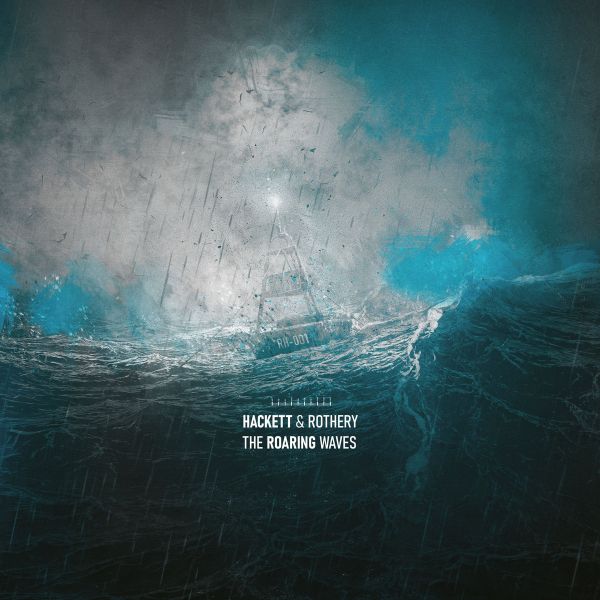
THE ROARING WAVES ALBUM REVIEW
“Yes, a masterpiece,” laughed Hackett. “But this was very influenced by film music and by ambient, whatever you want to call it. I think of tone poems, in classical terms. Much like Fleetwood Mac’s “Albatross.” It is nothing like anything we have on this album, but the fact that they were prepared to do something like a painting or a film. A film for the ear, rather than the eye.”
Interestingly, the choice of instruments had a large impact on the music as well.
“The character of the music came from the instruments themselves,” Hackett discussed. “The fact that we both enjoy sustained notes and lovers of different types of guitars. I very much enjoyed working with Fernandes guitars, which I used on most of the album. The Fernandes allows you to sustain and take your time with things, much like an EBow.”
“I caught the bug from Steve, really,” added Rothery. “The amazing results he got from using the sustain, so I bought one I have actually used on the new Marillion album. A lovely guitar. I also have a Les Paul one, and a super Strat. I haven’t tried the Strat yet, it has only just arrived.”
Even though The Roaring Waves is an instrumental album, it is deeply personal to both artists. Rothery, who grew up near the sea, certainly drew upon his childhood and life for the album.
“Looking back, I had a rather strange childhood. I was living in South Yorkshire in a mining area. My grandfather was a miner who also played the banjo and was a keen photographer, so it skipped a generation. We moved from there when I was about six, my parents separated, and we moved to a tiny village called Newham, just two and half miles outside of Whitby. But a beautiful place, like something out of a child’s story. However, quite isolated, we didn’t have a car, so when you had to walk anywhere it was a two and half mile walk through some very steep hills. But the great thing about it was that it was a mile and a half walk across the fields down to the beach and that is my enduring memory of being a child, walking that walk to Sandsend, which is one of the tracks on The Roaring Waves. Then, when I was 11, moving into the town, Whitby, such a horrible contrast at the time because it was a Victorian townhouse and it felt a million miles away from the countryside, which I had grown up in. But Whitby is a very powerful and provocative place, full of history and tales of the ocean. Captain Cook sailing from there to discover half the world, or Dracula landing there in Bram Stoker’s novel. All these myths and legends around Whitby. It gave me a lot of powerful imagery to draw upon at times. We just developed these ideas in such an unusual way, from initial jams to defining the shapes of the songs.”
This includes Hackett playing harmonica in the last track of the album, a song titled “Pacific Coast Highway”.
“It’s a funny thing, the harmonica was my first instrument,” recalled Hackett. “As a kid, my father played harmonica as well as other instruments, and so from the age of two I was practicing harmonica like crazy, which may sound mad. But it is true. It was a good 10 years before I was working with a guitar, I was playing harmonica. It wasn’t blues harmonica in those days; I evolved into a chromatic trying to sound like Tommy Riley and other harmonica players of distinction. So, I heard Paul Butterfield play, the most gifted white harmonica player I have ever heard, he had this incredible tone, a cross between guitar and trumpet, and an incredible vibrato. When I saw The Paul Butterfield Blues live in 1966, he had two great guitarists with him Elvin Bishop and Mike Bloomfield who was in Dylan’s band. The night I saw them, it was three incredible instrumentalists who could take over from each other. A friend said, ‘it was like braying dogs obeying their master’. It was a good way to describe it, because it was very animated. So, I grew up with the love of blues. As I say, my first instrument.”
The Roaring Waves is available in a number of formats, including an atmos Blu-ray, which, no doubt, will sound phenomenal.
“You just record it the best way possible,” said Rothery. “Let other people worry about how they are going to plate it in the sound field.” Hackett nodded in agreement. “We used Andy Bradfield, who we have worked with in the past. He does a lot of film work as well and a lot of albums and a lot of atmos work, so we were in good hands.”
However listeners choose to listen to The Roaring Waves, both artists do have some hopes for the album.
“I hope they recommend it to a friend, and it is an album that they keep going back to rather than listening to it once,” reflected Rothery.
“I hope people appreciate we didn’t do a shred-fest like a medieval pageant where instead of lances knocking each other off a horse there is fiery fret work.”
“We are the anti-shredders,” added Rothery.
“If there is such a thing as guitar breathing, we allow them to do that. Once you eliminate percussion and decay there is something in the middle that sounds like a violin or the human voice, and the Fernandes guitar allows you to have complete sustain.”
Steve Hackett Links


Steve Rothery Links
Photo Credit: Anne-Marie Forker

SPILL ALBUM REVIEW: STEVE HACKETT & STEVE ROTHERY – THE ROARING WAVES
SPILL ALBUM REVIEW: CROWN LANDS – APOCALYPSE
SPILL FEATURE: APOCALYPSE – A CONVERSATION WITH CROWN LANDS’ KEVIN COMEAU & CODY BOWLES

SPILL LIVE REVIEW: CROWN LANDS @ RICHMOND HILL CENTRE FOR THE PERFORMING ARTS, RICHMOND HILL