THE TORCH TO MOVE FORWARD
A CONVERSATION WITH JOE NALLY OF URNE
URNE’s music is like a controlled conflagration, one that knows how to manipulate the fiery intensity of their sound through subtle melodies that move like water dousing the flames till it is nothing more than embers settling in the darkness. With their new album, Setting Fire To The Sky, URNE aims to give listeners an experience that burns bright while also clearing the air. Impactful and expansive, Setting Fire To The Sky pushes the boundaries that the flames of their last release ghosted upon, yet left the door open to fully materialize in their latest album. If A Feast on Sorrow was a manifestation of darkness consuming the light, Setting Fire to The Sky is the light: a meditation that continues to excavate raw grief and aimlessness, what it means to truly lose someone, the anger and loss of self that come with it, and what it means to rise above it. In this new chapter, the band’s sound is brought to sharper relief yet inviting one to stand close to the emotional heat. Battle worn, triumphant, and hopeful, URNE is on a much different path from the dark spaces of A Feast on Sorrow and aims to give listeners a touch of grim realism and a path to hope.
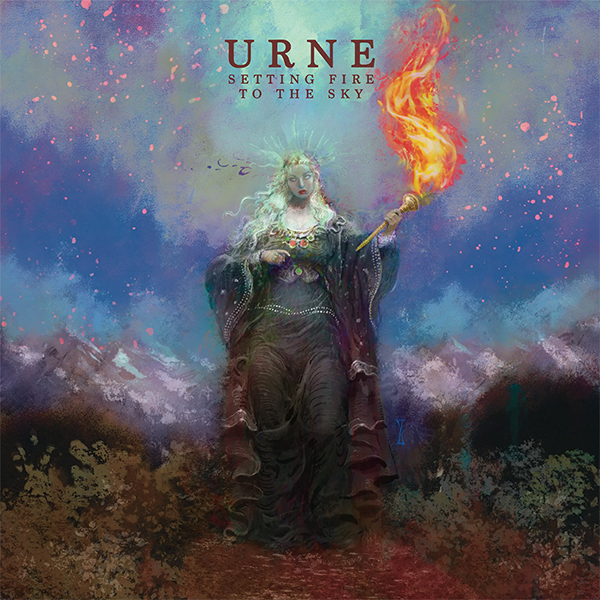
“I mean, for me, the last album’s such a dark, dark record that there’s obviously some elements and there’s some moments of it on this,” laughs vocalist Joe Nally. “You know, I can’t help it. I’m in a metal band. There was always going to be little, little moments, but it had to be more. It had to be more spiritual and more uplifting. Some people find going to church a spiritual thing. For me, listening to music is that thing. And I think it’s what can give me comfort amongst all the grief that I’ve been going through for the last few years. When writing this again, as much as I say, there’s always a tip of the hat to the negatives and the dark stuff, but I’ve also been looking for that more positive. The first time we wrote anything for this was ‘The Spirit, Alive’. The moment that kind of happened, I was just like, ‘Okay, I feel like the music is going to be a bit more triumphant, a bit more uplifting.’ The artwork for our last release was gray. I mean, bloody hell, how depressing can that be, just looking at a gray wave. But that’s how it was at the time. But this album artwork. It was, you know, it needed to be bright. It needed to be colorful. It needed to feel positive. We needed to have a torch to move forward . . . I’ve really, really found that the last five years have certainly going through what we have been going through, it had to be that. There’s more clean singing on this album. And I just think it was all trying to be more positive and trying to get out of that dark landscape that I have been stuck in previously for the last three, four years. You know, don’t get me wrong, the last two tracks on the album are quite lyrically darker. Certainly, the last album, the last track on it was as well, but I certainly tried to make it more positive. I’ve got some faith. Some of my favourite musicians talk about music as a healer, something that can bring you back. And it does. It does for so many of us, and that’s what creating this album did for me. I just hope people feel something from it, whereas in the last one, they might have felt a little sad. I think on this one, hopefully I’m bringing them along with me to get out of that dark place.”
After years of carving a distinct musical path from the darkness, Setting Fire to the Sky expands the band’s musical canvas. Threading together jagged guitar riffs, cinematic atmosphere, and moments of surprising tenderness, their new album marks a clear evolution without abandoning the band’s core emotional intensity. While it’s common for bands in this genre to speak of grief, resilience, and the existential weight it carries, Setting Fire to The Sky takes a different approach; instead of dwelling in the darkness, URNE turns that emotional pain into something else. The pain isn’t erased but shaped into something more open and brighter. Such a change comes only from staying in that world of pain for far too long and from the willingness to find a way out. Setting Fire to the Sky would inspire this unique emotional and creative shift within its instrumental and lyrical concepts, resulting in a beautiful journey that can be felt beyond the writer’s emotions and puts the music in a space for one to feel those emotions as well.
SETTING FIRE TO THE SKY ALBUM REVIEW
“I think with us, you kind of start the albums afresh. You know, we know what we’ve just been through, and honestly, without sounding bad, you know, after doing so much press for the last album, it made it hard to talk about. It wasn’t recording the last album that made things feel heavy. It wasn’t writing the lyrics. It was talking about it afterwards and then playing shows. Now, we’re not a big band. We’re not Metallica or whatnot, but we’re slowly growing. And what happens to these fans that we have now? They’re the ones who will stay with you. Many people connected with that last album came to those shows, and I was constantly talking about it, but then I was talking to them about their grief, and it weighed heavily on me…” Nally candidly responds. “It really weighed heavily, and it’s not a bad thing. Don’t be wrong. It’s not wrong if people want to talk about it. I was also going through some heavy stuff, and when you’re trying to process your own heavy stuff, sometimes it was like, ‘Oh my God.’ I don’t know if I always had the answer for what that person needed in that moment,” Nally says. “So, when we started writing the first track, which was ‘The Spirit, Alive,’ I think the title said it all. It was just this, as you said, coming out of trying to turn the negatives of everything into a positive, and me getting the opportunity to write another record. I could do that, you know? People have somehow related to me because of grief and sadness, but now, you know, hopefully I can show the way. Now, I’m not saying I’m any sort of leader, but hopefully my trying to turn it into a positive can help those people who went on the journey with me feel more uplifted inside or at least try to. And ‘The Spirit, Alive’ is, I guess, a play on The Bible. The world really is in a really bad place. And I guess in a way, there is one person who can really make that difference. Now, sadly, probably each country needs that one person, or each city, or each town, because it’s so big and helps the world so much, but it’s in such a bad place. And ‘The spirit Alive’ is just hoping for that one, one thing, that one entity, that one moment that could change things. Sadly, it’s not coming at the moment, but you can’t give up. And that’s the important thing. But honestly, once that first song came out, I was like, I’m going to want to write about hope. I want to write about religion, but the religion of it is music. I’ve spoken about, in a way, ‘Towards The Harmony Hall’ is this big cave, but I kind of made it seem like a religious thing. This is where everyone’s going to come together and set fire to the sky. It’s people standing on the mountain just praying, praying to the sky, praying to anything that will listen. It’s just trying to turn little bits and little moments into hope.”
Nally continues, “The opening track, in a way, isn’t like that, but the excitement of life: that excited kid going to a venue for the first time. And I couldn’t write a song from that perspective, me going into a venue to see my first gig. I couldn’t write it like that. I had to make it sound grown-up. I had to sort of use certain words and make it sound a bit smarter. But it’s just about that, trying to find that excitement in life again, what inspired me, and what makes me excited to be in a positive headspace. And this is what I’ve tried to do on this album. Don’t get me wrong, the last two tracks are maybe a little bit darker lyrically. For ‘Harken The Waves,’ I listen to a lot of traditional Irish folk music, and the Irish write a lot of songs about passing over, and that it’s not a bad thing, don’t be sad, and we’ll share these moments. There’s this song called ‘The Night Visiting Song,’ where a guy passes but gets to spend one more night visiting his partner; he will be gone when the sun rises, so he gets to spend that last moment outside her window, holding her hands. So, with that, ‘Harken The Waves’, it was my thing of trying to write from that perspective. I hope that when we pass over, we will all be greeted by whoever loved you, meet your friends, family, and they will take you on to where you’re meant to be beyond this. It sort of sounds dark, but it’s not meant to be.”
Across Setting Fire to The Sky, the record is built on contrasts: abrasive textures softened by melodic counterpoints, urgent rhythms that create breathing space for lyrics that balance personal moments with a broader, mythical scope, taking the record to another place of emotional intimacy and storytelling. The result is a record that is both visceral and reflective of one’s internal struggle and collapse, and that finds happiness and renewal despite it all. While the band says they are not as big as Metallica, Setting Fire to the Sky shows a band heading in the right direction toward that kind of success. While most who are inspired by the iconic band find themselves immersed in the artwork, awe-inspiring guitar riffs, and emotionally resonant lyrics, URNE has been inspired by something more distinct that keeps the fire of their creative energy alive.
“I think one of the big things that Metallica inspires in so many people is the riffs, the songs, and the album artwork. For me, one of the most inspiring things is that they really don’t give a shit what people think. They really don’t care. That’s why they take risks. And people laughed at them. They go, ‘Why have they done that?’ And ‘Why have they done this?’ It’s because they’ve earned the right to do that, and I respect that they do whatever they want, and at the end of the day, they wrote Kill ‘ Em All all the way through to the Black album. They changed so many people’s lives that they can do whatever they want. So, I think I’m inspired more by their ‘I don’t care what you think’ attitude. It’s almost like a British punk, punk sort of attitude, right?,” Nally responds. “I think with us, I’ve always looked back to that. What’s cool for us is that, as a young band, we’ve managed to make friends/fans with some legendary Bay Area bands, Forbidden, Death Angel, and Heathen. And I’m like, as a kid, I would never have thought that would happen, because people just look to all the major metal players like Metallica, Slayer, and stuff. But there are all the ones underneath that are so amazing, and it blows my mind that sometimes that’s where we are. Like, I will text one of the guys from Forbidden who is in the studio, go have a good time, and we’ll have a little chat. And I’m like, wow. Like, they like us, and they used to go and watch Metallica in the Bay Area. It feels like I’m getting a little bit closer to Metallica. But honestly, I just think, for me, it is just that the attitude of Metallica, Dave Mustaine, and Megadeth has inspired me to keep creating; that’s who I look to when I write music. I think it’s amazing that they got themselves to that point where they can just explore and do whatever they want.”
Artist Links