THE GUITAR IS AN OPEN BOOK, THE SKY’S THE LIMIT
A CONVERSATION WITH WARREN HAYNES
At 12 years old, Warren Haynes sat in the audience of Asheville’s municipal auditorium watching some of his earliest concerts. Decades later, The GRAMMY® Award-winning vocalist, songwriter, guitar legend, and producer, would find himself standing on that same stage — or, more precisely, the stage that replaced it — performing his own music with a 64-piece symphony orchestra.
It was, by his own admission, overwhelming.
“I got teared up several times over the course of those two nights,” Haynes recalls.
There is something almost circular about that moment, particularly for a musician who has spent more than four decades refusing to stand still. From Gov’t Mule and The Allman Brothers Band to his solo work and his deep connection to the Grateful Dead musical world, Haynes has built a career around the tension between composition and improvisation, structure and spontaneity. Now, with Dreams & Songs: A Symphonic Journey, he has turned that tension inward, taking songs from more than 30 years of his musical life and allowing them to become something he himself had never heard before.
The album, recorded in Haynes’ hometown of Asheville, North Carolina, in 2019 at the Thomas Wolfe Auditorium with the Asheville Symphony Orchestra, arrives September 18, 2026. But the idea began several years earlier, after Haynes was invited to perform Jerry Garcia’s music with an orchestra. That experience introduced him to the possibilities — and limitations — of bringing improvisational music into a symphonic setting.
The word “retrospective” might suggest looking backwards. Haynes, however, was interested in using his history as raw material for discovery.
He has never been particularly enthusiastic about the idea of simply placing an orchestra behind a rock band. “I’m not always a fan of marrying pop music or rock music or jazz or whatever with orchestras just for the sake of doing it,” he says. “I think it works on a song-by-song basis, but more often than not, I don’t think it works.”
The freedom to choose from his own catalogue meant he could eliminate the songs that didn’t make sense and concentrate on those that could genuinely be transformed.
“I wanted to choose not just my favourite songs and my favourite ones to play and sing, but also just going on instinct of which ones I felt like would really work,” he says.
Even then, Haynes had no idea what he was about to hear.
The arrangers sent him demos, but they were little more than skeletal previews. “They were just like cheesy keyboard demos,” he laughs. The real revelation came when the musicians gathered for rehearsal.
“I didn’t really know what they were really going to sound like until we got into rehearsal,” he says. “And it was overwhelming hearing all these arrangements and playing along with such a massive sound.”
For Haynes, however, the size of the orchestra wasn’t the point. The orchestra had to become part of the composition rather than an ornament attached to it.
“I’ve never really cared for it where it just sounds like the symphony’s glued on to what already existed,” he says. “I wanted there to be a bigger reason for these arrangements to exist based on the songs themselves.”
That philosophy is particularly apparent on “Raven Black Night,” a Gov’t Mule song whose original recording was remarkably sparse. There were no drums or bass, only acoustic instruments and percussion. The orchestral version, arranged by Vince Mendoza, moves in the opposite direction, becoming dense, expansive and cinematic.
Haynes describes it as “a great example of that song being taken to a place that it had never gone before.”
The transformation affected more than the arrangement. It changed Haynes’ own performance.
“I guess kind of emotionally, it caused me to sing the song differently, responding to the orchestra,” he says. “It was a completely different interpretation.”
That may be the most interesting thing about Dreams & Songs: A Symphonic Journey. These aren’t songs Haynes has forgotten or abandoned. They are songs he knows intimately, yet the new arrangements force him to listen to them again.
“Thorazine Shuffle” pushes that idea even further. Originally released on Gov’t Mule’s 1998 album Dose, the song already carries an unusual rhythmic structure and an unsettled quality. John Medeski’s arrangement takes that strangeness and pushes it into more avant-garde territory.
“It really just turned it into another piece of music,” Haynes says.
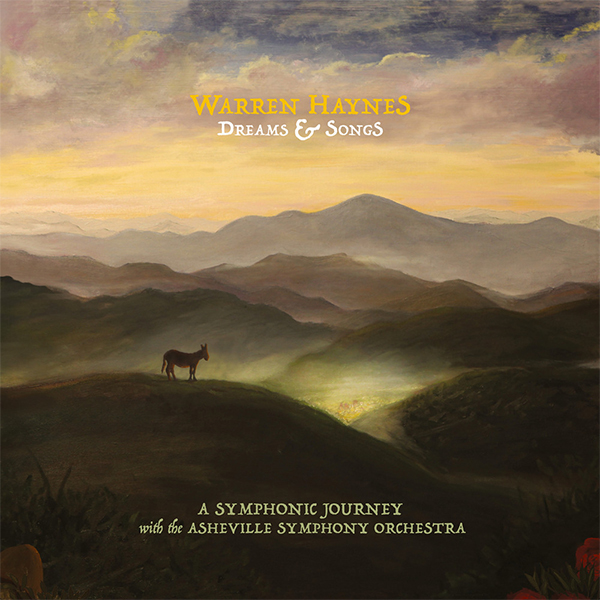
DREAMS & SONGS: A SYMPHONIC JOURNEY ALBUM REVIEW
That willingness to let a song become something else is rooted in a musical philosophy Haynes has carried throughout his career: improvisation is only as powerful as the song underneath it.
“We were trying to balance the improvisation aspect and the songcraft aspect, and include an equal amount of both of those things,” he explains.
He points to The Allman Brothers Band and the Grateful Dead as two very different examples of improvisational mastery, but he believes both understood the importance of having great songs beneath the experimentation.
“If they didn’t have great songs, the world would have forgotten that a long time ago,” he says. “It’s the combination of those two things together that makes it a timeless commodity.”
That balance became one of the greatest challenges — and pleasures — of working with the orchestra.
Haynes discovered that the symphony offered a dynamic range unlike anything he had previously experienced.
“Until you experience what that means on a symphonic level, you really have missed out on the whole concept of things going from a whisper to a scream,” he says. “It’s a beautiful concept.”
It also forced him to rethink his guitar playing. With so much sound occupying the musical landscape, he deliberately made his guitar smaller, cleaner and more responsive.
“I don’t want to be the one covering all that up,” he says. “I want to be enhancing that and bobbing and weaving and making what they’re doing even more effective as opposed to less effective.”
It is an unusually revealing comment from a guitarist whose career has often been defined by his ability to fill musical space. Here, Haynes had to learn when not to fill it.
Perhaps that is why the project ultimately feels less like a career retrospective than another chapter in an ongoing education.
Haynes describes The Allman Brothers Band and Grateful Dead approaches to musical “magic” as almost opposite philosophies. The Grateful Dead, he says, would “relax and wait for the magic to happen,” while The Allman Brothers Band would “force the magic to happen.”
His own approach?
“Somewhere in the middle.”
That middle ground has served him well. Every musician he works with changes his perspective, he says, and that includes the musicians who have helped shape Dreams & Songs: A Symphonic Journey.
The lesson is particularly evident when Haynes talks about songwriting. After decades of writing songs, he says the challenge is not to repeat what he has already accomplished.
“Every time you write a song, it’s like checking something off of a list and saying, ‘Okay, I’ve done that. Now I don’t want to redo that,’” he says.
The goal is to keep moving forward — and to surround yourself with people who make you want to try something you haven’t tried before.
That philosophy explains why Haynes hasn’t finished exploring. He is considering a jazz-influenced instrumental album and has also entertained the idea of making a record built around duets with some of his favourite singers.
For someone with a catalogue substantial enough to warrant a symphonic retrospective, there are still plenty left unchecked.
And that brings Haynes back to the beginning.
When I ask what still makes him pick up a guitar after everything he has accomplished and think, I want to see where this goes, his answer takes him back to being 12 years old.
“In a different way, it’s the same thing as when I was 12,” he says. “It’s a big mystery.”
He pauses over the possibilities contained within the instrument.
“The guitar is an open book. The sky’s the limit. You’re never going to discover a fraction of what is available to you.”
That may be the real story behind Dreams & Songs: A Symphonic Journey. Not nostalgia. Not simply revisiting a catalogue. Not even the spectacle of hearing rock music expanded to symphonic proportions.
It is the idea that after more than four decades, Warren Haynes can still walk into a rehearsal room, hear his own song in a completely unfamiliar form and discover something he didn’t know was there.
“As long as you’re willing to go down an uncharted path,” he says, “there’s always something there rewarding.”
For Haynes, apparently, the mystery never goes away.
And neither does his music.
Artist Links


Main Photo Credit: Shervin Lainez | Background Photo Credit: David Simchock