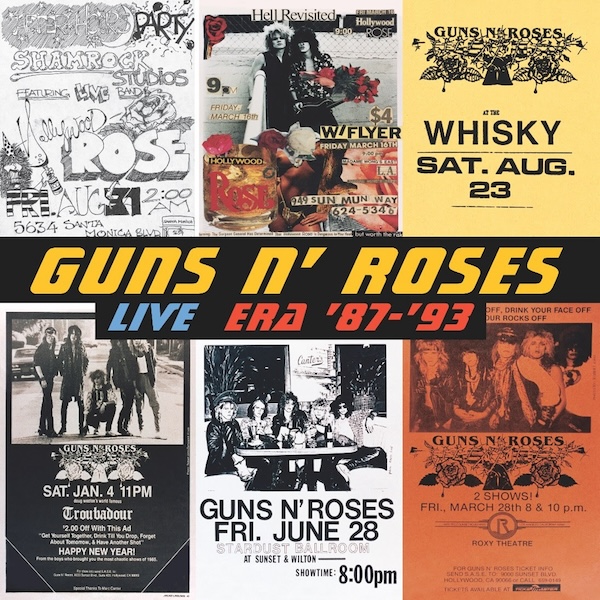
GUNS N’ ROSES
LIVE ERA ’87-‘93
UNIVERSAL MUSIC

Originally released, primarily on CD, in 1999, Live Era ’87-’93 captures the ascent of Guns N’ Roses in the wake of their monumental debut, Appetite For Destruction, to the conclusion of their larger-than-life tour in support of Use Your Illusion I & II. Now, the band has remastered their often-overlooked live collection with a massive four-LP package, marking the first time the album is widely accessible on wax. Most notably, the anniversary reissue of Live Era ’87-’93 also includes a performance of “Coma,” which was previously only available as a bonus track in Japan.
As “Nightrain” kicks in, the opening salvo of “Mr. Brownstone,” “It’s So Easy,” and “Welcome To The Jungle” is exceptional. Truly, this opening is the band at the height of their powers as Axl Rose screams over an array of heavy, blues-drenched guitars and a thunderous rhythm section. While the following tracks (which range from “Dust N’ Bones” and “My Michelle” to “Patience” and “November Rain”) are all well written and performed, the second half of the first disc suffers from a mid-tempo slog that deflates the monstrous momentum of the opening four songs. However, this is aided by the inclusion of “Coma,” an underrated but certainly superior offering from Use Your Illusion I, which makes you wonder why it wasn’t in the initial release. Stretching out over the course of nearly 11 minutes, this is Guns N’ Roses at their most progressive as the band navigates the twists and turns of the highly compositional and thrilling track.
The second disc opens with “Out To Get Me” and “Pretty Tied Up,” demonstrating, once again, that Guns N’ Roses know how to kick off a set on a high note. Unlike the first disc, the track listing of disc two benefits from a better pace, giving a greater display of the band’s range and versatility as both songwriters and performers. Besides the exhilarating bombast of “You Could Be Mine,” there is the melancholic longing behind “Estranged.” This disc also features a handful of different arrangements designed primarily for extended solos, each to varying degrees of effectiveness. The first, “Move To The City,” features a lengthy blues jam, featuring a spotlight on the horn section, a fixture of the Use Your Illusion Tour. While very well performed, there is something about jazzy horns that feels very sterile, family-friendly, and frankly, watered down about this section that has always led me to skip the track. Similarly, the reggae break towards the end of “Knockin’ On Heaven’s Door” feels equally silly at a Guns N’ Roses show. The best extended song on this disc is, without a doubt, “Rocket Queen,” where Slash leads the band through a weaving solo that indulges a darker side of the blues as he plays with tone and suspense to make a highlight among the entire live record.
Live Era ’87-’93 remains a masterclass in the excess that is very much synonymous with the Use Your Illusion era. While many may have hoped for the inclusion of more live cuts from these tours beyond “Coma,” there isn’t much more the band could have added; after all, the live collection includes 23 of the 42 album tracks in the band’s catalogue. Still, a few more songs would have certainly elevated the remastered version of Live Era ’87-’93. Nonetheless, this is Guns N’ Roses at their biggest, as they transition from the most dangerous band in the world to the last great bastion of classic rock ‘n’ roll in the era of grunge. Truly, this is Guns N’ Roses at their live zenith, from a production standpoint, as they pull out all the stops for a global stadium tour of unprecedented scale. Still, I can’t help but hope that, as the band wraps up reissuing their entire back catalogue, we may get an official vinyl and digital release of their concert film, Live At The Ritz 1988, which is arguably among the greatest hard rock ‘n’ roll performances of all time, as well as an authentic snapshot of a band bearing all their teeth before the glitz and glam of the stadium spotlights.
Artist Links


SPILL ALBUM REVIEW: GUNS N’ ROSES – LIVE ERA ’87-‘93
Gerrod Harris

SPILL ALBUM REVIEW: THE BEATLES – RUBBER SOUL – SPECIAL EDITION (SUPER DELUXE)
SPILL ALBUM REVIEW: DEAD POET SOCIETY – MONARCH
SPILL ALBUM REVIEW: LENE 3000 – GREATEST SWAMP HITS
SPILL ALBUM REVIEW: VACATIONS – PURSUIT OF ANYTHING