SHED A DIFFERENT LIGHT ON RINGO
A CONVERSATION WITH AUTHOR AARON BADGLEY
“I don’t know if you’ve noticed or not, but I’m a big Beatle fan!”
Spoken ironically and in jest, the quote above is truly an understatement. Aaron Badgley has been a listener, collector, and lover of all things Fab Four since he was a young child. As an adult, he turned his passion into a profession, as the creator and host of the syndicated radio program Beatles Universe. Currently working as a radio host, podcaster, and lecturer, Badgley is also a contributing writer for Spill Magazine. The year 2024 saw the publication of his first book, Dark Horse: The Story of George Harrison’s Post-Beatles Record Label. With all of his credits and accomplishments, Badgley was uniquely poised for his newest project, a book about Ringo Starr’s career in the 1970s.
Ringo Starr Solo Career: Got To Pay Your Dues is a complete and comprehensive work which fills many gaps in our understanding of Starr’s career in the decade following the breakup of The Beatles. Badgley gives context and shines new light on the work of the famous drummer, singer, actor, record label executive, and entrepreneur. Included are some things that readers might know about, and a lot of things that they certainly will not. “That is what I was trying to do, honestly,” he says, “This is going to sound funny – I really wanted to treat Ringo as if he was never in The Beatles, and just write about his career in the ’70s. I think, ‘Here’s this guy, he’s a solo artist. He starts off in 1970, and this is what happens throughout the ten years.’ I tried to fill in gaps. There was stuff that I didn’t know until I started doing the research. So, it was kind of exciting for me!”
Badgley covers his subject matter in chronological fashion, with plenty of cross-references and side stories, which enrich his narrative. Says the author, “I think I’m a very linear thinker. I don’t know that I initially set out to do it that way. I set out to tell the story, but when I was doing the research and putting it all together, I was making files, like, ‘Okay, this is ’70, this is ’71, this is ’73,’ and I would flop back and forth. Then I thought that maybe I should just write it that way… I think I was just trying to connect the dots in my own head.”

AUTHOR AARON BADGLEY
As a self-described ‘chart guy’, Badgley makes mention of various records’ charting statistics, release dates, and recording session details. In his hope that the book will find a wide audience he notes, “I hope people who just dig Ringo will want to read it. Why I include the charts, the stats and the release dates is because I think puts it into context. When I read a Beatle book, I want to know: did it do okay? How was it received? Sometimes it actually crushes myths. For example, if you read any Beatle book, they’ll say, ‘Well, Ringo the 4th was universally panned.’ Not true! When you start digging into the reviews – and everyone calls it his ‘disco album’ – I say it in the book, when you read all the reviews for Ringo the 4th, not one critic refers to it as disco. That’s why I went with the chart positions. I’m a chart guy. I’m so nerdy that way. So nerdy!”
Starr started his solo career in 1970 by releasing an album of American standards, and a country album recorded in Nashville, but made a real splash in the pop and rock charts with the albums Ringo (1973), and Goodnight Vienna (1974). Of this era, there is contention among fans as to what is the artist’s best work. To this point, Badgley relates, “Whenever I do interviews or talks about Ringo, people will say that his first two or his middle two albums were his best. And I don’t agree. I don’t say that in the book, because I try to shy away from opinions, really. But one of the reasons why I thought this book was important for me to write was, I’d love to write books about Ringo in the ’80s, ’90s, and 2000s, because Ringo’s albums have just gotten better. Beatle fans will go, ‘Oh, well, Bad Boy was just a garbage album.’ Well, no. Not really, and here’s why, and this is how it was produced. I just try to build a different narrative about some of Ringo’s stuff. A lot of what is said about Ringo is very ‘looking backwards’ as opposed to what was said. I’m in the fortunate position of having lived through it. I talk to a lot of Beatle fans who are, say, 30 years old, who weren’t even born when half these albums, or any of these albums came out.”
Having worked on this book for almost three years, Badgley conducted exhaustive research, poring over music chart listings, entertainment journals, trade papers, and even business registry archives. He also spoke with many people who were connected to Ringo during this period. Realizing that some information was simply impossible to find, Badgley remarks, “There’s not a lot written about Ringo, ’75 to ’80, other than looking at his personal life, which was not great. I had to go to the source, so I talked to his girlfriend, Nancy Lee Andrews, who he lived with in that time period. And I talked to Dr. Lawrence Blair, the producer and the director of the films that he produced, the wildlife films about the South Pacific. I literally had to go to (screenwriter) Ray Connolly, who wrote That’ll Be The Day, because I couldn’t find concrete information. I’d find stuff that was like, ‘Well, I think that’s what happened.’ Well, you think, or you know? I talked to people, and that was hard. Sometimes, the other hard part was setting aside my own biases, because, I don’t know if you’ve noticed, but I’m a big Beatle fan (laughs). It was harder than you’d think. You think, ‘there must be something on the internet’, and you start googling and there’s just nothing!”
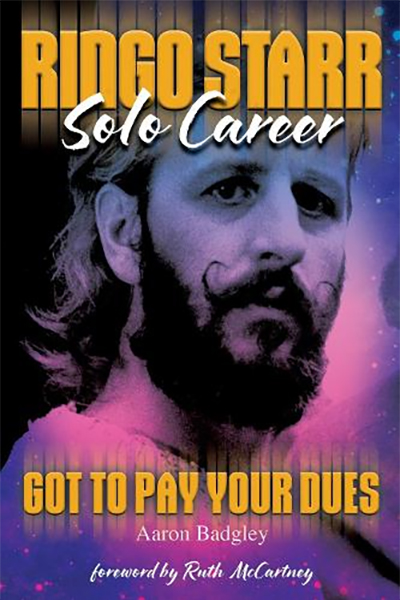
RINGO STARR SOLO CAREER – GOT TO PAY YOUR DUES BOOK REVIEW
Similar to his book about George Harrison and Dark Horse Records, Badgley generally does not make references to Ringo Starr’s personal life. Still, there were times when the personal and professional overlapped, such as with Starr’s breakup with his first wife, Maureen. Badgley maintains, “The only reason that I did that was in context of the music. In writing the book, and going through Ringo’s albums again, what I do when I write is actually just listen the catalogue with a different ear… I listened to Goodnight Vienna, and it hit me that all the tracks are about breaking up, like ‘All By Myself’. It’s a sad album. And I thought, well what was going on? I wrote about Ringo’s breakup because that was impacting the music he was making. And then when he gets with Nancy, and Nancy was telling me about being with Ringo, Rotogravure is very much a love album, and is very much about starting a new relationship. I didn’t want to get into the drugs and alcohol. Ringo made a comment. I quoted him, because I thought it was apropos. But I did get a little more personal, only because it related directly to the music.”
In addition to Ringo’s own music releases, Badgley also goes into detail discussing Starr’s own record label, Ring O’ Records. In speaking to some artists who signed with Ring O’ Records, Badgley explains, “The story has always been that Ringo had no involvement with Ring O’ Records, other than his name, and putting up the money. Then when you talk to these guys, they’re going, ‘No, Ringo was there, man. He was in the studio. He didn’t interfere, but he was certainly there.’ So, I’m trying to dispel these myths that Ringo was just kind of, you know, laissez-faire about this stuff. He wasn’t. He cared passionately about the Ring O’ Records label. So, talking with those guys was amazing.”
We are merely scratching the surface of the scope Badgley’s work in Ringo Starr Solo Career: Got To Pay Your Dues. The author does sum things up by commenting on Ringo’s staying power as an entertainer, saying, “I think his secret is that he absolutely loves what he does. I think it comes across in his music, and I think that he’s smart, and he works with really good people. I guess he can afford to. And he’s not afraid to take risks, certainly not in the last twenty years. But in the ’70s, he took some risks that paid off.”
When considering what readers will take away from his book, Badgley is positive and thoughtful , declaring, “I hope that they just take away that Ringo was, and still is, a viable artist, separate from The Beatles. He was his own man, and there is a lot to know about Ringo that people don’t know. I hope people can discover another side to Ringo by reading this book. And maybe, if people grab onto the old albums and listen to them again, that’d be great. It’s great timing – they just put out the first four albums again. Go out and buy them, and buy my book!”
Artist Links


SPILL NEWS: HEAR TODAY – TWIST & CRAWL 2026: GUELPH’S ONE-DAY INDIE DETONATION

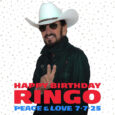
SPILL NEWS: JOIN THE RINGO STARR BIRTHDAY CELEBRATION AT TORONTO’S NATHAN PHILLIPS SQUARE | PEACE AND LOVE TO US ALL!
SPILL BOOK REVIEW: AARON BADGLEY – RINGO STARR SOLO CAREER: GOT TO PAY YOUR DUES