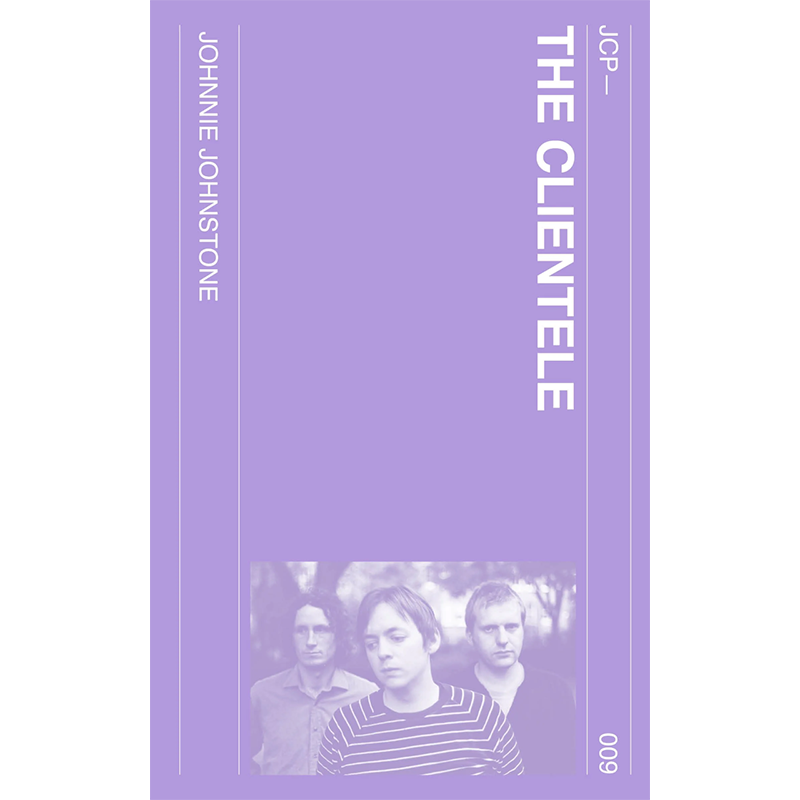
JOHNNIE JOHNSTONE – THE CLIENTELE
J-CARD PRESS
BOOK REVIEW BY JOHN PORTER
J-Card Press are just fantastic at their job. On the heels of their well-received book about The Dead Milkmen, something I also reviewed, comes this tome (insofar as you could call it one, given its pleasingly short-and-sweet length) investigating an even more obscure band in The Clientele. I confess I went into this one with a hell of a lot less background knowledge than I did with their former release. I wasn’t aware of The Clientele, and from the sounds of it, even if I had been, I wouldn’t necessarily have been able to tell you much about them. Here’s the crux of the book – The Clientele are an enigma. But that’s not where things end. Once again, J-Card have found their way to get the story told in tremendous detail – in this case by pairing up an obvious fan in author Johnnie Johnstone with the band. The result is something that lifts the veil, but doesn’t quite let you see the man behind the curtain.
t’s an engaging, curious, and interesting read throughout, with no fat or suppositions – what can’t be verified, what isn’t fact, and what doubles as hyperbole is left out. Johnstone’s love shows through throughout, without question, but he’s also very good at just letting the story breathe and the actors talking for themselves. That leaves a long, winding, occasionally frustrating journey right at your fingertips, told by the people who knew it all best. The story around Suburban Light – the singles collection that essentially saved the band’s future as they looked set to throw in the towel – is particularly striking, but there’s plenty of secondary threads and side stories, many that don’t even officially reach an end point.
One of the many good things you can say about this book is that it certainly inspired me to check out The Clientele’s music, something I was unfamiliar with – their story is told with such care and genuine affection that it’s hard not to be drawn in. To that end, there’s something here for fans, who’ll love the detail and time taken on a band not often heralded, but also curious onlookers like me, too. In addition, no one needs to worry about the band’s mystique or legacy being under any threat. This isn’t a controversial tome, even if it is achingly true at times, while Johnstone expertly straddles the line between pulling back the curtain and leaving just enough to the imagination. Perhaps for some, that’d be frustrating – and maybe there are details here and there that we’d have loved to have heard more about – but it all seems strangely fitting, somehow. One of the biggest mysteries of the last three decades of British pop still largely remains an enigma, but an enigma that has now had at least some of its story put to paper and ink. This book’s a triumph, as are most J-Card releases, and I eagerly await the stories they’ve left to tell.
ISBN-13: 979-8991739481
PURCHASE THE CLIENTELE VIA


SPILL BOOK REVIEW: BRIAN BECK – ON THE RECORDS: 80 MUSICIANS ON BELOVED AND OVERLOOKED ALBUMS

SPILL BOOK REVIEW: DINA DOUGLASS – SHOT AS A TEEN
SPILL BOOK REVIEW: ANDREA SWENSSON – FLEETWOOD MAC AND RUMOURS: 50 YEARS
SPILL BOOK REVIEW: NICKO McBRAIN – HELLO BOYS AND GIRLS!