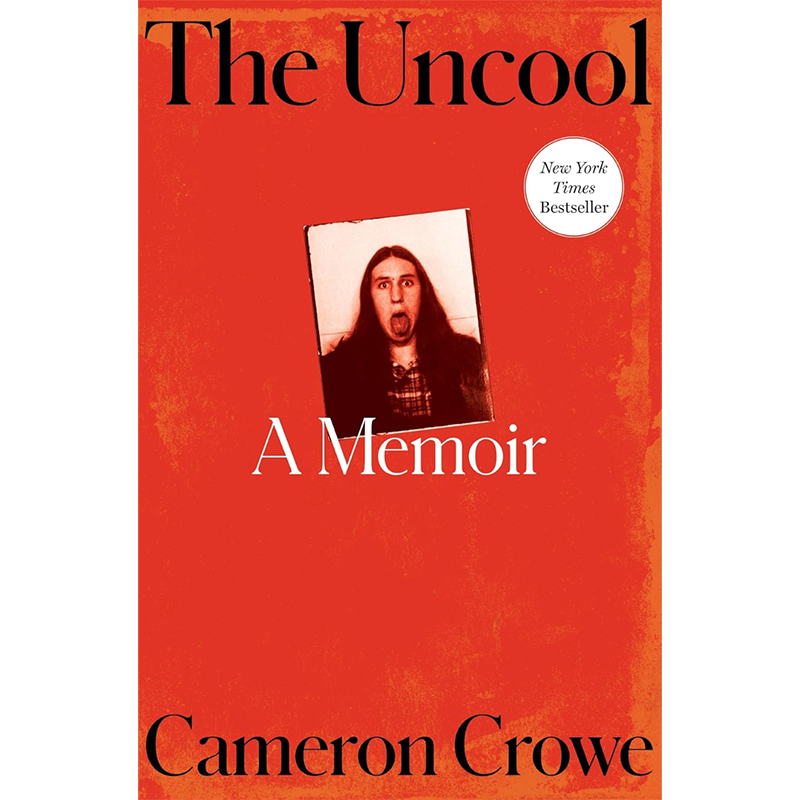
CAMERON CROWE – THE UNCOOL: A MEMOIR
AVID READER PRESS/SIMON & SCHUSTER
BOOK REVIEW BY TRISH MELANSON
Adolescence is a time of struggle. The struggle to find oneself, to find a place in this world as an adult. But the adolescents of the early 70s had become disillusioned with the political battles being forced into their living rooms daily as clips of the horrors of the Vietnam war were spoon-fed in black and white, or if you were lucky, in living colour. Generation Jones (don’t call us Boomers!) was on a search for one thing—to be cool. Music was slowly shifting its focus away from political protests which was clearly reflected in its new set of heroes.
It was at this time that a 14-yr-old Cameron Crowe, son of a real estate agent and a beloved Sociology and English college professor, would experience a series of events that would land him in the ultimate throne of the land of Cool. In The Uncool: A Memoir, Crowe chronicles his life as a pioneering teenage music journalist whose roster includes interviews with the greatest rock stars of all time.
Here he recounts the series of events that led him down the path of Music Journalism, much to the chagrin of his parents who felt he was destined to be a lawyer. While writing his first assignments at The San Diego Door at the tender age of 14, he made the acquaintance of legendary rock critic Lester Bangs, who had been an editor there, and who soon became Crowe’s mentor. Bangs set him up to interview an up-and-coming new band called Wild Turkey that was opening for Yes and Black Sabbath. The goal was to procure an interview with Jethro Tull’s Ian Anderson, who was championing the fledgling band that featured former Tull member, Glenn Cornick. In the process, Crowe found himself slipping in and out of dressing rooms, wandering around interviewing band and crew members, sticking the microphone of his “portable” cassette recorder into the faces of Jon Anderson and Rick Wakeman. “Have you interviewed Black Sabbath yet?” Larry Vallon [show promoter] asked. “Let me introduce you to Ozzy.” Just like that. The rock royalty in that building at that moment alone is now beyond comprehension, and that was just the beginning.
A disastrous profile published in Rolling Stone a mere two days before the untimely death of guitarist and founder of The Allman Brothers Band, Duane Allman, left the already-devasted band members horrified. The writer at the time had been at odds with Duane, which was reflected in the profile, closing the door to any future connections between the band and the publication. Gentle and soft-spoken Crowe was able to convince Dicky Betts to allow him to interview the band. He soon found himself in a hotel room with a distraught Gregg Allman, recording a conversation that would become a legendary interview for Rolling Stone, published only after a turn of events that could have completely derailed his career. The article became his first Rolling Stone cover story. The inscription at the bottom of the first column read: “The author is a 16-year-old student from San Diego, who has written for Rolling Stone and the L.A. Times.”
Over the years, Crowe interviewed dozens, if not hundreds of legendary rock stars, including Pete Townshend, Jimmy Page, Neil Young, and Tom Petty. He spent 18 months with David Bowie during his period of “reinvention” while working on Station to Station, and partied with everyone’s buddy, Ron Wood. He developed a relationship with Lynyrd Skynyrd which left him devastated after the tragic plane crash that took the lives of five members of their band and crew. He shared a house in Laurel Canyon with both Glen Frey and Don Henley, each with a bedroom at opposite ends of the house, and his room right in between, witnessing one of the biggest songwriting partnerships in rock history at work.
The Uncool: A Memoir not only explores his incredible journey as one of the greatest rock journalists of all time but lovingly shares the role and influence that his family played in his life and on his career. Much as in his semi-autobiographical, cult-classic 2000 film, Almost Famous, the presence and influence of his family, the life lessons and wisdom his mother instilled in him, as well as the love of music that his two older sisters, Cathy and Cindy, shared with him, were a huge influence in shaping who he was to become.
As a journalist, Crowe writes with a gentleness and compassion that was often lacking in the early days, where gonzo journalism was oft the flavour of the day, unlike his mentor Bangs. Portraying the artists as humans first and foremost, he possesses the rare ability of being able to ask the RIGHT questions and to see beyond the surface. “I’d been a music journalist, translating time and place for others to savor.” Yet Crowe has an incredible facility to translate people into words, as humans first and foremost, while never, ever judging. You won’t find any dirt here; each character in his memoir is portrayed with sensitivity, vulnerability, and humanness.
In The Uncool: A Memoir, Crowe revisits many of his interviews, providing detailed background and thoughtful, caring insight into the emotional and intellectual component that did not make it to print originally. Interestingly, the book revisits early interviews with later encounters with the same artist, providing some closure and connecting dots. But it is his attention to detail, and his uncanny ability to see and feel in the spaces in between, that make Crowe a such a great writer. “The more I didn’t speak, the more he enjoyed our conversation,” he reflects about his conversation with Kris Kristofferson. Additionally, he speaks of the scrupulous attention to detail in Almost Famous, including the empty turquoise chair at the kitchen table. Sadly, his oldest sister Cathy took her life at a young age. That was her chair. The chair made her present in her tragic absence.
Written with humility, clearly Crowe does not set out to make a hero of himself. This is a memoir written with love and kindness, one filled with adventures, one that you cannot put down. One is left to wonder at the title. Uncool? Really? “You made friends with them,” said Lester Bangs. He sighed loudly and coughed. “That was your mistake. They made you feel cool, and I met you. You are not cool.” … “We’re from fucking San Diego,” he said. “We’re uncool!”
I beg to differ.
View this post on Instagram
ISBN-10: 1668059436
ISBN-13: 978-1668059432
PURCHASE THE UNCOOL: A MEMOIR VIA



SPILL BOOK REVIEW: MIKE DALEY – YORKVILLE: HOW A 1960s COFFEEHOUSE SCENE REWROTE POPULAR MUSIC
SPILL BOOK REVIEW: RICHARD BOWES – GARY NUMAN: A PEOPLE’S HISTORY
SPILL BOOK REVIEW: KELLY CATLIN – KURT COBAIN: FOREVER IN BLOOM: THE LEGACY BEYOND THE TRAGEDY
SPILL BOOK REVIEW: NIGEL DICK – MUSIC VIDEO MISCHIEF: OZZY TO BRITNEY, OASIS TO GN’R, McCARTNEY TO CHER: A LIFETIME OF ROCK AND CHAOS