


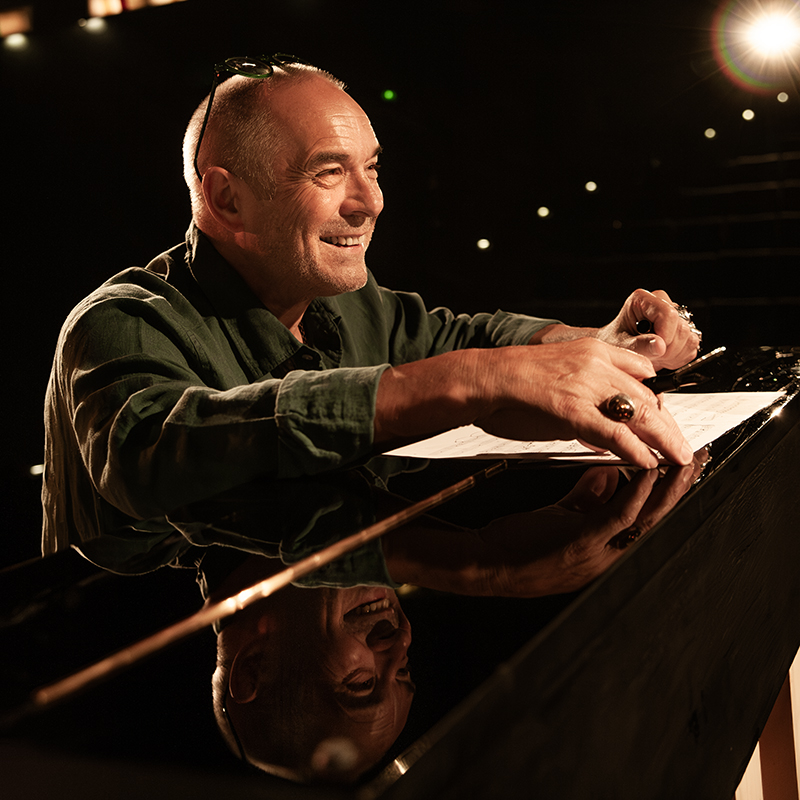
WITHOUT WIND/WITHOUT AIR
A CONVERSATION WITH ROGER ENO
I first became aware of Roger Eno in 1983 when I purchased the album, Apollo, an album he recorded with his brother, Brian, and Canadian producer/musician Daniel Lanois. The album, and Roger Eno’s talents floored me, and I began buying his music. Eno’s music is hard to categorize: classical, ambient, jazz, new age…so many terms can apply. The bottom line, however, is he has a catalogue of brilliant, original, and stunning music. Whether working solo or collaborating, Roger Eno is a quiet force of nature.
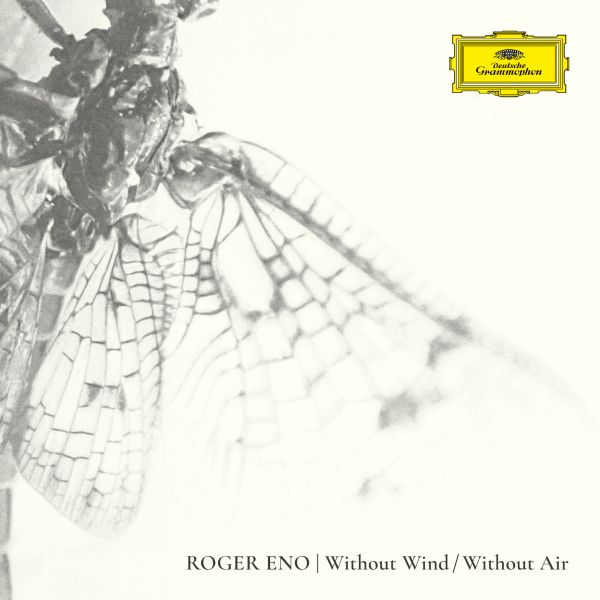
He has just released a new album, Without Wind/Without Air, his 34th studio album and quite possibly his best work yet. The music on this album ranges from collaborations, to orchestrated, to solo piano pieces, to everything in between. It is an absolutely fantastic album, which features his two daughters, Cecily (who also designed the sleeve) and Lotti. He also collaborates with longtime friend, Christian Badzura (who has worked with Eno on several projects), soprano Grace Davidson and Jonathon Stockhammer, who conducts the Scoring Berlin strings on three tracks.
It has been a couple of years since Eno’s last studio album, the skies, they shift like chords. He has also released a couple of rarities compilations (The Turning Years – Rarities and the skies: rarities), so the new album was a very welcomed return. “It was time to do another one, basically. I mean I work all the time, and I have been doing live performances in between. But what happened was strange, really. I had done a tour with Cecily, we did a little tour of North America. And I had been playing similar material during that tour, but I got back and felt utterly bored. I had been playing the same stuff for all this time. So, I thought, right, no more living, for at least a year, so I can think about where I want to go. That entailed getting other people to help me. I realised that I had gotten into a rut, and I wanted someone to help me dig myself out of it. So that became Christian, the great clarinet player, Alexander Glücksmann. He is fabulous. He has lungs the size of Greenland. He can sustain notes, they go on and on. He is fabulous. My daughters… what is going to make it a different palate to use. So that is why there was a break, to give me time to think of what I wanted to present.”
WITHOUT WIND/WITHOUT AIR ALBUM REVIEW
Eno is a very disciplined artist. He has a routine that has served him well and allows him to wear two different hats. “My process is that I get up early, I get up at six and I start work immediately. Make myself a cup of tea, stick the equipment on and start improvising, because at that time of the day the editor has not woken up. Because what editors do, they will say, ‘ah you have done that before…do you really want to do that?’ There is a constant internal debate but if you get up before he has woken up, you just do whatever comes. And then, later in the day or the week, you invite the editor in to say, ‘what do you think about this?’ Then you put the editor hat on and move things around and finish the song. It is a good idea to split your personality between the artist and the editor. That is what I do. After a while of doing this, you can imagine…I did a tune a day in September, so now I have 30 pieces. It is remarkable that some sound really good, but I have to give more time to them. What you want is for the excitement to dissipate. You don’t want to think, ‘ah, this is great,’ because the probability isn’t. So, that is where a lot of the work comes in. You end up with a selection of 100s of pieces, but which ones are the best? What feeling do you want to give?”
His new album has a rather unique title, Without Wind/Without Air. It is a phrase that came from a friend of his. “I have a very old and dear friend, named Pier Luigi Andreoni, which hints at the fact that he is not from Scotland,” laughed Eno. “He is an Italian friend of mine, we worked together in the 1990s. He was in a band called The Doubling Riders, an Italian band. And there is one track of his, which I think he wrote the lyrics for, which contained the words “without wind, without air”. And it might have been his way of saying that, very characteristic speech and that phrase has lived with me since that time. And I never thought of doing anything with it, but recently it took meaning…which wasn’t abstractly poetic, it always has been. I love some poetry because you don’t quite get what it is about. So lyrical that it enchants you, and that was the case with this phrase.
“And it is also where mankind is headed. Because we have managed to bugger the planet up so much that there is going to be no resources left for it or us to exist. So, in this record, there are two hints to this. One track is called “The Final Year Of Blossom,” which is another hint at that. When the Japanese celebrate sakura, when the cherry blossoms come out, in my imagination, they have picnics to see the beauty. But now we have made it so it is the last time you will ever see it. It is more than pathos, it is anger really on this record. Although, you get the idea that I am not a particularly angry person.”
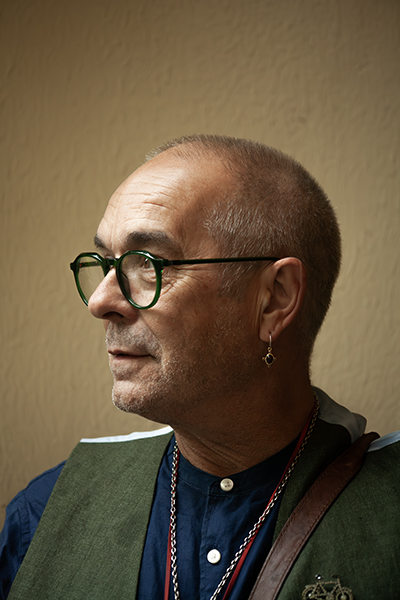
Eno is quite correct, he is not an angry person, and quite funny when one talks with him. “There are elements on the album that are particularly sweet,” he admits. To top it off, Eno’s two daughters joined him on this album, lending their voices, music talent and artistic ability. “They have come to an age where they like to do it. I never want to cajole them into doing anything. I really hoped that they would become musicians or artists, and both have, in fact the youngest one is a psychotherapist…modeling someone’s mind for them…give me your mind and I will make it into something useful,” said Eno in between his bursts of laughter. “I don’t know how she would feel about me taking it so lightly. The elder one, Cecily, we have worked together quite frequently. So Lotti is a little more reluctant to go down the art line, although she’s making it available now. People do different things, don’t they, and for her, she likes to keep art as a sideline. Where Cecily has wholeheartedly embraced it. She did the cover for me, all the artwork, which she did with the previous two as well.”
Although his music is primarily instrumental, vocals are included on the album. Cecily Eno sings on two songs, “Tapestry” and the folky song “There Was A Ship.” “I just love her voice. Brian, myself, and Cecily sang at the Acropolis, and hearing her voice, it did reduce me to tears. I mean, being a dad, we are a very close family. And I thought, this has got to be recorded, so on the new album, she did it in one take. Both of them have a lovely air, that you just want to be around them. Some people are like that. They walk in the room, something they carry with them makes you feel blessed to be involved in and that’s it.
Eno, himself, sings on the album as well. He takes the lead vocals on the wonderful “The Moon And The Sea.” “Christian Badzura, who I like as a producer and is a friend of mine as well, which is one of the greatest things in the line of work I am in. What often happens is people you work with become your friends. The art world, in my opinion, if you treat it properly you get to tell people what your heart is thinking, and they reciprocate. It is a very open situation. So, Christian has a midi piano, and I didn’t want to sing this piece, because it is a difficult one to get the emotion correctly without sounding like it is faux pathos. Like you are hamming it. So, I said, ‘I won’t be able to sing this, but I will put down a piano track that I can get it right.’ But Christian, being a very very cunning fellow, put up two stereo mics, which recorded me singing along with the song. It was a one take, that I didn’t expect to use. It doesn’t get better than that, does it? Right, let’s go down to the pub then,” Eno said with a chuckle.
“You find that people have used your music for the most important points. I heard people say they listened to my music when they were giving birth, for example. Frankly, compliments don’t get much greater than that. If you are saying that this is relaxed enough that I want to introduce my child into this world, that touches your heart completely. Yet, the music was never made for that purpose. Once you have written the music, it becomes someone else’s personal property or emotional property. I have done my bit, hopefully got paid for it, you know all that practical nonsense. But my emotional bit is done. I have written it. Said ‘this is what I wanted to say’, and however people interpret that, is entirely their business. It is too trite to say, ‘I hope they enjoy it’. It is not up to me anymore.
Artist Links


Photo Credits: Cecily Eno

SPILL ALBUM REVIEW: ROGER ENO – WITHOUT WIND/WITHOUT AIR

SPILL FEATURE: FROM BASEMENTS TO BRIXTON – A CONVERSATION WITH MOBY

