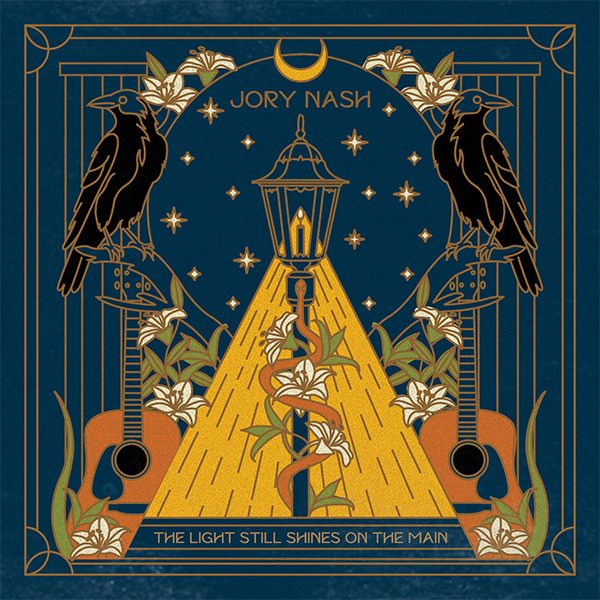
THE LIGHT STILL SHINES ON THE MAIN
A CONVERSATION WITH JORY NASH
Regarding the way that people, places, and situations change over time, the phrase, “You can’t go home again” is a poignant one. But singer-songwriter Jory Nash is challenging that notion. If home is the writing room, or the recording studio, or the concert stage, not only has Nash gone home, but he has been welcomed with open arms.
A working musician for the past 30 years, Nash first came on the scene with his 1998 release, One Way Down. Although he walked away from the music business in 2019, he is back, and is set to release his tenth studio album, The Light Still Shines On The Main, on October 24th. But it has not been an easy road.
The short version of what followed is that, in 2021, Nash’s partner was diagnosed with multiple cancers and had to undergo treatment and surgeries. That same year, after a fire in their Toronto home, Nash and family moved from Toronto to Cobourg, ON, to help with his partner’s recovery, and for their young son to start kindergarten. In addition to all of that, Nash’s bank account was cyber-hacked, cleaning out the family’s funds, with no recompense offered by the bank. By 2024, his partner’s cancer was in remission, but sadly, Nash lost his sister to cancer in June of that year. What a strange set of circumstances it was, that prompted Nash to return to music, and from which the new album sprung!
The Light Still Shines On The Main is an impressive collection of songs. Nash takes that compliment graciously but asserts that he did not intend to make the album, saying, “I really thought I was done. I quit the business in 2019, right? Because it was so hard, and lots of things happened after. And so, I didn’t intend to make a record until a year and a half ago. I started writing tunes, and it came together. I would say it like this: every other record I have made, which I’m proud of, are collections of songs that worked together. This is a complete arc of a story, and the songs are of its space. They really wouldn’t fit in on other records, and I don’t have other songs that could have fit on this one.”

At the time that his account was cyber-hacked, Nash took to social media, imploring friends and fans to put pressure on the bank, to help him to recover his stolen money. There was great support for his cause, with many fans writing letters of support to the bank. There was even one person who threatened to pull his ten-million-dollar business account if the bank did not address Nash’s plight. It was over four weeks before the bank finally made good on the artist’s loss.
Nash picks up the story, “That was at the end of February 2023. I was so grateful. So grateful! I felt like I had to say, ‘thank you’, but how do you say thank you to people who are only invested in you for your music? So, I said, ‘I’m gonna put it out there. Maybe I’ll make a record. I’ll commit to making a record.’ But I didn’t have any money, so I went back on social media and I said, ‘Listen, I would love to make a record.’ I had to do crowdfunding, and so I put it out there. I said, ‘If I make the money, I’ll write the record.’ Literally, I didn’t have songs! I had a few songs, sketches of songs, but I had nothing, really. And within four weeks, I had enough money to start the record.” Initially, Nash got a break on studio fees, to get the album started, but he says that, “Ultimately, I was able to boost that up, when the crowdfunding did better. But that didn’t create pressure, It was like a fire, creatively. It’s like I’ve got this support, and I’m not gonna fuckin’ let people down.”
For a project born out of such adversity, The Light Still Shines On The Main is full of joyful moments. Recorded primarily at Union Sound Company by Chris Stringer and Darren McGill, the album was produced by Stringer and Nash. With a core band consisting of Jason Fowler (guitars), Maury LaFoy (bass), Robbie Grunwald (keyboards), and Mark Mariash (drums), Nash says the album was recorded mostly live. “We broke the sessions up, partly because of musician availability, and partly because people got Covid part-way through and we had to cancel sessions. We recorded the acoustic stuff first, and we did it in trio form – me, Jason Fowler, and Maury LaFoy. We were in for two days, where we cut those tracks live, and I do a ghost voice as we do it, and then re-do vocals. We cut live together as a trio, and then we did the full band stuff the following March, earlier this year. We were in for like three days and did all the full band stuff in those three days, again all together, live off the floor, the five of us.’
“Then there was a little bit of overdubs with [lap steel player] Christine Bougie and [cellist] Kevin Fox. This one I envisioned, for budgetary reasons, and it just made sense to do it together more live off the floor, as opposed to tracking. I’ve done both in the past. I can’t say one is better than the other, sonically or anything, but in terms of organically, the vibe for the tunes, [recording] together made sense.”
THE LIGHT STILL SHINES ON THE MAIN ALBUM REVIEW
For fans of Nash’s past work, there are plenty of classic folk/acoustic sounds on this album. Despite that fact, the album is quite expansive and diverse, as the artist makes wonderful use of his collaborators’ creativity. Ahead of the album’s release, a few singles have been dropped, the first one being the intro track, “Oh, Little One.” Of this song, Nash notes, “It kind of sets the tone. It’s a very delicate song, but it has optimism to it, which was important. The musicianship and the playing is lovely. It’s also the song that Chris Stringer considers his favourite song on the record. He always says, ‘There’s always one song on every one of your records that I think is my favourite,’ and that’s the one for him. I listen when someone has no vested interest. He’s responding viscerally, musically. So I knew that that was one the people are responding to, when they hear it. It made sense to have that as the first.”
The only song that was not recorded in the studio with the band was the track entitled “Bombs Away,” which was recorded, produced, and performed by Rob DeBoer, of the jazz-groove ensemble, Four 80 East. Nash comments, “We chose ‘Bombs Away’ because it’s so unique. I’m actually not playing on it. It was the only one that wasn’t cut in the studio, where we did the record. It was done by my friend Rob DeBoer who I’ve known since grade five. He’s a very, very highly respected and talented player… When he moved up here, we thought, ‘It’d be silly not to do something.’ We’ve been saying every time we see each other, for 20 years, ‘Let’s do something!’ So we finally did. I had this tune, I thought, ‘It’s not right. I don’t hear the band. Let me see if Rob hears what I hear,’ and he got it right away.”
After the album’s release, Nash and band will play a gala show on November 1st, at Toronto’s venerable acoustic and roots music venue, Hugh’s Room Live. He enthuses, “It’ll be me, Jason Fowler, Maury LaFoy, Robbie Grunwald and Marc Mariash. That’s the five-piece that is the band on all the tunes [on the album], and/or the quieter stuff. And Lori Cullen is going to be guest vocalist, to sing on a whole bunch of songs. There’ll be a couple of other guests, like Chris Stringer will probably jump up, and be on a couple of them as well.” Beyond that, Nash has a number of solo house concerts planned, across Ontario, and will be playing in January 2026 at the Flato Theatre in Lindsay, Ontario, and at Toronto’s Winterfolk Festival, in February.
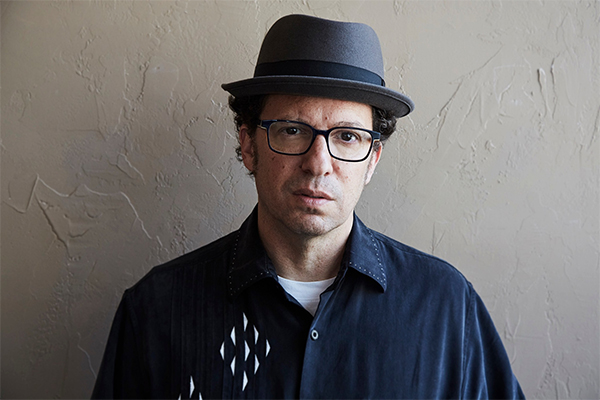
Coming up, as he did, playing folk societies and festivals across Canada, Jory Nash has noticed a drop in the number of volunteer organizations and venues for presenting music. “I played the Greenbank Folk Society last winter. They called and they needed a late booking, so I jumped in. It struck me that when I started, there were a lot more places like the Greenbank Folk Society, like the Vital Spark in Whitby, like Acoustic Harvest in Toronto, and there are almost none anymore. There are so few, and that is a shame… (they were) very, very integral for my growth as an artist, and I have to imagine that other folk societies did the same for other artists. There just isn’t that kind of incubation out there anymore, for younger artists, in the same way.”
Considering the circumstances behind Nash’s return to music, and the production of his new release, how does he view his future music career? Is the crowdfunding model something that he will continue to lean on? “I can see myself writing some more songs and wanting to record them, but I don’t currently see a way to do it without some kind of crowdfunding or benefactorial support. If I were somehow, independently wealthy, I’d just make ‘em all! But I can’t, so it’s this kind of dance. When I left the business in 2019, I made some seriously grandiose and stupid statements, like, ‘I’ll never apply for the Ontario Arts Council. I had 10 grant refusals in a row. I will never apply for a program with you again.’ Well, I should have learned. I’m going to apply for grants where and when it makes sense, but you can’t rely on them. So, will I do another crowdfunding? If I have to, I would put it out there, yes.”
These are difficult times for many, and independent musicians are no exception. Still, we remain hopeful for the future, and thankful that artists like Jory Nash are still in the game.
Jory Nash on tour HERE.
Artist Links


Photo Credits: Jen Squires