
MICK ROCK & TIM MOHR – ROCKY HORROR: A BEHIND-THE-SCENES LOOK AT THE CULT CLASSIC
HARPER COLLINS
BOOK REVIEW BY GERROD HARRIS
In 1975, The Rocky Horror Picture Show bombed at the box office, making an estimated $21,000 on its opening weekend. The film has gone on to gain a cult following that persist to today, making the Jim Sharman film one of the most enduring and iconic films of its time. Now, in celebration of the film’s 50th anniversary, the Mick Rock estate has opened the vault to his extensive work documenting the making of the film. His work has been collected beside the words of Tim Mohr, who pulls from a wide array of interviews with the original cast and production team, to create Rocky Horror: A Behind-the-Scenes Look At The Cult Classic, a stunning book that tells the story of cinema’s greatest non-binary rock opera.
Rocky Horror: A Behind-the-Scenes Look At The Cult Classic is a stunning book. From the outer sleeve embellished with silver glitter on Frank-n-Furter’s lips to the opening pages, Rock’s work is magnificent. The story goes that Rock was deeply involved as the film’s photographer with unrestricted access, granting him the ability to not only capture scenes as they unfolded on set, but shots of the cast posing in character and having their makeup done. There is a vulnerability to his work that, despite giving a peek behind the curtain, only serves to heighten the energy behind the film. For fans of The Rocky Horror Picture Show, just for Rock’s photos alone – many of which have never been seen before – this is an essential coffee table book.
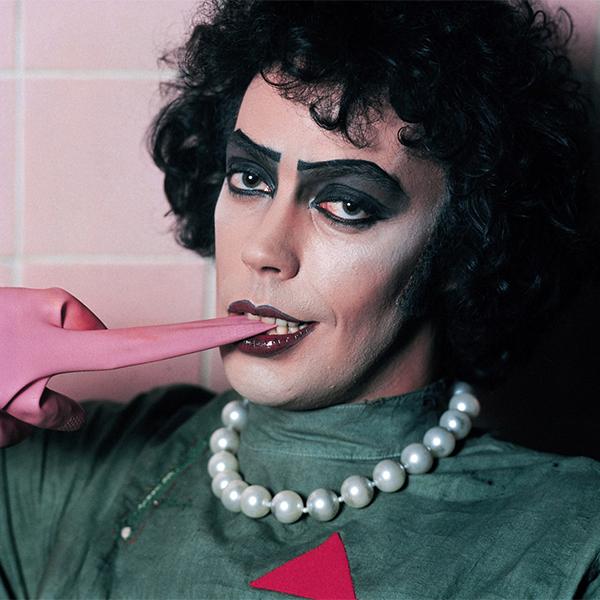
PHOTO CREDIT: ESTATE OF MICK ROCK 1974
Alongside Rock’s vast collection of photos is the words of Mohr, who has crafted a narrative from the perspective of each of the central actors, from Tim Curry and Susan Sarandon to Patricia Quinn and Richard O’Brien, and then some, as well as members of the production team to tell the story behind The Rocky Horror Picture Show. Through this, Rocky Horror: A Behind-the-Scenes Look At The Cult Classic documents the transition from play to film and the slowly growing wave of popularity that would follow the film through generations.
The work of the late Rock remains forever iconic. Few else have been able to contribute to the imagery of rock ‘n’ roll and counterculture in such a tangible way. Rock’s work behind the lens proves to be as influential to the development of the aesthetic of the zeitgeist as the subjects of his work. Rocky Horror: A Behind-the-Scenes Look At The Cult Classic is yet another example of this. Between Rock’s photography and the narrative crafted from primary interviews, Rock and Mohr’s book is an essential celebration of 50 years behind what is perhaps the greatest cult classic of all time.
ISBN-10: 0063385686
ISBN-13: 978-0063385689
PURCHASE ROCKY HORROR: A BEHIND-THE-SCENES LOOK AT THE CULT CLASSIC AT HARPER COLLINS HERE OR VIA



SPILL BOOK REVIEW: JOE MATERA – THE MAKING OF ABBA: THE STORY BEHIND THE BAND’S BREAKTHROUGH ALBUM
SPILL BOOK REVIEW: ANDREW PERER – TURN MY HEAD INTO SOUND: A HISTORY OF KEVIN SHIELDS AND MY BLOODY VALENTINE
SPILL BOOK REVIEW: PIERS HEMMINGSEN – THE BEATLES IN CANADA: THE EVOLUTION 1964-1970
SPILL BOOK REVIEW: MARTIN BARRE – A TRICK OF MEMORY: THE AUTOBIOGRAPHY OF JETHRO TULL’S GUITARIST