



VARIOUS ARTISTS
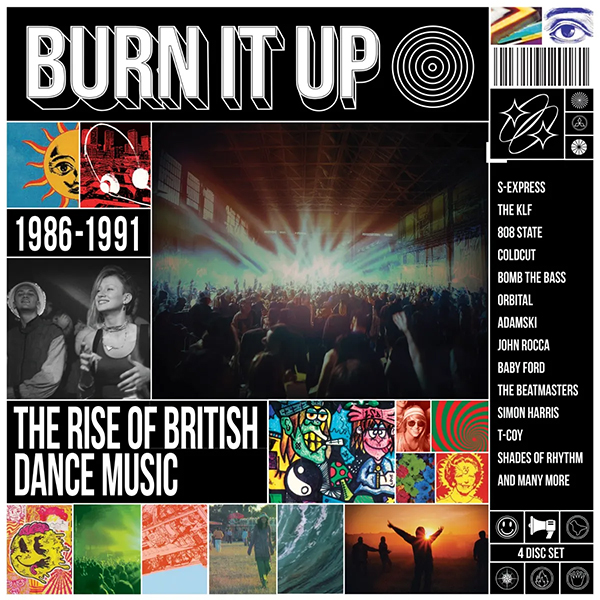
BURN IT UP: THE RISE OF BRITISH DANCE MUSIC 1986-1991
CHERRY RED RECORDS

Cracking open like a neon time capsule, Burn It Up gathers 50 snapshots on 4 CDs, from Britain’s 1986-1991 dance detonation, the moment cheap drum machines, TB‑303 squelch, and sampler bravado pushed bedroom ideas into the mainstream. It’s the rocket’s first fire: sometimes gauche, often visionary, and now burnished with a good‑vintage patina. For the initiated, it dusts off basement strobes, tentative floor invites, and post‑club hamburgers; for newer ears, it’s like rummaging through a parent’s closet—plenty of chaff, yet enough wheat to show that they are, or were once, even a little, cool.
Bill Brewster, the British DJ and co-author of the influential dance-music histories Last Night a DJ Saved My Life and The Record Players, presents a balance of obvious anthems with left‑field lore, and the sound of the era comes through in detail. Mel & Kim’s “System (House Mix)” frames Stock Aitken Waterman’s pop hooks with house‑club architecture, an extended 12″ structure, programmed drum machine and keys‑led drive that marked their pop/house crossover experiments. Simon Harris’ “Bass (How Low Can You Go?) (Bomb The House Mix)” is a sampler‑era calling card: an upfront house beat and synth‑bass built around cut‑up vocal stabs (famously including Chuck D’s “Bass, how low can you go”) and additional collage elements. The Beatmasters feat. the Cookie Crew’s “Rok Da House” hard‑wires rap verses to Chicago‑leaning drum programming, an early UK template for hip‑house. The KLF’s “What Time Is Love? (Pure Trance 1)” arrives in its original 1988 incarnation as austere, hypnotic, trance‑techno, a minimalist pulse and cycling motif that prefigures later stadium‑rave revisions. The Moody Boys’ “Acid Rappin” folds TB‑303 filigree into dubwise sensibility, UK acid house with a sound system aftertaste. Monie Love’s “Grandpa’s Party (Love II Love Remix)” bears Soul II Soul’s studio fingerprints (Jazzie B and Nellee Hooper on the remix): rolling break‑beats, warm keys, and swung percussion that tuck her quicksilver cadence into house uplift. The Beloved’s “The Sun Rising” floats on Balearic drift, built around a sample of Emily Van Evera’s medieval vocal from “O Euchari,” whose choral haze turns the track into sunrise devotional. 808 State’s “Pacific‑202” is tropical‑cool and weightless-layered synth pads, that unmistakable birdsong sample and soprano‑sax lead creating a languid shoreline over rolling breaks. And Cabaret Voltaire’s “Easy Life” carries the sleek Chicago‑house polish of the Groovy, Laidback and Nasty sessions, melding the group’s post‑industrial sensibility with lithe club production.
Across four discs the arc is simple and thrilling: renegade spirit met a ready public, and Britain answered with hands‑in‑the‑air joy. Not every cut is timeless, but the story absolutely is, which is proof that a sampler, a drum machine and a bit of nerve could vault a track from bedroom to chart.
Cherry Red Records Links


SPILL ALBUM REVIEW: VARIOUS ARTISTS – BURN IT UP: THE RISE OF BRITISH DANCE MUSIC 1986-1991
Paul van der Werf


SPILL ALBUM REVIEW: SINGER. MATTRESS. CAT. – SUBTROPICAL PERSONALITY

SPILL ALBUM REVIEW: NICOLA CONTE – VIAGGIO
SPILL ALBUM REVIEW: ALEXISONFIRE – HOUSE OF STROMBO (LIVE IN TORONTO, ON 2019)

SPILL ALBUM REVIEW: WARFIELD – DEATHROCK DEVOTIONALS

